
Your partner for astronomy

Observations

Infographic: Astronomical highlights in autumn 2026

September 1 2026, Isabella Predehl

The nights are getting longer, and the Moon, planets and star clusters meet in the sky. The new infographic shows you the most beautiful celestial events of autumn 2026.

Saturn, Neptune and Uranus are particularly easy to observe. Mars passes through the Praesepe star cluster and later meets Jupiter. This time, there is also a rare occultation of Venus in the daytime sky.

This infographic gives you a quick overview. You can find out more about the individual events in the accompanying text.

Enjoy observing!

You are welcome to use this graphic on your own website. Please include a link to www.astroshop.eu.
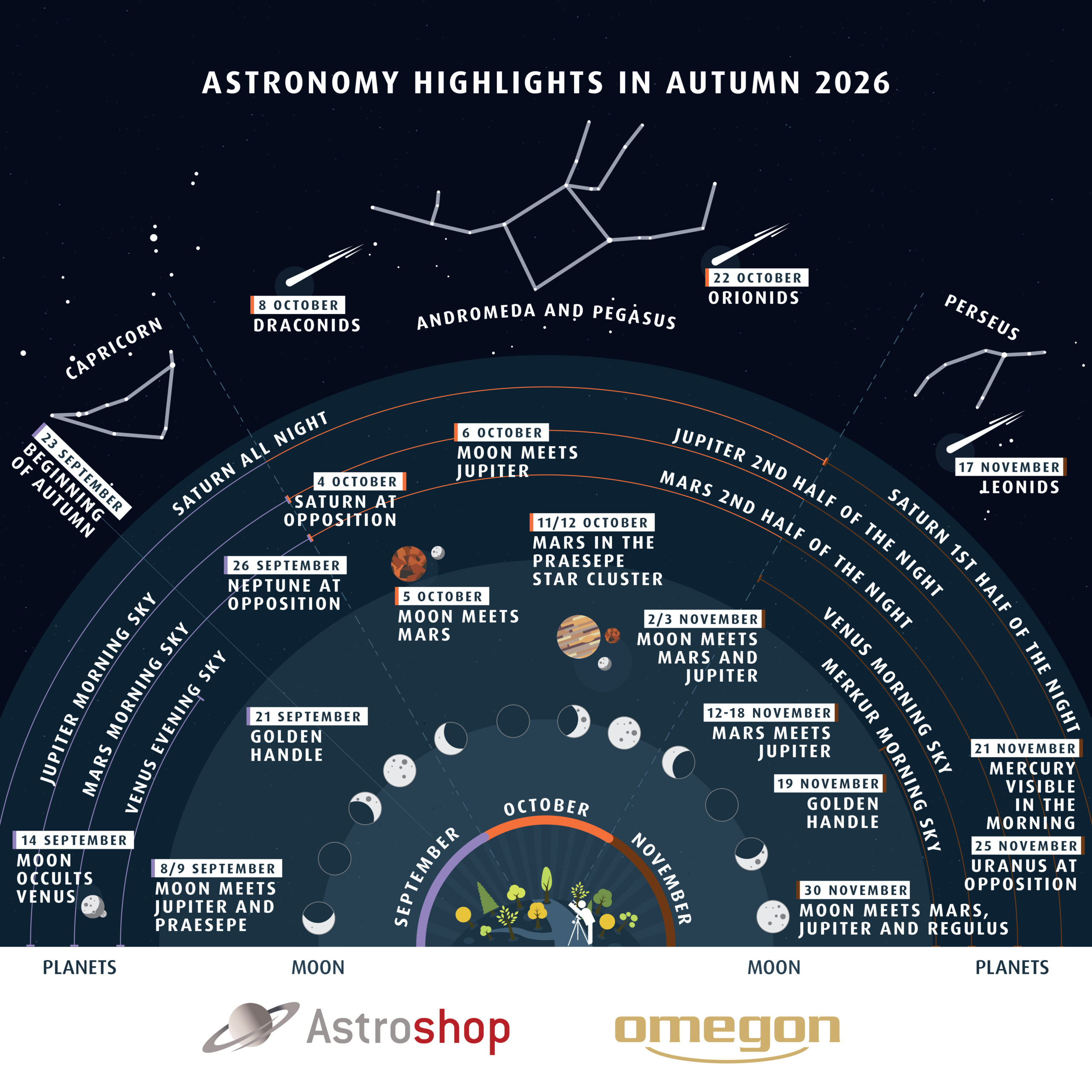
Astrohighlights Graphic

September


08./09.09.2026 Moon meets Jupiter and Praesepe

In the early morning hours of 8 September, the slender crescent Moon passes through the open star cluster Praesepe, also known as the Beehive Cluster or M44. The star cluster is especially beautiful when viewed through binoculars. The following morning, the crescent is positioned below Jupiter. This creates two particularly beautiful configurations low above the eastern horizon. An unobstructed view to the east is important.

14.09.2026 Moon occults Venus

This is one of the most exciting events of the autumn: in the daytime sky, the slender crescent Moon passes in front of Venus. Depending on the observing location, the planet disappears behind the Moon between approximately 11:29 and 11:35 and reappears at around 12:40.

Because the celestial event takes place during the day and the Moon is only low above the horizon, you will need a telescope and an unobstructed view. Important: the Sun is also in the sky (of course, it is daytime). Never search for the Moon and Venus without a precise plan. It is best to observe using an automatically aligned mount and make sure that it cannot accidentally point towards the Sun.

After sunset, the pair appears once again in the evening sky. The slender crescent Moon and bright Venus are then low in the west. Here too, you will need an unobstructed horizon.

21.09.2026 Golden Handle

Today, the Golden Handle appears on the Moon. The Sun is already illuminating the peaks of the Montes Jura, while the plain of Sinus Iridum is still in shadow. This creates a bright, curved handle at the edge of the Moon.

The play of light begins in the early evening and remains visible for several hours. The Golden Handle is particularly well displayed at around 20:00. Binoculars are sufficient, but through a telescope the seemingly floating arc of mountains looks even more impressive.

23.09.2026 Beginning of autumn

On this day, the Sun crosses the celestial equator heading south. This marks the beginning of astronomical autumn for us in the Northern Hemisphere: day and night are now approximately equal in length. Over the coming weeks, it will get dark progressively earlier. For us stargazers, this marks the beginning of a particularly pleasant observing season, and we can even look at the stars during the week without having to struggle with tired eyes the following day.

26.09.2026 Neptune at opposition

Today, Neptune is opposite the Sun and visible throughout the night. The distant planet is located in the constellation Pisces and reaches a brightness of approximately magnitude 7.8. It therefore remains invisible to the naked eye.

Even with a smaller telescope, you can spot Neptune as a star-like point of light. With an aperture of around 100mm or more and steady air, it can be identified as a tiny bluish disc. A precise finder chart or GoTo control makes it easier to locate.

October


04.10.2026 Saturn at opposition

Now is an especially good time to observe Saturn. It is opposite the Sun, rises in the evening and remains visible throughout the night. After midnight, it reaches its highest position above the horizon.

Through a telescope, Saturn appears with a planetary disc measuring around 19.7 arcseconds. Its rings are also slightly more open than in the previous year, at 9 degrees. Even a small telescope clearly separates the ring from the planet. With a larger aperture, fine details and several of its moons become visible.

05.10.2026 Moon meets Mars

For almost the entire second half of the night, the Moon is only slightly more than one degree away from Mars. Both are located near the Praesepe star cluster. Through binoculars, you can observe the reddish planet, the crescent Moon and several stars of the cluster together.

06.10.2026 Moon meets Jupiter

The very next morning, the Moon meets Jupiter. The two are positioned very close together. During the day—something we are unable to observe—their separation temporarily shrinks to around 15 arcminutes.

You can spot the Moon and Jupiter above the eastern horizon. The slender crescent and the bright planet create a beautiful subject for a landscape photograph.

08.10.2026 Draconids

The Draconids originate from the constellation Draco. The point from which they appear to radiate is already high in the sky in the evening. You can therefore begin observing as soon as darkness falls.

It is difficult to predict how many meteors will appear from this shower. In some years it remains inconspicuous, while in others unexpectedly elevated rates occur. Conditions are particularly good in 2026: the Moon is only about one percent illuminated and hardly interferes with observations.

11./12.10.2026 Mars in the Praesepe star cluster

For night owls or early risers, this is a worthy celestial event: during the second half of the night, Mars moves directly through the open Praesepe star cluster in the constellation Cancer. The red planet stands out clearly from the cluster’s many fainter stars.

The encounter is best observed through binoculars. It is also very interesting for astrophotography: because Mars is located in the midst of the star cluster, this rare sight is well worth photographing.

22.10.2026 Orionids

The Orionids reach their maximum during the night of 21 to 22 October. The meteors originate from dust particles left by Halley’s Comet and strike the Earth’s atmosphere at particularly high speed. Under good conditions, around 20 shooting stars per hour are possible.

During the first half of the night, the bright Moon still causes interference. It sets at around 3:00. After that, the sky becomes darker and conditions improve. The best observing period is therefore between approximately 3:00 and the beginning of morning twilight.

November


02./03.11.2026 Moon meets Mars and Jupiter

During the night of 2 November, in the second half of the night, the Moon, Mars and Jupiter form a trio. Jupiter stands out because of its great brightness, while Mars can be identified by its reddish light.

By the following morning, the Moon has already passed both planets. This significantly changes their arrangement. It is therefore worth looking at the sky on both days.

12.–18.11.2026 Mars meets Jupiter

For several days, Mars and Jupiter move progressively closer together in the morning sky before passing one another. Between 15 and 17 November, their separation is only around 1.2 degrees. Both planets therefore fit together within the field of view of many telescopes and binoculars.

Their brightness and colour make the pair particularly striking: Jupiter shines considerably brighter, while Mars adds an orange-red accent beside it. The encounter can be followed over several nights.

17.11.2026 Leonids

The Leonids reach their maximum during the night of 17 to 18 November. Their radiant lies in the constellation Leo. At around 10–20 meteors per hour, the shower is generally rather quiet, although occasional outbursts occur. The shooting stars are very fast and sometimes leave bright trails.

The Moon sets during the first half of the night. Conditions are therefore good during the second half of the night. At that time, Leo is also higher above the horizon.

19.11.2026 Golden Handle

The Golden Handle appears on the Moon for the second time this autumn. The peaks of the Montes Jura are already glowing in sunlight, while Sinus Iridum remains in darkness. Binoculars are sufficient for observing it. Through a telescope, the rugged mountain landscape can be seen especially clearly.

21.11.2026 Mercury visible in the morning

Mercury reaches its greatest western elongation from the Sun. This provides the best morning visibility of the year. The planet rises around one hour and 45 minutes before the Sun and appears low above the eastern horizon.

Begin searching approximately 1.5 hours before sunrise. Binoculars will help you locate Mercury in the twilight. As soon as the Sun rises, you should stop observing.

25.11.2026 Uranus at opposition

Today, Uranus is opposite the Sun and visible throughout the night. The planet is located in the constellation Taurus and reaches a brightness of approximately magnitude 5.6. Under a very dark sky, this theoretically places it at the limit of naked-eye visibility. Binoculars make it significantly easier to locate.

Through a telescope, Uranus appears as a small greenish-blue disc. Since the full Moon occurred only one day earlier, its light strongly brightens the sky. Observing conditions are better a few days before or after opposition. Uranus will still remain visible for almost the entire night.

30.11.2026 Moon meets Mars, Jupiter and Regulus

At the end of the month, the Moon, Mars and Jupiter gather in the morning sky. Regulus, the principal star of Leo, is also part of this busy scene of celestial objects. Jupiter and the Moon are the most conspicuous. Mars is somewhat farther away and can be recognised by its reddish colour. From the second half of the night onwards, you will find the group above the eastern horizon.
 

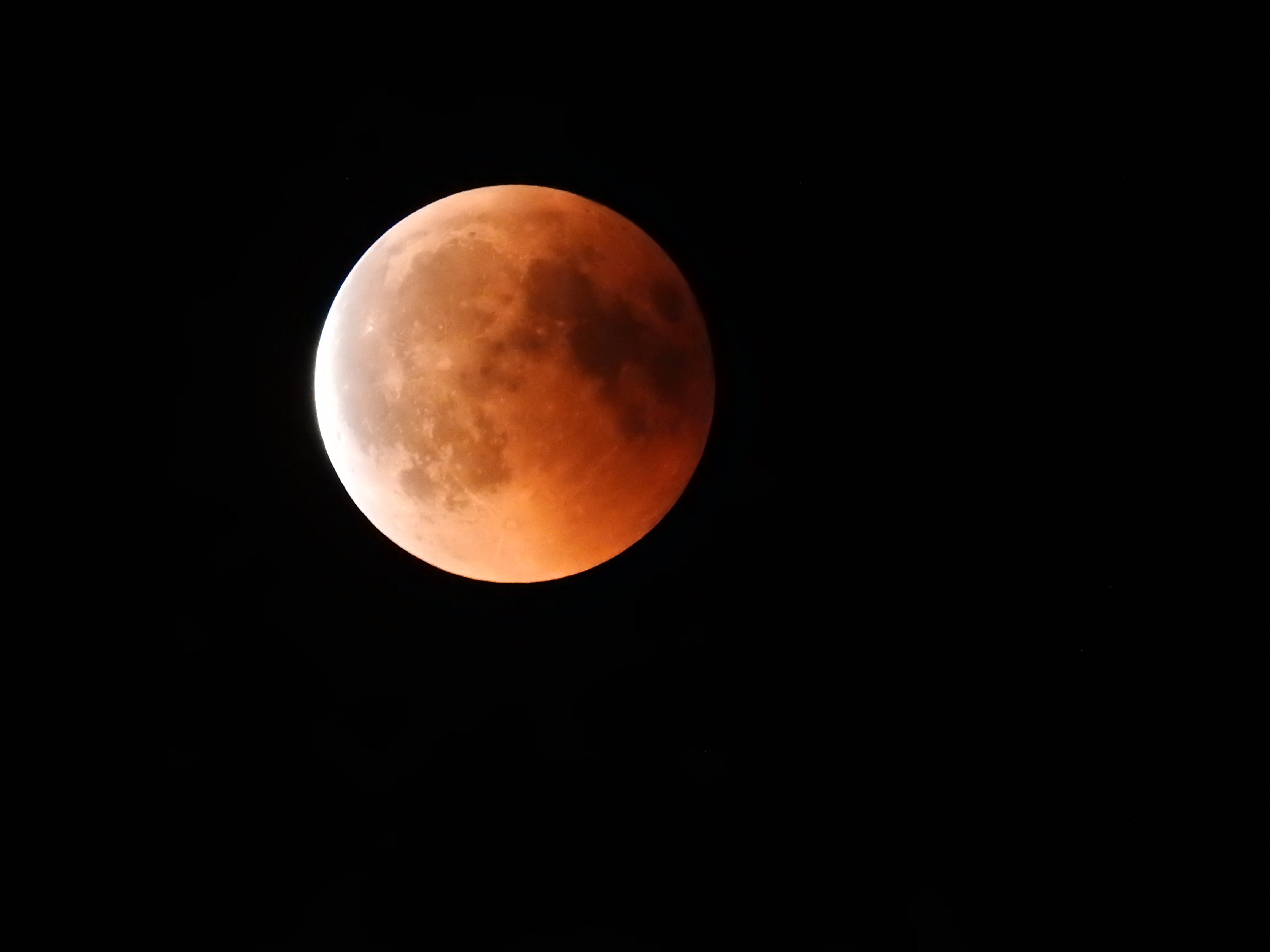
Partial Lunar Eclipse on 28 August 2026: A Dark Moon at Dawn

August 15 2026, Isabella Predehl

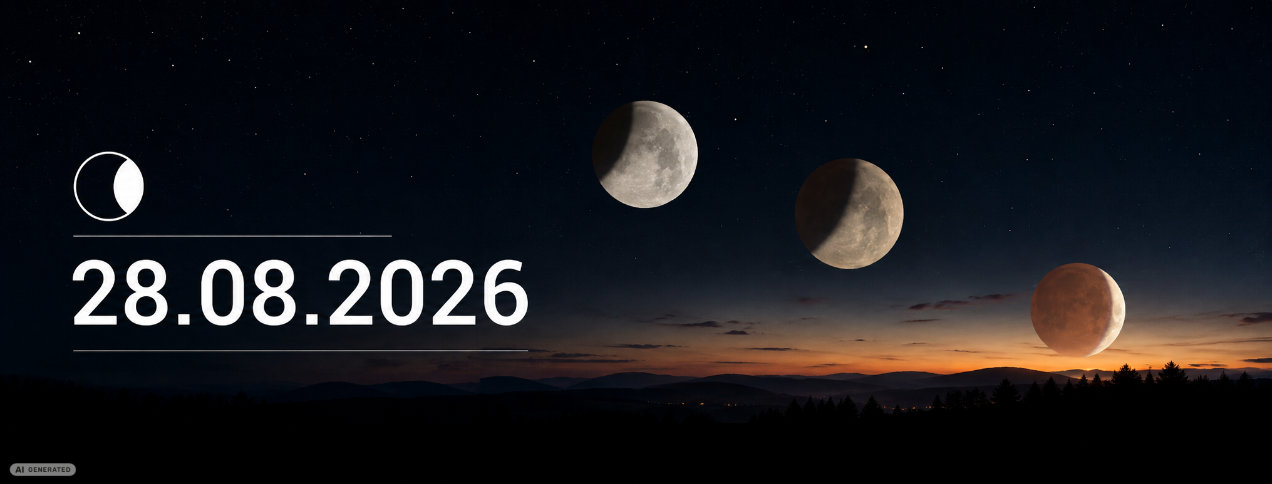
In the early morning hours of August 28, 2026, a partial lunar eclipse will be visible. During this event, part of the Moon will enter Earth’s shadow and become noticeably darker.

In our new magazine article, you will learn what a lunar eclipse is, how it occurs, and how you can photograph it.

Enjoy reading!

New in the magazine: You shouldn’t miss these articles

July 16 2026, Isabella Predehl

There is fresh content in the magazine once again. Particularly worth reading this time are the new articles about the solar eclipse. A fascinating celestial event that will certainly raise many questions. Just take a look and browse through exciting features.

10 Must-Have Items for the 2026 Solar Eclipse
Sun Photography for Beginners
Solar Eclipse in Europe:
Everything You Need to Know About the Total Solar Eclipse on August 12. 2026
Photographing a Solar Eclipse with ZWO Seestar:
How to Take Great Photos with the S30 Pro and S50


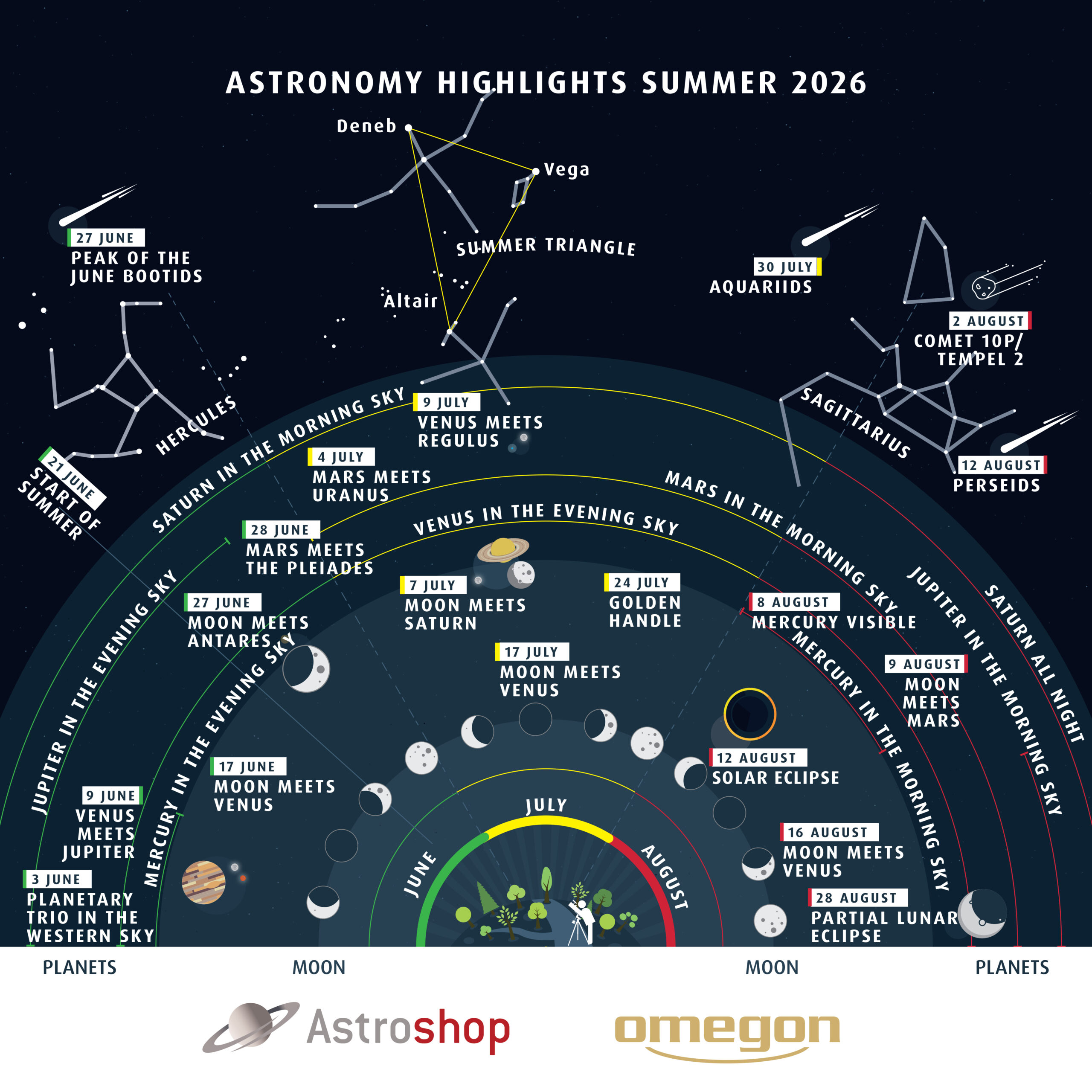
Infographic: Astronomical highlights for summer 2026

June 1 2026, Isabella Predehl

Be inspired by the astronomical highlights of summer 2026. A rare planetary trio, a total solar eclipse, the most beautiful shooting stars of the year, and a comet. This
summer has plenty to offer. So that you don’t miss any of these astronomical events, we have put together an overview.
In this infographic, you will find a quick overview and a selection of particularly interesting celestial phenomena. More information and details with explanations can
be found in the accompanying text. Enjoy observing!

June


03.06.2026 – Planetary trio in the western sky.

At the beginning of June, a planetary trio consisting of Venus, Mercury, and Jupiter appears very low in the western sky, directly above the horizon. All three are located in the constellation Gemini. This is actually one of the winter constellations, but its position far to the west shows that winter has long since ceased to matter. In any case, it is a beautiful sight and perhaps worth a photo.

09.06.2026 – Venus meets Jupiter
Before it gets properly dark, two brilliantly bright planets meet in the western twilight: Venus and Jupiter. They are separated by only 1 degree and 22 arcminutes. Venus reaches a magnitude of -3.8, close to its brightest phase.

17.06.2026 – Moon meets Venus

Shortly after the middle of the month, there is another very beautiful event: the very slender crescent Moon meets Venus. In the evening twilight, when the sky is not yet completely dark, it creates a wonderful sight. One that appeals not only to amateur astronomers, but also to people who normally do not look up at the sky. The Moon is only three days old. Compared with the beginning of the month, Venus has gained a little more brightness. It is now shining at its maximum brilliance.

21.06.2026 – Start of summer


27.06.2026 – Moon meets Antares

The full Moon is approaching. On this evening, the Moon meets red Antares, the main star of the constellation Scorpius. At around 10 p.m., both can be seen toward the south. They cross the meridian and disappear below the horizon at around 3 a.m.

28.06.2026 – Mars meets the Pleiades

Very early in the morning, Mars approaches the Pleiades, the M45 star cluster in the constellation Taurus. Since Taurus is one of the winter constellations, it can only be seen shortly before sunrise, at around 3 a.m. in the northeast together with Mars. Both climb quite a bit higher until twilight begins, but then disappear in the glare of sunlight.


July


04.07.2026 – Mars meets Uranus

In the early morning hours, Mars and Uranus rise above the northeastern horizon. As a duo, they move across the sky until they disappear in the morning twilight. They are separated by only 0.7 degrees. This means that both can be observed together in one eyepiece field of view or photographed in a single image field.

07.07.2026 – Moon meets Saturn

Today and tomorrow morning, the approximately half-illuminated Moon passes above the ringed planet Saturn. Both are currently located in the constellation Pisces. The constellation lies below Andromeda and Pegasus – and is relatively inconspicuous, as there are no bright stars to be found in it.

09.07.2026 – Venus meets Regulus

The last two July events took place in the morning sky. Today, Venus makes things more convenient. It appears in the evening sky. Low in the west, it shines as the brilliant evening star and stands just above Regulus, the main star of the
constellation Leo.

17.07.2026 – Moon meets Venus

As soon as twilight sets in, two beautiful celestial objects emerge on the western horizon: the delicate crescent Moon and the planet Venus. Together with the landscape, this creates a beautiful atmospheric scene.

24.07.2026 – Golden Handle

On 24 July, the Moon shows itself at its most beautiful: the Golden Handle is visible. The low-angle illumination near the lunar terminator creates a fascinating play of light and shadow. For several hours, the peaks of the Montes Jura are illuminated by the Sun, while the small plain of Sinus Iridum still lies in shadow.

30.07.2026 – Aquariids

The July or Delta Aquariids reach their maximum on the 30th. These are shooting stars from the region of the constellation Aquarius. Under good conditions, up to 25 shooting stars per hour are possible! Unfortunately, the bright Moon interferes with observation this year.


August


02.08.2026 – Comet 10P/Tempel 2

Comet 10P/Tempel 2 is currently visible in the sky and reaches a brightness of up to magnitude 8. Today it passes through perihelion; tomorrow it approaches Earth to within 61 million kilometers. From around 11 p.m., it rises above the horizon – clearly visible with binoculars or a telescope. It reaches its highest position at around 2:24 a.m.

08.08.2026 – Mercury visible

Mercury is the innermost planet and accordingly fast-moving. Its apparent distance from the Sun is small. That is why you do not often get to see it. At the moment, however, it appears in the morning sky with pleasant brightness. From 1 August to around 15 August, it can be spotted above the eastern horizon.
09.08.2026 – Moon meets Mars

The waning crescent Moon passes the planet Mars. Both are located in the constellation Taurus. Tomorrow, the Moon moves into the constellation Gemini.

12.08.2026 – Solar eclipse

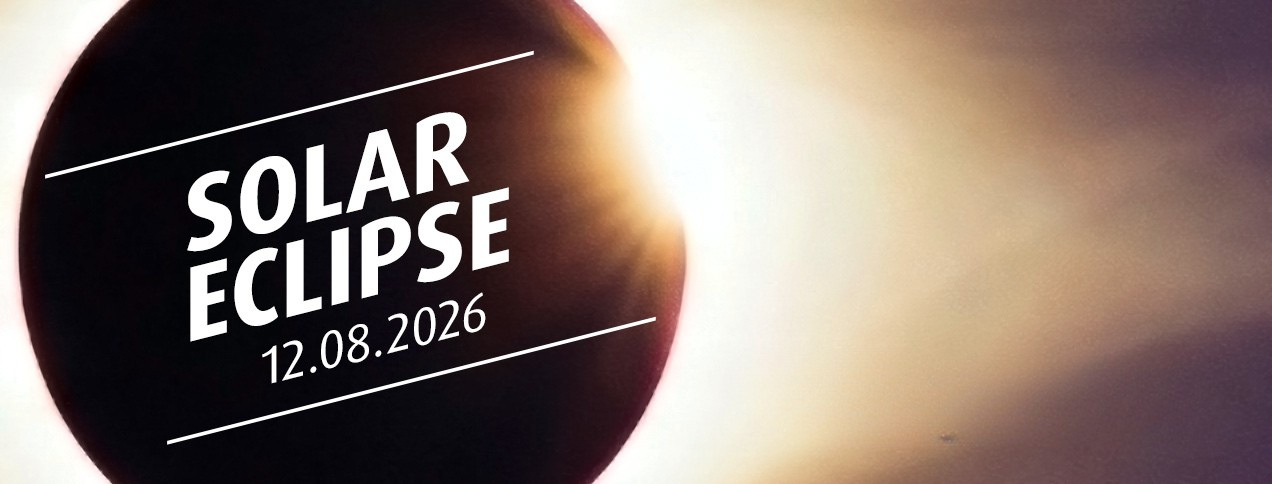
On 12 August, another total solar eclipse will take place. In most parts of Europe, it will be visible as a partial eclipse. It is the first total solar eclipse in Europe in 27 years, making it a very special event for everyone on the continent. The eclipse takes place in the evening hours shortly before sunset. A good observing location with an unobstructed view to the west is therefore ideal. More information with times and observing locations can be found in our magazine article on the solar eclipse.

12.08.2026 – Perseids

They are the most beautiful shooting stars of the year: the Perseids. And on the same day as the solar eclipse. This day is truly astronomical! In the morning hours of 13 August, the meteor shower reaches its maximum. In theory, up to 100 shooting stars per hour can appear, traveling at an incredible speed of around 216,000 km/h. The maximum occurs between 10:00 p.m. and 4:00 a.m. And because there is also a solar eclipse today, we have a new Moon: the shooting stars can therefore be observed without interference.

16.08.2026 – Moon meets Venus

A beautiful sight in the evening sky: Venus and the very slender, four-day-old crescent Moon meet today.

28.08.2026 – Partial lunar eclipse

On 28 August, a partial lunar eclipse will take place in the second half of the night. Its initial phase is easy to observe. Although the eclipse is partial, it has a very high eclipse magnitude: 93.5% of the Moon enters the umbra. At first, the full Moon can still be seen quite normally; the penumbra is barely noticeable. At 4:34 a.m. CEST, the Moon enters the umbra. Shortly after the maximum, the Moon sets. We will therefore no longer be able to follow its exit.

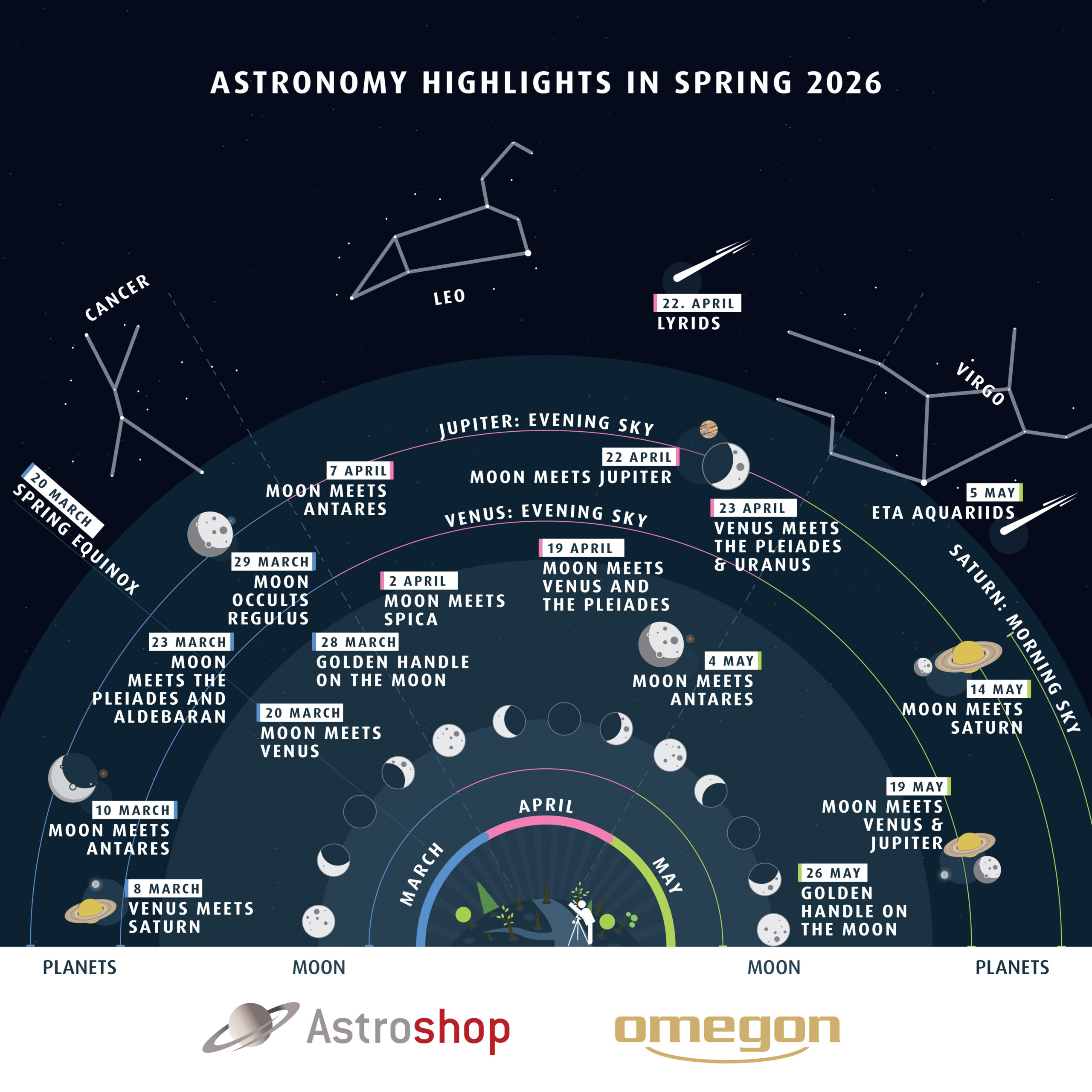
Infographic: Astronomical highlights in spring 2026

February 27 2026, Marcus Schenk

Temperatures are rising and the first rays of sunshine are drawing even couch astronomers back outside. Now is the perfect moment to look up at the sky once again. In the west, the familiar stars of winter are slowly setting. At the same time, the first stars of spring are already rising above the eastern horizon. It’s almost like a cosmic relay handover. The next three months offer rare moments in the sky.
Particularly fascinating: The Moon moves directly in front of the bright star Regulus. Our “Astro Highlights Spring 2026” show you all the important dates: The graphic presents the key dates at a glance, followed by a detailed description of the celestial events in the text below.
If you like, you can share the graphic on your own website. In that case, please include a link to www.astroshop.eu. Enjoy discovering!

March

08/03/2026 Venus meets Saturn
Just above the western horizon, the planets Venus and Saturn meet on March 8. While Venus shines brightly at -3.9 mag, Saturn appears much more subdued and almost delicate beside it. This contrast makes the encounter especially picturesque.
Nearby, the distant planet Neptune is also present. However, due to the bright twilight sky, it remains invisible and usually eludes observation even through a telescope.

10/03/2026 Moon meets Antares
In the early morning hours of March 10, the waning Moon approaches the main star of Scorpius: Antares. It is a red supergiant that shines brightly with a reddish glow in the night sky. With a diameter 700 times larger than our Sun, it would swallow several planets, including Earth, if it were in the place of our home star.

20/03/2026 Moon meets Venus
At dusk, they make a beautiful pair: the Moon and Venus. Both can be seen shortly after sunset just above the western horizon. The waxing crescent Moon is illuminated by only 3.5% and is just two days old. Both celestial bodies appear delicate against the blue twilight sky.

23/03/2026 Moon meets the Pleiades and Aldebaran
Even before it gets completely dark, we spot the crescent Moon above the western horizon. As darkness falls, the two bright stars Aldebaran and Capella appear nearby. About 5 degrees from the Moon, you can recognize the Seven Sisters, the Pleiades. Compared to the Moon, they appear almost filigree.

28/03/2026 Golden Handle on the Moon
At the end of March, the Moon once again shows one of its most beautiful sights: the Golden Handle becomes visible. This is a light phenomenon and offers something different from simply observing craters.
The shallow illumination near the lunar terminator creates a beautiful interplay of light and shadow. Over several hours, the peaks of the Montes Jura are illuminated by the Sun’s rays while the small plain of Sinus Iridum still lies in shadow. In the darkness, a delicate arc of light appears, resembling a golden handle.

29/03/2026 Moon occults Regulus
The waxing Moon occults the bright star Regulus in the constellation Leo. It is a striking event because Regulus, at magnitude 1.3, is one of the brightest stars in the sky. Astronomically speaking, this event occurs relatively often, as Regulus lies close to the Moon’s ecliptic path. When the Moon happens to be at exactly the same height along its orbit, an occultation occurs.
Binoculars or a small telescope are sufficient to follow the event. It begins at 20:20, when the star disappears behind the still unilluminated side of the Moon. About 1 hour and 20 minutes later, Regulus reappears shining from the other side of the Moon.

April

02/04/2026 Moon meets Spica
Spica is a massive blue star, a variable star and also a binary system. At a distance of 262 light-years, with 13,000 times the Sun’s luminosity and 7.5 times the Sun’s radius, it ranks sixteenth among the brightest stars in the sky.
At Spica’s position, Virgo holds an ear of wheat in her left hand—hence the star’s Latin name. On April 2, the Moon is nearby.

07/04/2026 Moon meets Antares
In the middle of the second half of the night, the constellation Scorpius rises above the horizon. We are currently enjoying spring—but in the early morning hours, we get a taste of the next season: summer. Scorpius lies within the summer Milky Way and neighbors Sagittarius. In Central Europe, Scorpius is known as a “horizon crawler,” as only part of the constellation rises above the horizon. The famous stinger of the Scorpion, which brought about Orion’s downfall, remains below our horizon. Tonight, the Moon is very close to the main star Antares.

19/04/2026 Moon meets Venus and the Pleiades
Clear skies and an unobstructed horizon? Then use the evening twilight for a quick observation or an atmospheric photo. Tonight in the west, the extremely thin crescent Moon appears near the Pleiades and the planet Venus. The distant Uranus also glimmers between the two celestial highlights.

22/04/2026 Lyrids
The Lyrids are a meteor shower that produces only 10 to 20 meteors per hour at its peak on April 22. During the optimal observing time between 10:00 p.m. and 4:00 a.m., we can observe them this year without Moon interference only in the second half of the night. The Moon sets at 2:46 a.m. and is positioned on the opposite side of the sky from the radiant in Lyra. Even before that, it is low enough on the horizon to cause minimal disturbance.

22/04/2026 Moon meets Jupiter
Right after the meteor shower, another spectacle appears: During the night of April 22–23, the Moon passes above the king of the planets. Until they set, they approach each other to within about 2.5 degrees.

23/04/2026 Venus meets the Pleiades & Uranus
Venus and Uranus in a single field of view? Few have probably tried this—but it is indeed possible on April 23. On this night, they approach each other to within 42 arcminutes—close enough to observe them together in a 2″ wide-angle eyepiece.

May

04/05/2026 Moon meets Antares
On the morning of May 4, the Moon once again approaches the star Antares in Scorpius. If you missed it in March, you now have another chance. The event is ideal for early risers. What else is interesting about Scorpius? You can find that a little further up in the text.

05/05/2026 Eta Aquariids
In the second half of the night, we once again see a meteor shower. The Eta Aquariids appear to originate from the constellation Aquarius and leave long, bright trails across the sky. However, Aquarius rises only around 3:00 a.m. and barely climbs above the horizon in Central Europe. Nevertheless, we can still catch some bright meteors. Average rates range between 20 and 60 per hour.

14/05/2026 Moon meets Saturn
The Moon frequently pays our planets a visit. On May 14, the slender crescent visits Saturn. Such encounters are truly beautiful sights—and a wonderful opportunity for an atmospheric photo with a stationary camera and lens. Early in the morning, a clear view of the eastern horizon is required.

19/05/2026 Moon meets Venus & Jupiter
As twilight falls on May 19, an inviting celestial gathering awaits us. Low above the western horizon around 10:00 p.m., three striking celestial bodies assemble in the constellation Gemini: the Moon, Venus and Jupiter.

The Moon appears as a delicate waxing crescent, illuminated by about 13 percent. To its right shines Venus, the brightest planet in the night sky. On the other side, Jupiter glows with a slightly yellowish light. With a brightness of -3.9 mag, Venus clearly outshines the gas giant, which still reaches -1.9 mag. A direct comparison of these two planets is rarely this easy. The spectacle is especially beautiful during evening twilight—a perfect backdrop for a photo.

26/05/2026 Golden Handle
On the evening of May 26, we can observe the Golden Handle on the Moon. It appears when the waxing Moon is illuminated to exactly 83 percent—about 10 days after new Moon. The light phenomenon takes place, and on the dark side of the Moon’s light-shadow boundary, a handle-shaped arc emerges.


Planet Party in the Sky: 6 Worlds in One Night

February 6 2026, Marcus Schenk

The sky is putting on a show. Between February 24 and March 2, six planets will gather in the sky at the same time. It’s a cosmic parade that rarely occurs: Venus shines like a spotlight, Jupiter reigns in the south, and even swift Mercury dares to emerge from hiding. But the best thing you can do is look up yourself.

When and where can you see the planets?

The observation window is clear: it lies between sunset and about 9:30 PM (CET). If the sky is clear, you’ll be able to spot Venus, Jupiter, and Saturn with the naked eye. Mercury is a bit more challenging, as it hugs the horizon. For Uranus and Neptune, you’ll need binoculars or a telescope.

Venus, Jupiter, and Saturn shine brightly enough to be seen without any aids. Mercury is also visible, but it’s a challenge near the horizon. For Uranus and Neptune, binoculars or a telescope are a must.

These planets are lined up

Mercury: Mercury had its evening visibility peak in February and still skims low along the western horizon. It appears nearly at the same height as Venus, just about 5 degrees apart. Simply grab a pair of binoculars and pan slightly to the right. And bingo! There it is, glowing in your field of view. Very important: choose a location with a completely unobstructed view of the horizon. But don’t wait too long—both planets dip below the horizon around 7 PM.

Venus: Venus beams like a cosmic spotlight low in the southwest and naturally draws the eye. It will remain our loyal companion until mid-March.

Jupiter: After dusk, our largest planet appears prominently in the southern sky and is the brightest object after Venus and the Moon.

Saturn: Saturn is still visible but is leaning heavily toward the western horizon. In just a few days, it will fade into the twilight.

Uranus & Neptune: Uranus (between Taurus and Aries) remains visible until mid-April. Neptune is less than a degree to the right of Saturn—a perfect opportunity to catch both planets through a telescope.

It’s best to grab your favorite stargazing app to pinpoint the exact positions in the sky.

You’ll find telescopes, a pair of binoculars, or astronomical glasses and other suitable accessories for your observations right here in our shop—feel free to browse our product range. Thanks to our fast shipping, in-stock items will arrive at your doorstep within just a few days.

Infographic: Astronomy Highlights Winter 2025/26

November 27 2025, Marcus Schenk

The winter draws near and with it the darkest time of the year. Already in the early evening the Winter Hexagon sparkles in the sky and invites you to observe. In the coming three months there is much to discover in the heavens: from the Geminids without disturbing moon‑light to the bright Jupiter and even a small planetary parade in February. Our new astro‑highlights guide you through this time: month by month, star by star.

If you like, you are welcome to embed the graphic on your own website. Please link it then to www.astroshop.eu

December

4 Dec. Moon meets the Pleiades
In the early morning hours the nearly full Moon passes through the constellation Taurus and encounters the Pleiades, one of the most beautiful open star clusters of the winter sky. In binoculars the close encounter appears particularly impressive. Even with the bare eye you recognize the group as a small, sparkling star‑nest next to the Moon. Around 4 a.m. the constellation stands high in the sky and offers a mood‑filled start to the winter observations.

7 Dec. Mercury at greatest western elongation
Shortly before sunrise the otherwise shy Mercury shows itself. At the beginning of December it reaches its greatest western elongation, i.e., the largest separation from the Sun, and thus stands particularly favorably in the morning sky. From about 6:30 a.m. you spot it deep above the south‑eastern horizon, as a small, bright point in the first light of dawn. A clear horizon view is essential, because the time window is short before the Sun outshines it. For early risers the view pays off: Mercury appears as distinctly as hardly any other time of the year.

14 Dec. Maximum of the Geminids
On the night from 13 to 14 December you have, with a bit of weather luck, the chance to admire the most famous winter meteors. This active meteor stream reaches its maximum, and the conditions this year are almost perfect: the Moon hardly disturbs, the sky remains deep dark for most of the time. From midnight the radiant rises high in the sky, and the activity increases once again. Under good conditions you could theoretically count up to 80 meteors per hour. In practice there will be fewer, yet every bright meteor is a moment, right?

21 Dec. Start of winter
Here it is: Winter begins, and at 16:00 the Sun descends as deeply as it never does all year. The day bids farewell early and the night stretches across the remaining hours. For many stargazers this is the finest time of the year: Long nights invite you to set up the telescope after work. From now on the light also returns slowly – barely noticeable, yet a little more each day.

22 Dec. Ursids
Hardly are the Geminids over, the next meteor stream is already on deck. On the night from 22 to 23 December the Ursids reach their maximum. This is a small but fine meteor stream, appearing to come from the constellation Ursa Minor. With about ten meteors per hour it offers no spectacle, but rather a modest finale. In this year no moonlight disturbs, and in the long winter nights you can take your time.

31 Dec. Moon meets the Pleiades
Late in the afternoon dusk sets in, and you discover the bright Moon exactly above the eastern horizon. If the sky is clear, the two bright stars Aldebaran and Capella appear close by. Next to the Moon, at about 1.5 degrees distance, you recognise the Pleiades. In comparison to the Moon they appear almost delicate. By the way: If you raise a glass at midnight, above you shines the bright Jupiter, which reaches opposition in January.
 

January

3 Jan. Quadrantids
Hardly has the new year begun, meteors again streak across the sky. On the night from 3 to 4 January the Quadrantids reach their maximum. Their radiant lies in the modest constellation Boötes, near the star Arcturus, and only rises higher after midnight.

3 Jan. Moon meets Jupiter
Right after the meteor shower another spectacle shows: On the night from 3 to 4 January the Moon passes near the planet Jupiter. Around 10 p.m. the two celestial bodies stand about three degrees apart. You notice that with the bare eye.

6 Jan. Moon meets Regulus
Late in the evening the waning Moon traverses the constellation Leo and encounters Regulus, the constellation’s brightest star. A star‑occultation by the Moon even takes place, which you cannot follow because Regulus still lies below the horizon at that moment. In binoculars the two bodies later appear splendidly.

10 Jan. Jupiter at opposition
Today Jupiter stands in opposition to the Sun. Now it lies closest to Earth and is visible all night long. Once the Sun sets, Jupiter ascends in the east and reaches its highest point in the south around midnight. With a brightness of about −2.7 mag it outshines every constellation and dominates the winter sky. Even in binoculars you recognise its four Galilean moons as tiny points of light shifting night by night. In a telescope you see its cloud‑covered atmosphere with its typical belts – and perhaps the “Great Red Spot” if it happens to be visible.

23 Jan. Moon meets Saturn
In the early evening the crescent Moon passes by Saturn – a beautiful sight during dusk. Around 6 p.m. the two stand in the southwest, about five degrees apart. The ring planet shines as a yellowish point, while the Moon hovers directly above. With binoculars you see both comfortably in the same field of view, and in a telescope the fine rings of Saturn already show at modest magnification. For many this is the last good chance to observe the planet before it sinks deeper into the dusk in February.

27 Jan. Moon meets the Pleiades
On this night the Moon again passes the Pleiades and comes especially close to the cluster. Around 10 p.m. both stand in the constellation Taurus, only a few arc‑minutes apart. At about 10:35 CET the Moon even occults the 4.3 mag bright star 19 Tau with its dark side. Tip: Times and whether an occultation occurs depend on location in Europe. Even with the bare eye you easily notice the Moon–Pleiades approach if the sky is clear. A familiar sight for many amateur astronomers – yet still fascinating.

30 Jan. Moon meets Jupiter
At month’s end two of the most noticeable objects in the sky meet: the bright Moon and Jupiter. Late in the evening they stand together in the constellation Gemini and catch the eye effortlessly. Not far away the stars Castor and Pollux glitter and frame the scene.


February

3 Feb. Moon meets Regulus
On this evening the Moon again traverses the constellation Leo and passes Regulus at exceptionally close distance. Only at about 5 a.m. the closest approach at approximately ten arc‑minutes occurs. That is extremely close and thus definitely worth looking.

7 Feb. Moon meets Spica
In the second half of the night (i.e., the night of 6/7 February) the waning Moon meets the bright main star of the constellation Virgo: Spica. Shortly before sunrise both stand deep above the south‑eastern horizon, only somewhat more than two degrees apart.

11 Feb. Moon meets Antares
Before dawn the Moon crosses the constellation Scorpius and approaches the reddish glowing Antares. Around four a.m. both appear above the south‑eastern horizon. Antares – a red super‑giant and the heart of the Scorpion.

18 Feb. Moon meets Mercury and Venus
On 18 February the Moon approaches the two planets Mercury and Venus, which stand in the evening dusk directly above the western horizon. This evening proves special, because the already delicate young lunar crescent is only 1.5 % illuminated, for the new Moon occurred just yesterday. That creates a beautiful mood‑portrait.

19 Feb. Moon meets Mercury and Saturn
A lovely trio shows up in the early evening deep above the western horizon. The young Moon stands in the dusk snugly between Mercury and Saturn. Both planets remain hard to catch, because the dusk dominates. Yet if you start observing early you also discover Venus right over the horizon.

27 Feb. Moon meets Jupiter
Toward month’s end the Moon and Jupiter meet again, this time high in the constellation Gemini. Already in the early evening both are unmistakable: the two brightest objects of the sky close together.

28 Feb. Small planetary parade
As a finale you face a rare spectacle. Shortly after sunset several planets line up along the ecliptic. Mercury and Venus very low in the west, a little higher Saturn and invisible beside it Neptune. High in Gemini shines Jupiter and in Taurus the faint Uranus. You see: everything present here, yet the parade demands effort: Some planets stand low and fade quickly in the dusk. If you bring patience and pick a spot with perfect horizon view, then you may discover several planets with binoculars.

Infographic: Astro Highlights in Autumn 2025

August 29 2025, Marcus Schenk

The nights are getting longer and the air is often clear: a good time to observe the sky. In autumn 2025, there will be special celestial events. Experience a total lunar eclipse, rare planetary conjunctions, or an occultation of the Pleiades.In the current infographic “Astro Highlights in Autumn 2025,” we have clearly compiled the most beautiful celestial events.Feel free to use the graphic on your website (with a link to www.astroshop.eu) and inform your visitors about the exciting upcoming events.

1.9. Venus meets the star cluster M44

On the morning of September 1, it is worth a look at the eastern sky: Venus is very close to the open star cluster M44, also known as Praesepe or the Beehive. The sight is already recognizable to the naked eye as a faint light spot right next to the prominent Venus. With binoculars, the stars of the cluster become clearly visible.

7.9. Total Lunar Eclipse

On the evening of September 7, a real highlight awaits you: a total lunar eclipse. For Central Europe, the timing is particularly favorable, as the moon rises already eclipsed. This means you will see the moon directly on the eastern horizon in the evening.

Times for Germany:

The eclipse begins even before moonrise, which occurs in Germany around 7:38 PM, depending on the location. At this point, the moon is in the midst of totality and appears noticeably reddish. It reaches maximum darkness around 7:30 PM, and the total phase ends at 8:53 PM.

For an unobstructed view, you should find a spot with a clear view to the east. Binoculars will show the lunar eclipse beautifully, but a telescope with a smartphone adapter is also great equipment for quickly capturing a photo.

8.9. Moon Meets Saturn

On the night of September 8th to 9th, the nearly full moon is near Saturn. Both objects are easy to find in the sky with the naked eye: the bright moon as a distinctive point and Saturn a little further away as a “star” that shines steadily.

This duo can be observed particularly beautifully through binoculars. You can recognize the planet as a small, yellowish disc – its rings appear as a thickening at low magnification. For many, this is a good opportunity to take out the telescope and examine the rings more clearly.

12.9. Moon covers Pleiades

On this night, our satellite covers the Seven Sisters, including all the bright main stars of the star cluster. It begins around 10 PM: The moon approaches from the eastern direction and first covers the star Electra. Then it continues to move – from its bright side – in front of the remaining companion stars. It’s best to observe all of this from an unobstructed location with a good horizon view. In addition to the interesting and quite rare occultation, it is the first harbinger of the winter sky, as the Pleiades officially belong to the constellation Taurus.

19.9. Venus meets Regulus

On the morning of September 19, it’s worth taking a look at the dawn sky. Venus is still the morning star and on this day is very close to the bright star Regulus in the constellation Leo. Nearby, you can also see the delicate crescent moon. Together, they create a beautiful trio in the sky.

If you are an early riser, this is your opportunity to capture the moment with your camera.

21.9. Saturn in Opposition

On September 21, Saturn is in opposition to the Sun. This means: Earth is positioned directly between the Sun and Saturn, and the ringed planet is visible all night long, reaching its greatest brightness. The special feature of the 2025 opposition: The rings are almost seen edge-on, making them hard to see and only about 2 degrees open. Even during twilight, the ringed planet rises above the eastern horizon and follows its apparent arc across the sky until dawn.

23.9. Neptune in Opposition

On September 23, Neptune reaches its opposition and stands favorably in the sky. This distant ice giant can be seen all night and appears in the telescope as a small, bluish disk.

Neptune is about magnitude 7.8, making it invisible to the naked eye. Binoculars show it as a faint point of light, but a telescope is needed for reliable identification. A star chart or app can help locate it in the constellation Aquarius.

2.10. Ceres in Opposition

On October 2, the dwarf planet Ceres reaches its opposition to the Sun. It is visible throughout the night and is particularly close to Earth. Ceres, with a brightness of 7.6 magnitude, can easily be found with binoculars or a small telescope. Ceres moves as an inconspicuous point of light through the constellation Cetus, but it is not visible to the naked eye. However, a simple pair of binoculars separates it from the fainter stars in its vicinity. Those who track its movement from night to night will recognize the typical motion of a planet against the backdrop of fixed stars.

5.10. Moon meets Saturn

On the evening of October 5th, the almost full moon passes by the ringed planet Saturn. Both are high in the sky and easily found with the naked eye. In a telescope, Saturn appears as a yellowish glowing disc. The narrow edge of the rings is only visible with a small aperture. Although the bright moon brightens the sky, it doesn’t matter for observing Saturn.

8.10. Draconids

The Draconids are a rather unknown meteor shower and reach their peak every year at the beginning of October. The name already reveals it: The meteors seem to come from the constellation Draco. This constellation is visible in the sky all night. The number of meteors varies greatly and always brings surprises. Normally, about ten meteors fall per hour, but in 2012, there were suddenly 400. What does that mean? It’s always worth taking a look at the sky, because perhaps a surprise is waiting. However, this year the moon will cause a brighter sky.

14.10. Moon meets Jupiter

In the second half of the night from October 13 to 14, the waning half moon meets the giant planet Jupiter. Both are in the constellation Gemini and are already conspicuous to the naked eye. You will see the moon as a bright half-circle and Jupiter as a shining point of light beside it.

19.10. Moon meets Venus

Early in the morning on October 19, the thin crescent moon is close to the bright Venus. Both can be seen well in the eastern sky. Together, they create a beautiful photographic motif.

22.10. Orionids

Meteor showers are a beautiful event for any enthusiastic stargazer, and the Orionids are no exception. Peaking from October 21 to 22, they promise about 25 to 30 meteors per hour. However, the number of shooting stars can vary from year to year. To catch the best view, set your alarm and look outside in the early morning hours. A must for all shooting star lovers.

2.11. Moon meets Saturn

On the evening of November 2, the Moon is near the planet Saturn. Both shine in the southeastern horizon already at dusk. The Moon is a prominent point of orientation, and Saturn is slightly to the west of it.

November: Saturn in Edge Position

In November 2025, Saturn’s rings will still be in edge position as seen from Earth. They will appear so narrow that they are hardly visible. This is a unique opportunity to observe Saturn without its ring system, even though the sight will be very unusual. Additionally, there will be two Titan transits in November. On November 6 and November 22, the moon Titan will pass across the gas giant.

9.11. Moon Meets Jupiter

On the night of November 9 to 10, the Moon moves past the planet Jupiter. The Moon appears as a large bright spot, and Jupiter looks like a very bright star.

A pair of binoculars or a telescope reveals even more details. On Jupiter, you can see two dark bands of clouds. Next to it are its four largest moons, arranged as small bright spots evenly spaced. The Moon also shows many craters, which are particularly visible along the terminator.

17.11. Leonid Meteor Shower

On the night of November 16 to 17, the Leonids reach their maximum, offering an impressive celestial event with up to 20 meteors per hour. This celestial event is a must for meteor fans.

The Leonids get their name from the constellation Leo, from which they appear to originate. The origin of this meteor shower lies in the comet Tempel-Tuttle, whose particles cause the meteor showers annually. Particularly noteworthy: every 33 years, the meteor stream condenses into a real meteor shower, producing far more than 20 meteors per hour – sometimes even up to several hundred per hour.

21.11. Uranus in Opposition

Uranus reaches its opposition. It shines with a brightness of 5.6 mag. Theoretically, you can see Uranus with the naked eye. In practice, however, it is better to use binoculars or a telescope. This way, you can clearly identify it.

To find Uranus, it is best to use a star map. Through a telescope, Uranus appears as a small, clear disc. It has a slightly greenish color.

25.11. Venus meets Mercury

On the morning of November 25th, Venus and Mercury will be close together at the southeast horizon. Both planets will be visible shortly before sunrise. Venus shines much brighter and thus helps with orientation. The observation is not easy, as it takes place very close to the horizon during dawn.


Total lunar eclipse 7.9.2025: Quick info for the event

August 27 2025, Marcus Schenk

Finally, the long wait is over! On September 7, our Moon will transform into a copper-red jewel in the evening sky. The best part: this time, you don’t have to get up in the middle of the night—the eclipse begins during prime family time.

Lunar eclipse shortly before the end

Lunar eclipse shortly before the end

The perfect timing for Moon fans

Normally, the sky has a rather nasty sense of humor. Beautiful events tend to happen at 3 a.m. This time, it’s making an exception! Starting at 7:38 p.m., the Moon will rise above the horizon as a copper ball. By then, the eclipse will already be in full swing.

The eclipse times at a glance (CEST):

6:27 p.m. – Start of the partial phase (below the horizon)

7:30 p.m. – Start of the total phase (below the horizon)

7:45 p.m. – Moonrise – now it begins

8:12 p.m. – Middle of the eclipse

8:53 p.m. – End of the total phase

9:57 p.m. – End of the partial phase

You have over an hour to enjoy this cosmic show.

The perfect viewing spot

During the eclipse, the Moon will be only 4° to 10° above the horizon. So choose a clear spot facing east. A hill, a meadow, or your top-floor balcony—anything where houses and trees don’t block your view.

Pro tip for photographers: The Moon’s low position is actually a gift. Your landscape shots with the red Moon will be absolutely atmospheric.


Part 2

Equipment for the lunar eclipse

After such a long wait, you’ll surely want more than just to look. Here’s your equipment list:

Binoculars

For beginners and all-round observers: The Omegon Blackstar 2.0 8×42 binoculars bring the Moon within arm’s reach. The 8x magnification shows every crater in crisp detail. You don’t need a tripod, and you’ll still get steady images.

Omegon Blackstar 8x42 binoculars

For wide-viewers: The Omegon Blackstar 2.0 10×50 brings you even more detail. With the larger aperture, you collect more light—perfect for future Milky Way trips or viewing open star clusters.

Omegon Blackstar 2.0 10x50

Stability boost: With the stable yet affordable Omegon Basic 250 tripod, you’ll get an even steadier image.

Telescopes

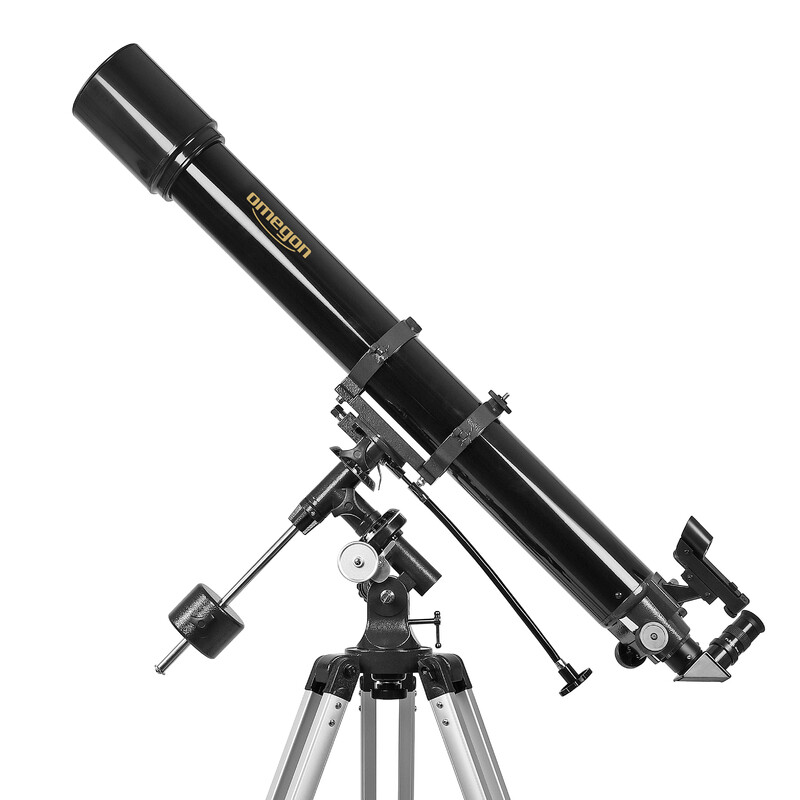
Beginners: The Omegon 90/1000 EQ-2 brings the Moon so close you’ll feel like you can touch it. The equatorial mount automatically tracks the Moon. Great fun for the whole family. The Moon and planets will become your new best friends.

Omegon Basic 90/1000 EQ-2 telescope

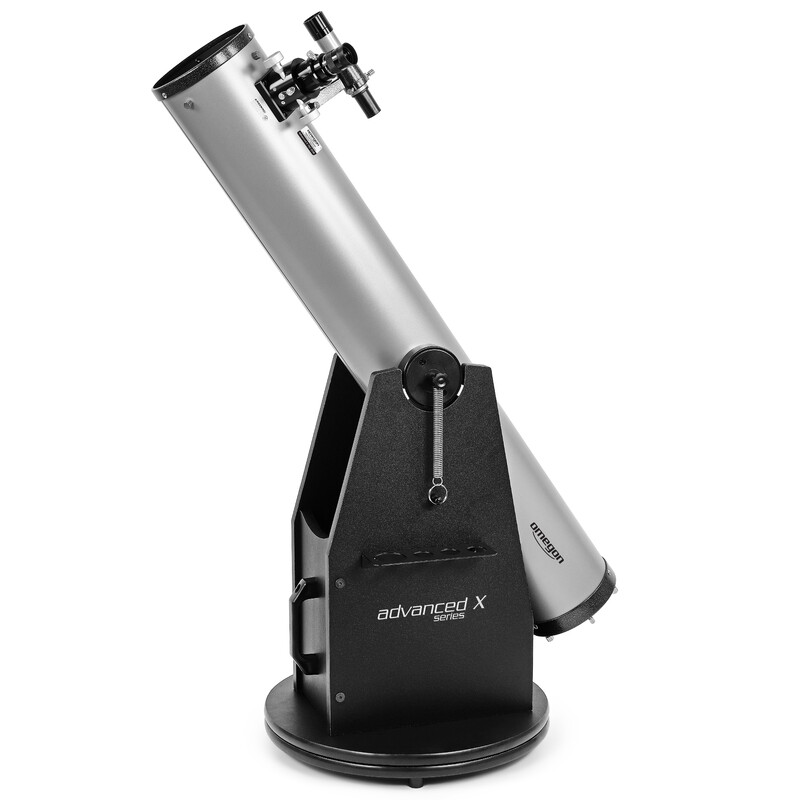
Dobson power: The Omegon Advanced X Dobson 150/1200 is your entry into the league of light-gathering telescopes. A 150 mm aperture means: the Moon, planets, and countless nebulae will be bright and clearly visible. As a new hobby astronomer, you’ll love the intuitive handling—just aim and go!

Omegon Dobson 152/1200

Smart telescopes

Into modern tech? Smart telescopes make astrophotography a breeze. Their apps even have special lunar eclipse modes. Perfect for tech-loving astrophotographers.

Smart Telescope Seestar S50

Smartphone photography

Want spontaneous snapshots directly through your telescope? The Omegon Easypic Universal Smartphone Adapter fits any 1.25″ eyepiece. Just attach your phone, focus, click, and you’re done.

For advanced users: Check out the camera adapters or special Moon and planet cameras. They’ll help you get the most out of your shots.

An experience to remember

Not until December 31, 2028 will we once again enjoy the next total lunar eclipse. That’s more than three years of waiting! Check your equipment now.

Perseids 2025: Nights of Shooting Stars in August

July 21 2025, Marcus Schenk

It’s that time of year again: The Perseids are coming! From the night of August 12th to the 13th, the famous summer shooting stars will once again reach their peak. There’s just one small drawback: this year, the bright, almost full moon will outshine many fainter meteors. Therefore, we need to focus our attention on the brighter ones.

Quick Tip: Lie down comfortably and look toward the east. You don’t need a telescope—just a dark sky, some patience, and perhaps a pair of binoculars.

Perfect for observing and photography:

With the Omegon 2.1×42 wide-field binoculars, you’ll spot more meteors than with the naked eye alone, while keeping things technically simple.

Want to photograph shooting stars? Then bring along a MiniTrack LX3 photo mount. It helps you create impressive astro-nightscapes.

For comfortable viewing, pack a camping chair, a warm blanket, and a thermos.

You’ll find more tips and background information in the magazine article “Successfully observing the Perseids: Here’s how” on Astroshop.

Compare 0/4