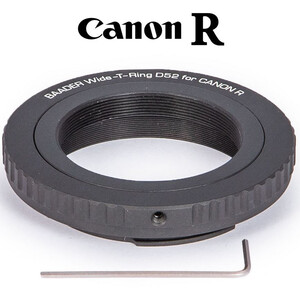
Clip filters for Canon EOS R and RP full-frame mirrorless cameras: The clip filters can be quickly and easily mounted in the camera body without tools. The filter can be inserted or removed at any time, even on the go or at night. No modification to the body is required to use the clip filters. Removal is done with a small hook, which is included in the scope of delivery.
Compatible Canon EOS cameras: Canon EOS R, Canon EOS Ra, Canon EOS RP, Canon EOS R3, Canon EOS R5, Canon EOS R5 Mark II, Canon EOS R6, Canon EOS R6 Mark II, Canon EOS R8, Canon EOS R7, Canon EOS R10
NOT compatible with these camera lenses: Canon RF 35mm f/1.8 IS MACRO, Canon RF 85mm f1.2 L USM, Extender RF 2x, Extender RF 1.4x, Canon RF-S
Astronomik XT filters for wide-angle lenses: The new Astronomik XT filters have been specially developed for astrophotography with wide-angle lenses and deliver sharp star images right into the corners of the image.
Astronomik clip-on filters have been a popular and well-known accessory for astrophotographers around the world for many years. However, when using lenses with very short focal lengths for wide-angle photography, standard clip-on filters can cause aberrations, and the stars in the outermost corners of the image become streaked. To solve this problem, the new Astronomik XT filters are mounted on an extremely thin substrate with a thickness of only 0.3 mm or 0.5 mm, which significantly reduces these aberrations.
Despite their reduced thickness, Astronomik XT filters offer the highest optical quality: they are finely polished, free of streaks, internal stresses and bubbles, and suitable for the most demanding applications.
Astronomik XT filters are manufactured using the same durable coating technology as all Astronomik filters. They are extremely scratch-resistant, insensitive to high humidity and non-ageing. This ensures that they maintain their performance for years to come.
Please note that not all Astronomik filters are available as XT versions, as the manufacture of these extremely thin filters is very complex. Currently, filters are being produced that are ideal for photography with wide-angle lenses.
Filters with MaxFR coating are optimised for astrophotography with very fast telescopes, such as Celestron RASA optics or the Omegon Pro Astrographs.
For the three most important lines – namely OIII, H-alpha and SII – the series offers filter sets with half-widths of 12 nm and 6 nm.
The filters provide the best possible out-of-band blocking across the entire spectral range from UV to IR! The benefits are maximum contrast, minimal stray light, no halos and the finest star resolution. With Astronomik MaxFR narrow-band line filters, you obtain raw data of the highest quality: the ideal starting point for further processing into an impressive astrophotograph!
Maximum filter transmission is required for the best possible yield:
- For MaxFR filters with a 12 nm half-width, this means unrestricted usability from f/1.7 to f/8 and approximately 85% of maximum transmission
- For MaxFR filters with a 6 nm half-width, this means unrestricted usability from f/2.2 to f/8 and approximately 90% of maximum transmission
The sii filter is optimised for particularly high-contrast results by blocking H-Alpha and NII (nitrogen).
Photography with narrowband line filters: If you are observing under bright skies, line filters are the best way to get started in astrophotography and take successful pictures. An H-alpha filter is usually the first sensible purchase: with this filter, you can easily take detailed pictures even when the moon is full or the sky is very bright! It is also the right filter for all nebulae that glow in red light.
The OIII filter greatly expands your possibilities, as it allows you to capture all greenish/bluish structures in detail and with high contrast. Planetary nebulae and star-forming regions are particularly rewarding targets! With the SII filter, your HSO filter set is complete, and with the three channels you can take colour images like the Hubble Space Telescope!
The H-beta filter is not available in the 6 nm version, as this filter has virtually no useful application.
Which half-width is the right one? When shooting under dark skies, images taken with a DSLR and even with many cooled CCD cameras are limited by the dark current of the camera and not by the background brightness of the sky. In this case, further suppression of the sky background by a smaller half-width will not reveal any more details in the object! Compared to the 6 nm filters, the 12 nm filters have the advantage that they usually make it easier to find tracking stars with cameras that have a built-in tracking sensor!
If you have a camera with particularly low dark current and good cooling, the 6 nm filters offer all their advantages: Even stronger suppression of sky brightening allows even longer exposure times and thus even deeper images! Due to the low half-width, the stars become tiny, and faint stars disappear almost completely. Especially in Milky Way regions with many stars, the 6 nm filters allow even faint objects to be displayed with high contrast without getting lost in the swarm of stars.
In short, we recommend using 12 nm filters for DSLRs and all cameras with limited dark current.
The 6 nm filters are the right choice in locations with strong light pollution, for cameras with extremely low dark current, and when faint objects require maximum contrast in the image!