The luminance channel is very important for a successful astrophotograph! The sharpness, contrast and low noise of the luminance data are crucial for achieving the best possible quality in the final result!
The purpose of the L-filter is to provide maximum transmission across the entire visible spectrum, as the combination of the widest possible bandwidth and high transmission enables the capture of the greatest possible number of photons.
Not all telescopes or additional elements such as correctors, field flatteners and Shapley lenses have perfect colour correction. An L-filter with too broad a bandwidth allows wavelengths to pass through for which your optics are not properly corrected. The result is unattractive, bloated, out-of-focus stars that do not match the RGB colour channels.
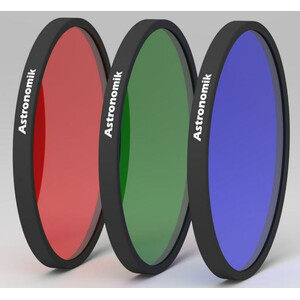
Astronomik offers three different UV+IR blockfilters for the luminance channel, designated L-1, L-2 and L-3. Please ensure you check the relevant designation in the product name.
How to find the right luminance filter: Depending on the colour correction of the instruments used, the L-filter with the widest transmission should be used. The L-1 filter has by far the widest spectral transmission, whereas the L-3 filter has the narrowest spectral window. If the optics you are using can be classified as free from chromatic aberration, the L-1 filter is the right choice. For general use, e.g. with telescopes of varying chromatic purity or when using additional, light-refracting elements in the optical path, we recommend the Astronomik L-2 version. For ‘colour-rich’ optics, e.g. an achromatic telescope, we recommend the Astronomik L-3 filter to enhance image sharpness.
The transmission characteristics and coating technology of the new Astronomik L-series have been developed to ensure that no halos or reflections are visible. Even with bright stars in the field of view, nebulae and galaxies are imaged with the finest structures and maximum contrast.
Like all Astronomik filters, the L-1, L-2 and L-3 filters feature an extremely resistant and durable coating, applied to a special precision-optical substrate of the kind also used in space flight. A fundamental requirement for such material is that it is free from streaks, tension marks and bubbles. Furthermore, Astronomik filter holders are machined to a uniform thickness in a dedicated process: perfect homofocality and minimal wedge error are the resulting benefits!