

A much more comfortable observing position can be achieved with a refractor or catadioptric telescope by using an erecting lens. The beam of light exiting the telescope is deflected by 90° before it enters the eyepiece. In this way, even objects close to the zenith can be observed comfortably.
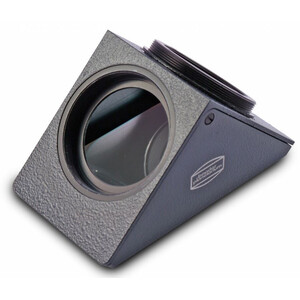
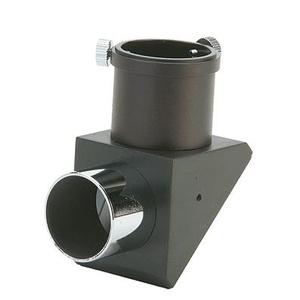
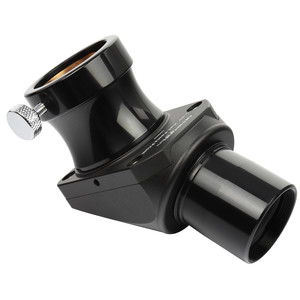
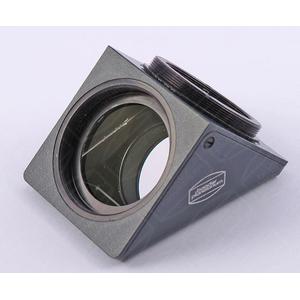
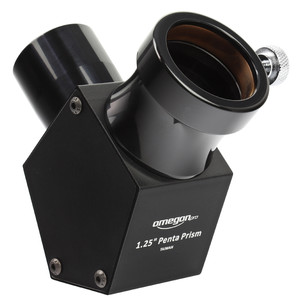
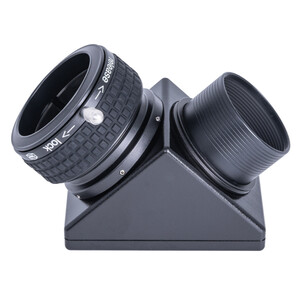
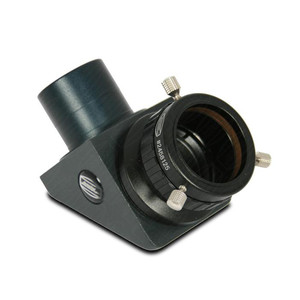
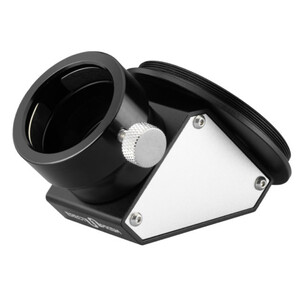
Erecting lenses are available as zenith mirrors, zenith prisms or Amici prisms. The latter are useful for terrestrial observation and are therefore also available with a flatter deflection angle of 45°.
- Without an erecting lens, the image in the telescope depicts north below and east to the right.
- With zenith mirrors and zenith prisms, the telescope depicts a laterally transposed image: north is at the top, east is at the right and, without tracking, stars wander to the left.
- Amici prisms show a correct image as it would be seen with the naked eye. Therefore, these prisms are essential for nature-watching. However, their more complicated construction makes them susceptible to image defects, which is why the laterally transposed image is preferred in astronomy.
Most erecting lenses have simple plug-in connectors, as is common seen with eyepieces. For SC telescopes, however, there are also models with screw threads.