Omegon off-axis-guider with Microfocus: Successful astrophotography without a guide scope
Why it is sometimes better to take photos with an off-axis-guider
With an off-axis-guider, you’ve almost got the perfect astrophotograph in the bag. Photos with long exposure times require precise tracking. That is exactly what this guider specialises in, making it an essential tool for astrophotographers. With it, you too will soon have the most beautiful astrophotographs in the bag.
The advantages at a glance:
- Take sharp, point-like and beautiful astrophotos
- For refractors, SC, MAK, CC and RC telescopes
- Off-axis-guider with a length of just 24 mm – adds very little bulk.
- Stable yet lightweight: just 180 grams
- 45 mm optical aperture: full illumination even for large sensors
- Microfocus: exceptionally smooth helical focusing with 0.05mm accuracy
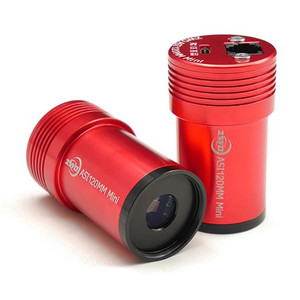
An off-axis-guider is an ingenious invention. This component sits in the 2-inch focuser in front of the camera. A small prism directs a little light from the telescope into a separate tunnel: the slot for your guiding camera or reticle eyepieces. Whilst your camera photographs the object for several minutes, you have the opportunity to correct deviations immediately. For perfectly round stars!
The connections
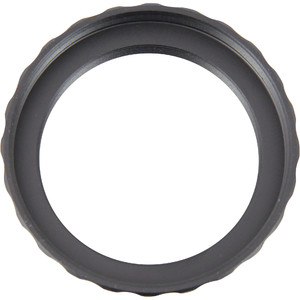
Easy adaptation: The Omegon off-axis-guider features an M48 thread on the telescope side and an additional sleeve for 2-inch focusers. The accessory side has three screws. These clamp a flat M48 adaptor for connecting your camera. The advantage: you can rotate your camera at any time to find the optimal framing for your subject.
Precise microfocus with 10 mm travel: For autoguiders and crosshairs
A small prism directs light sideways into the control unit of your Guide via a 1.25-inch rotating focus. Now insert your autoguider (an automatic tracking camera) or the crosshair eyepiece. With the generous 10mm travel, you can find the optimal focus for your guide star. Impressive: this special helical focuser can be adjusted with a scale to a super-fine 0.05mm. This means you can quickly refocus at any time.
Guiding scope or off-axis-guider?
For many, this is a matter of preference. But there is more to it than that. During longer exposures, the positions of the guide scope and the telescope’s optics can shift slightly. This is particularly true for reflector telescopes. An off-axis-guider solves this problem elegantly. This is because there is only one optical path and therefore no misalignment.
Our expert comment:
In order to get into focus with the Guide camera, some extensions must be inserted between the off-axis-guider and the object camera. Which and how many sleeves are required depends on the flange focal distance of the guiding camera and the flange focal distance of the object camera.
Only trial and error will help here.
With one 28mm and 2 x 14mm, a solution can usually always be found:
http://www.astroshop.de/teleskop-zubehoer/adapter/15_37?q=finetuning
For many DSLRs there are solutions from M48 to the respective bayonet:
Alternatively, an adaptors from M48 to T2 is required. Suitable is for example: Omegon M48/T2 adapter – short version