

Temperatures are rising and the first rays of sunshine are drawing even couch astronomers back outside. Now is the perfect moment to look up at the sky once again. In the west, the familiar stars of winter are slowly setting. At the same time, the first stars of spring are already rising above the eastern horizon. It’s almost like a cosmic relay handover. The next three months offer rare moments in the sky.
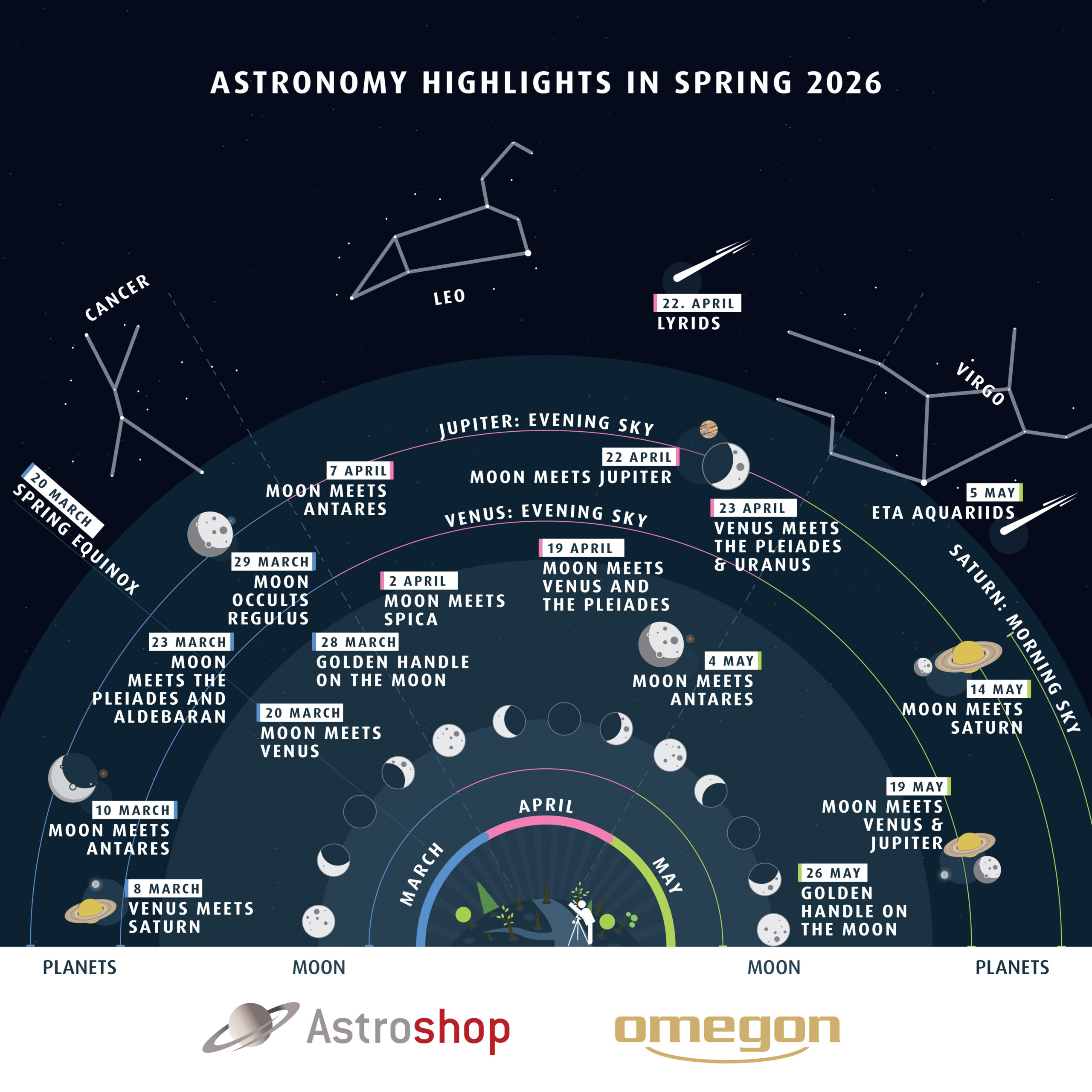
Particularly fascinating: The Moon moves directly in front of the bright star Regulus. Our “Astro Highlights Spring 2026” show you all the important dates: The graphic presents the key dates at a glance, followed by a detailed description of the celestial events in the text below.
If you like, you can share the graphic on your own website. In that case, please include a link to www.astroshop.eu. Enjoy discovering!
March
08/03/2026 Venus meets Saturn
Just above the western horizon, the planets Venus and Saturn meet on March 8. While Venus shines brightly at -3.9 mag, Saturn appears much more subdued and almost delicate beside it. This contrast makes the encounter especially picturesque.
Nearby, the distant planet Neptune is also present. However, due to the bright twilight sky, it remains invisible and usually eludes observation even through a telescope.
10/03/2026 Moon meets Antares
In the early morning hours of March 10, the waning Moon approaches the main star of Scorpius: Antares. It is a red supergiant that shines brightly with a reddish glow in the night sky. With a diameter 700 times larger than our Sun, it would swallow several planets, including Earth, if it were in the place of our home star.
20/03/2026 Moon meets Venus
At dusk, they make a beautiful pair: the Moon and Venus. Both can be seen shortly after sunset just above the western horizon. The waxing crescent Moon is illuminated by only 3.5% and is just two days old. Both celestial bodies appear delicate against the blue twilight sky.
23/03/2026 Moon meets the Pleiades and Aldebaran
Even before it gets completely dark, we spot the crescent Moon above the western horizon. As darkness falls, the two bright stars Aldebaran and Capella appear nearby. About 5 degrees from the Moon, you can recognize the Seven Sisters, the Pleiades. Compared to the Moon, they appear almost filigree.
28/03/2026 Golden Handle on the Moon
At the end of March, the Moon once again shows one of its most beautiful sights: the Golden Handle becomes visible. This is a light phenomenon and offers something different from simply observing craters.
The shallow illumination near the lunar terminator creates a beautiful interplay of light and shadow. Over several hours, the peaks of the Montes Jura are illuminated by the Sun’s rays while the small plain of Sinus Iridum still lies in shadow. In the darkness, a delicate arc of light appears, resembling a golden handle.
29/03/2026 Moon occults Regulus
The waxing Moon occults the bright star Regulus in the constellation Leo. It is a striking event because Regulus, at magnitude 1.3, is one of the brightest stars in the sky. Astronomically speaking, this event occurs relatively often, as Regulus lies close to the Moon’s ecliptic path. When the Moon happens to be at exactly the same height along its orbit, an occultation occurs.
Binoculars or a small telescope are sufficient to follow the event. It begins at 20:20, when the star disappears behind the still unilluminated side of the Moon. About 1 hour and 20 minutes later, Regulus reappears shining from the other side of the Moon.
April
02/04/2026 Moon meets Spica
Spica is a massive blue star, a variable star and also a binary system. At a distance of 262 light-years, with 13,000 times the Sun’s luminosity and 7.5 times the Sun’s radius, it ranks sixteenth among the brightest stars in the sky.
At Spica’s position, Virgo holds an ear of wheat in her left hand—hence the star’s Latin name. On April 2, the Moon is nearby.
07/04/2026 Moon meets Antares
In the middle of the second half of the night, the constellation Scorpius rises above the horizon. We are currently enjoying spring—but in the early morning hours, we get a taste of the next season: summer. Scorpius lies within the summer Milky Way and neighbors Sagittarius. In Central Europe, Scorpius is known as a “horizon crawler,” as only part of the constellation rises above the horizon. The famous stinger of the Scorpion, which brought about Orion’s downfall, remains below our horizon. Tonight, the Moon is very close to the main star Antares.
19/04/2026 Moon meets Venus and the Pleiades
Clear skies and an unobstructed horizon? Then use the evening twilight for a quick observation or an atmospheric photo. Tonight in the west, the extremely thin crescent Moon appears near the Pleiades and the planet Venus. The distant Uranus also glimmers between the two celestial highlights.
22/04/2026 Lyrids
The Lyrids are a meteor shower that produces only 10 to 20 meteors per hour at its peak on April 22. During the optimal observing time between 10:00 p.m. and 4:00 a.m., we can observe them this year without Moon interference only in the second half of the night. The Moon sets at 2:46 a.m. and is positioned on the opposite side of the sky from the radiant in Lyra. Even before that, it is low enough on the horizon to cause minimal disturbance.
22/04/2026 Moon meets Jupiter
Right after the meteor shower, another spectacle appears: During the night of April 22–23, the Moon passes above the king of the planets. Until they set, they approach each other to within about 2.5 degrees.
23/04/2026 Venus meets the Pleiades & Uranus
Venus and Uranus in a single field of view? Few have probably tried this—but it is indeed possible on April 23. On this night, they approach each other to within 42 arcminutes—close enough to observe them together in a 2″ wide-angle eyepiece.
May
04/05/2026 Moon meets Antares
On the morning of May 4, the Moon once again approaches the star Antares in Scorpius. If you missed it in March, you now have another chance. The event is ideal for early risers. What else is interesting about Scorpius? You can find that a little further up in the text.
05/05/2026 Eta Aquariids
In the second half of the night, we once again see a meteor shower. The Eta Aquariids appear to originate from the constellation Aquarius and leave long, bright trails across the sky. However, Aquarius rises only around 3:00 a.m. and barely climbs above the horizon in Central Europe. Nevertheless, we can still catch some bright meteors. Average rates range between 20 and 60 per hour.
14/05/2026 Moon meets Saturn
The Moon frequently pays our planets a visit. On May 14, the slender crescent visits Saturn. Such encounters are truly beautiful sights—and a wonderful opportunity for an atmospheric photo with a stationary camera and lens. Early in the morning, a clear view of the eastern horizon is required.
19/05/2026 Moon meets Venus & Jupiter
As twilight falls on May 19, an inviting celestial gathering awaits us. Low above the western horizon around 10:00 p.m., three striking celestial bodies assemble in the constellation Gemini: the Moon, Venus and Jupiter.
The Moon appears as a delicate waxing crescent, illuminated by about 13 percent. To its right shines Venus, the brightest planet in the night sky. On the other side, Jupiter glows with a slightly yellowish light. With a brightness of -3.9 mag, Venus clearly outshines the gas giant, which still reaches -1.9 mag. A direct comparison of these two planets is rarely this easy. The spectacle is especially beautiful during evening twilight—a perfect backdrop for a photo.
26/05/2026 Golden Handle
On the evening of May 26, we can observe the Golden Handle on the Moon. It appears when the waxing Moon is illuminated to exactly 83 percent—about 10 days after new Moon. The light phenomenon takes place, and on the dark side of the Moon’s light-shadow boundary, a handle-shaped arc emerges.