
Your partner for astronomy

Author Archives


Marcus Schenk

Marcus Schenk

Posts composed by Marcus Schenk

Blog Archives

Telescope configurator with new telescopes: 6 steps to your dream telescope

August 15 2016, Marcus Schenk

Optics, mounts and accessories: For two years you have been able to use the Astroshop.de telescope configurator to custom compile your own telescope, and now we have considerably extended the configurator’s functions. You can now choose from 12 different telescopes and adapt the telescope to even better serve your needs.

as-omegon-konfigurator-en

In the past, you have had to content yourself with the telescopes on offer. Why not switch things up and make buying a telescope a more personalised experience? This is what we at Astroshop.de thought, too, when we designed the configurator. We started with two Newton telescopes.

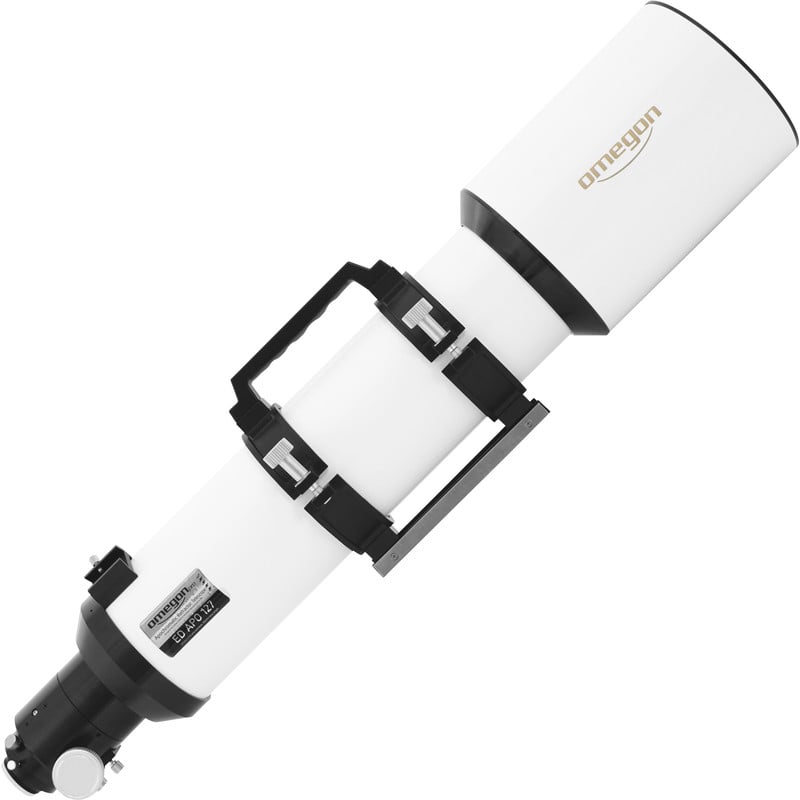
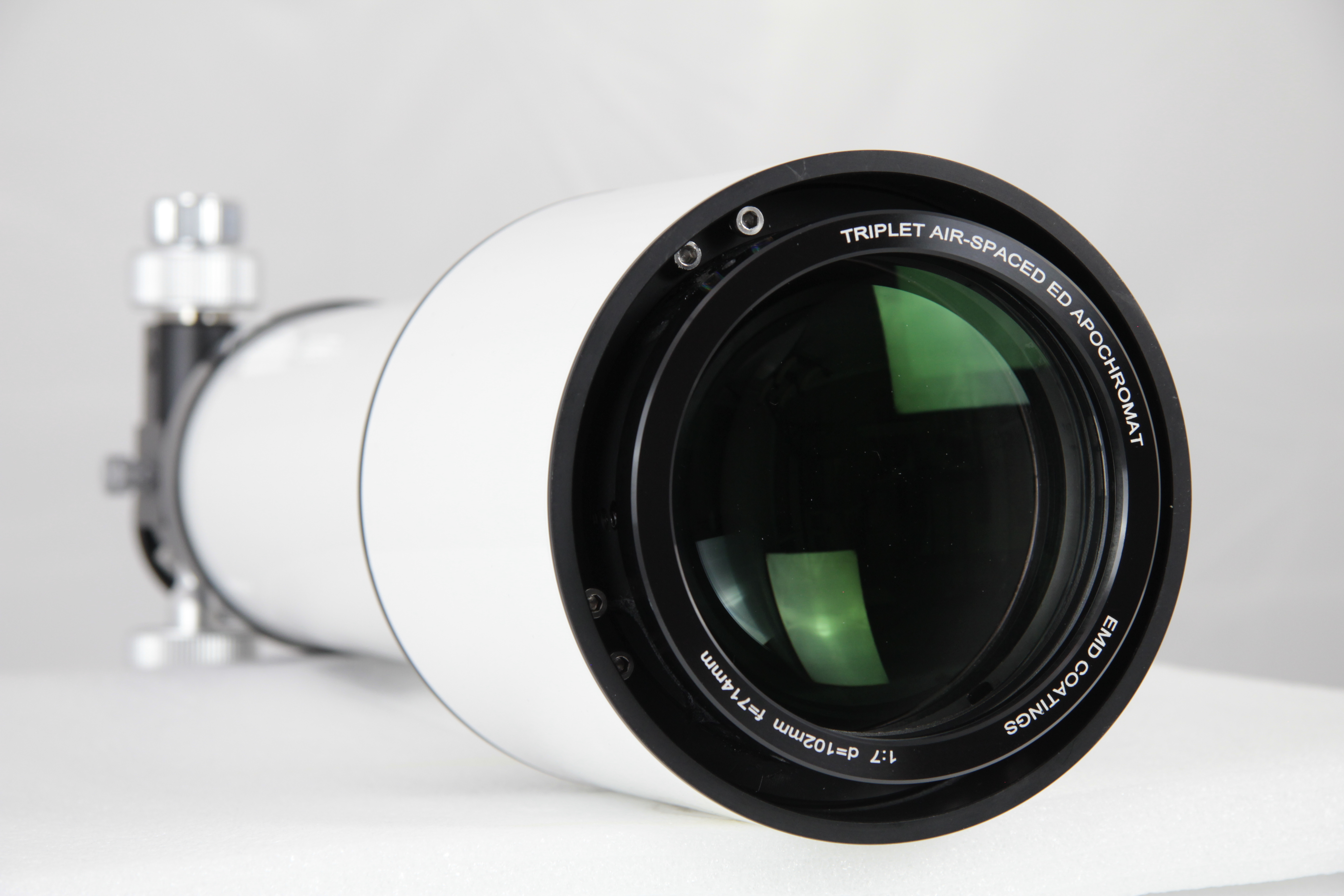
Now, the Advanced Telescope Series offers a full range of new reflectors and refractors:

Would you like to give it a try and take a look at the telescopes? This way to the telescopes!

How to start telescope selection

It’s fun to play with the configurator. What might my telescope look like? Which mounts and accessories are important to me? Do I prefer a simple or a more sophisticated eyepiece?

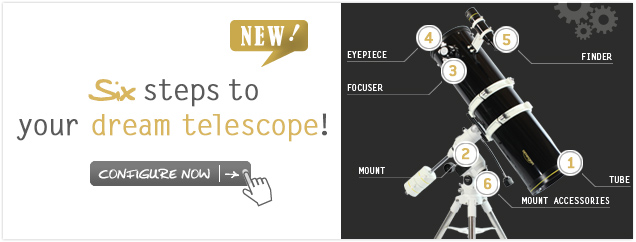
Simply click on this link and start configuring your dream telescope by first choosing the optics. The overview shows all available optics including basic prices. Step by step, you now make your way to mounts, focusers, eight different finderscopes, eyepieces and other accessories.

When it comes to accessories, you may even skip individual steps; for example, if you already have good eyepieces. This means that you are almost entirely free in your selection.
And the best part is: You can activate or deactivate your selection with a tick on the right. You can see in real-time how the prices change in the top right corner. This way, you not only choose each individual telescope component, but you also have full control over pricing.

Protection against unsuitable combinations

One of the most important prerequisites: the tubus needs to match the mount. How quickly do you accidentally place too large an optics on too small a mount. Using a 6” refractor, for example, on a small EQ-300 mount would be an unstable and shaky affair, as if you were using a telescope on a sailing ship in heavy seas. To avoid this, not every tubus can be combined with every mount. In this case you won’t see a tick but a cross next to the item.

No matter whether you’re a beginner or an advanced stargazer: For hobby astronomers, the telescope configurator is an alternative to the finished telescope sets. It simply gives you more control when purchasing your telescope.

Why not give it a try: configure your telescope now.

Info-graphic: Summer Highlights 2016 – All the Info at a Glance

June 13 2016, Marcus Schenk

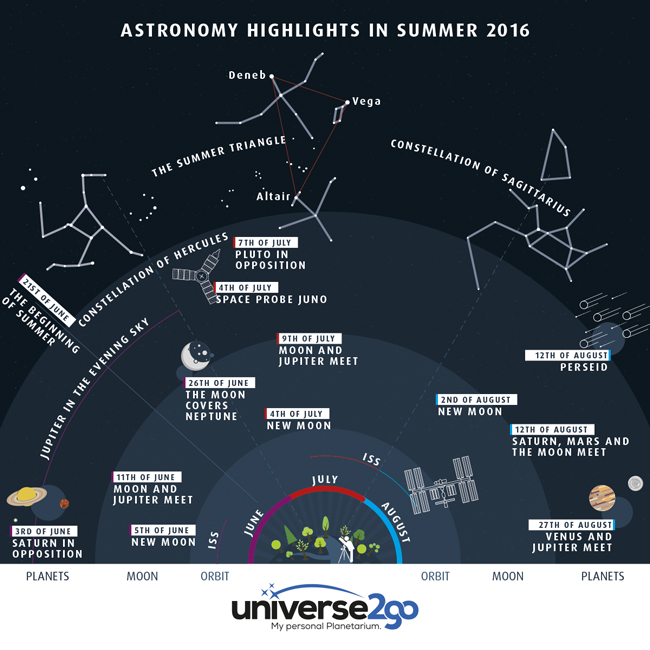
What can you discover during the mild summer nights?  Our new info-graphic has your answers – “Summer Highlights 2016″.  A quick glance is enough to know what is happening between June and August.

u2g-infografik-himmelsfahrplan-sommer-en

If you would like to use our info-graphic on your website, please feel free to use the code below:

More info on each highlight in the graphic can be found below.  We wish you hours of observational enjoyment and fun, as well as a warm Summer!


June

Jupiter in the Evening Sky

Last chance to see Jupiter in the evening.  Our solar system’s biggest planet will sparkle in the western sky.  An arc second of 35″ is enough to recognized details of the planet, for example, the cloud bands and the (in)famous Great Red Spot, or Jupiter’s moons.  The planet will be visible in the evening until the end of July.


3rd of June – Saturn in Opposition, Awesome Rings and Ophiuchus

On the 3rd of June, Saturn will stand in opposition, being visible for the entire night.  The planet will be roughly 1.35 million km (840,000 miles) away from Earth, offering us a perfect impression.  Saturn will enthrall us with a perfect perspective of its rings at 26 degrees.  The gas giant will rise at around 9 PM and create a wonderful constellation along with Mars and Antares.


11th of June – Our Moon meets with Jupiter

During dusk, a look to the west will be very rewarding.  There, you will see a waxing Moon along with a shining Jupiter above to the right.  Both objects on this evening will be only 2° away from one another.  With a camera, a telephoto lens and a clear evening sky, you’ll have everything for a unique photo.


21st of June – Summer Solstice

The 21st of June is the longest day and shortest night of the year.  The sun will set after 9 PM (depending on your coordinates) and will rise again after 5 AM.  The night won’t be extremely dark by astronomy standards, as the sky will always appear dimly lit.  The Earth will be at its greatest distance to the Sun in its elipse and the Earth’s tilt of 23.5° will result in a very high angle of incidence.  With hotter days on the horizon, we will flock to our parks, lakes and rivers for some summer fun.


International Space Station Visible 

The ISS will be visible during the summer months, but will vary depending on your location.   Luckily a handy website from NASA allows you to check ISS visibility in your area.  Check it out for more info!


26th of June – The Moon Obscures Neptune

On the 26th of June, for those in Europe, the Moon will move in front of Neptune.  Around 1 AM, Neptune will disappear behind the lit Moon disk and will appear again on the non-illuminated side at around 1:30 AM.


July

4th of July – Space Probe Juno Reaches Its Destination

The space probe Juno was launched  on the 5th of August 2011 and will arrive at Jupiter after a five year trip.  The probe will take up a polar orbit in order to research Jupiters atmosphere and magnetic field.  At mission’s end in October of 2017, the probe will send itself plunging into the planet’s atmosphere, only to be crushed by the atmosphere’s massive pressure.


7th of July – Pluto in Opposition

Once there was a planet that was indeed only a dwarf planet.  Pluto will be especially interesting to observe on the 7th of July as it stands in opposition.  The 2,374 km large body is 4.4 million km away and will shine only at a 14.1 mag, like a tea light between the larger plants.  You will only be able to see the dwarf planet with a large telescope, but even there it won’t be able to differentiate itself from stars.  With Universe2go, however, you will be able to get a full experience of Pluto without a telescope.  You can even see its heart, which the space probe Philae discovered last year.


9th of July – A Lunar Meeting with Jupiter

At only 4.5° apart, the Moon will encounter Jupiter this evening on the western horizon, providing a good photo op for those looking for a unique image.


August

12th of August – Conjunction of Saturn, Mars and the Moon near Scorpio

Mars, Saturn and the Moon will meet up near Antares, providing an intriguing sight.  Lined up like a string of pearls on the 12th, we will find them close to Antares, the primary star of Scorpio.  Observations and images of this quartet will be fruitful to say the least!


12th of August – Perseid Meteor Shower

In the night of the 12th into the 13th of August, the Persied Meteor Shower will reach its peak.  Up to 100 meteors per hour will rain down and thunder through our atmosphere at an unbelievable speed of about 216,000 km/h (134,000 mph).  So, do you hold out and stay up all night or get up early?  Since the shower will peak between 10 PM and 4 AM, the choice is yours.  The Moon will disturb the night sky at the beginning, but will set after midnight, allowing us enjoy darkness in all its splendor!

We can thank the comet 109P/Swift-Tuttle for this meteor shower, which in its orbit around the sun has lost a portion of its mass.  Every year that the Earth crosses the comet’s orbit in August, the Perseids occur in our night sky.

This year, we can expect even more meteors, since the Earth has moved closer to the path of the comet.  As a result, astronomers believe we will see a greater number of meteors than in previous years.  Is that not enough reason to check it out?


27th of August – Conjuntion of Venus and Jupiter in the Evening 

Keep an eye on Jupiter and Venus this evening.  Both planets will race across the sky, as Venus overtakes the gas giant to the north.  Before those in Europe even see their closest encounter, both will set in the evening in the western horizon, allowing those in the western hemisphere a fantastic show!

It is best to go out with binoculars at dusk, but be sure to avoid looking into the Sun by waiting for our star to set.