Your partner for astronomy

Author Archives


Marcus Schenk

Marcus Schenk

Posts composed by Marcus Schenk

Blog Archives

The right telescope for Christmas

November 26 2024, Marcus Schenk

Candlelight and the smells of freshly brewed coffee and just-baked biscuits: it could all be so tranquil.

Instead, for most of us, the weeks before Christmas are the most stressful of the year. The children are moody and you still haven’t bought the tree. Phew!

How can this be a good time to research buying your first telescope?

Luckily, you don’t have to.

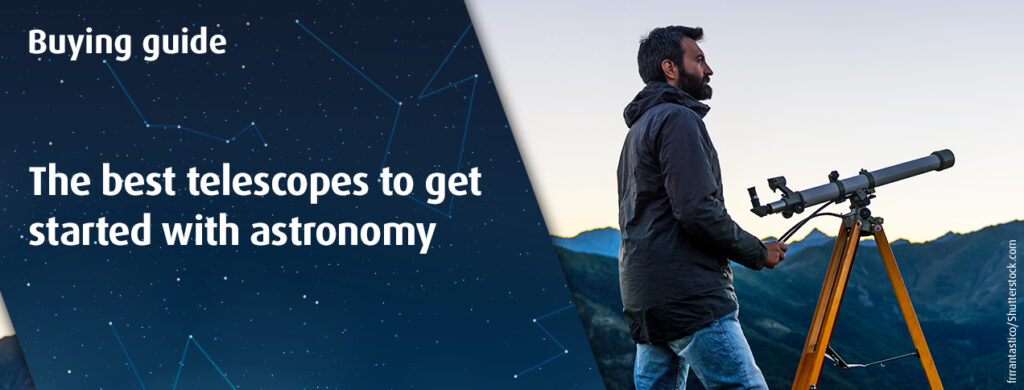
In the guide Telescopes for beginners“, we show you how, in just a few minutes, you can find a telescope which will take you from your balcony directly into space. Together with suitable recommendations that will ensure that the parcel under the Christmas tree will bring you endless pleasure.

Read our buying guide: The best telescopes for beginners.


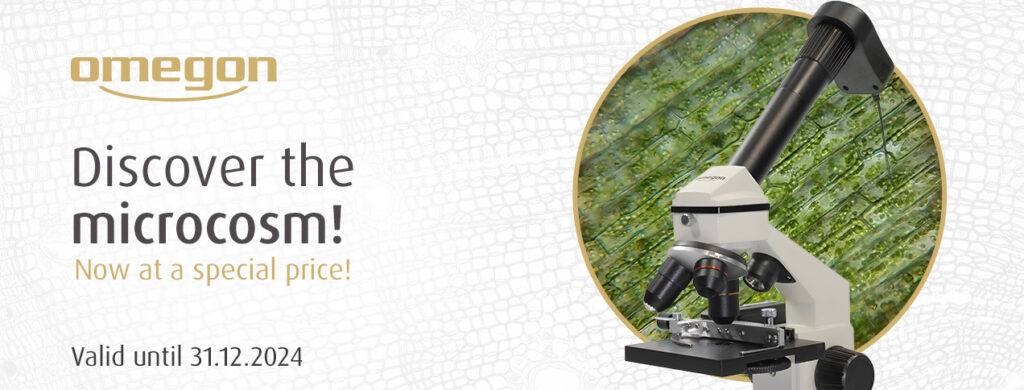
Omegon Monoview: Discover the Microcosm – at a special price!

November 1 2024, Marcus Schenk

Buy the Omegon Monoview microscope now and save 30%.

Promotional period: Nov 15th to Dec 31st,2024

Discover Nature: 20% off the Omegon 40x80mm Spotting Scope

September 17 2024, Marcus Schenk

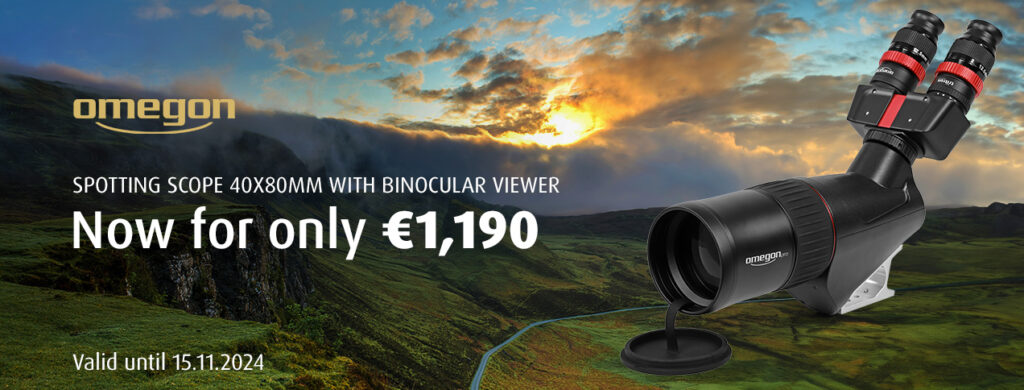
Attention stargazers and nature lovers! Our autumn highlight is here: The high-quality Omegon 40x80mm spotting scope now at a sensational promotional price of just € 1,190.

You can bring nature up close right before your eyes with this powerful bino spotting scope. Don’t miss this unique opportunity!

Save 20% on the Omegon 40x80mm spotting scope from 15/09 to 15/11/2024.

Purchase your personal spotting scope now and enjoy comfortable observations with both eyes!

Sharp stars, clear prices: Omegon Pro Apochromat AP 96/575 on offer

September 17 2024, Marcus Schenk

Have you been dreaming of super sharp and clear astrophotos? If yes, this is something especially for you!

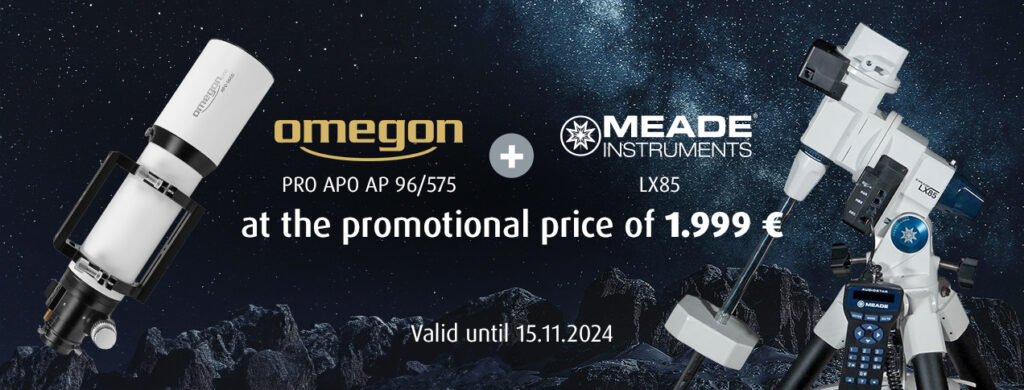
In this special offer you can now get the Omegon Pro APO AP 96/575 (renowned for its fantastic image quality) together with the sturdy Meade LX85 mount for an amazing price of just €1,999.

You save 28% compared to the regular price!

Whether you are a beginner looking for a telescope with particularly clear and high-contrast imaging or an experienced astrophotographer – this offer is a real highlight for both of you. Get it before the price goes up again!

This exclusive timely-limited promotion runs from September 15 to November 15, 2024. So, don’t miss out!

Infographic: Astro Highlights in Autumn 2024

September 1 2024, Marcus Schenk

From encounters with famous planets – thereof two oppositions – up to nights with beautiful meteor showers: The starry fall sky from September to November offers fascinating views for all stargazers.

In the current infographic “Astro Highlights in Autumn 2024” we have compiled the most beautiful of these celestial events.

You are welcome to use the graphic on our website (with a link to www.astroshop.eu) and inform your visitors about upcoming exciting events.


September:

8.9. Saturn in opposition

Saturn is in opposition to the Sun and reaches its best visibility. It can be seen all night long and shines with a brightness of 0.5 magnitudes. It is as bright as the brightest stars in the sky, but is easily recognizable by its yellowish color and steady glow. The ringed planet will reach its highest position – the meridian – only after midnight, making it particularly good to behold in telescopes. Its currently present narrow ring opening is striking, which will continue to diminish until Saturn reaches its edge-on position to Earth in March of next year. This however will not be visible to us because the ringed planet will then be in conjunction with the Sun.

17.9. Moon and Saturn

On September 17th, at 19:15 CEST, we expect a beautiful celestial spectacle: The rising full Moon meets the planet Saturn. The bright Moon and the comparatively weaker Saturn will appear in the evening sky about 5.5 degrees apart. Saturn, which was in opposition to the Sun on September 8th, remains well visible.

18.9. Partial Lunar Eclipse

During the night of September 18th we will experience a glimpse of Earth’s shadow: A partial lunar eclipse. Early birds can perceive the first shadow on the Moon at 4:12am CEST, approaching from the northwest. The maximum coverage of just under 10 percent will be reached around 4:45am CEST. The Moon will finally emerge completely from the Earth’s umbra at 5:18am CEST. Although this is just a minor eclipse, it is a must for all amateur astronomers – keep your telescopes and binoculars ready.

21.9. Neptune in Opposition

On September 21st Neptune reaches its opposition and shines with a brightness of 7.8 mag in the night sky. The planet is visible all night long and can be observed with both telescopes and binoculars. Neptune shows a distinct disc size and a characteristic color appearance in the eyepiece, that clearly distinguishes it from the surrounding stars. Definitely an exciting target for all amateur astronomers.

23.9. Moon meets Jupiter

Just after midnight on September 23rd we can observe the Moon and Jupiter in the constellation of Taurus. Both celestial bodies are about 6 degrees apart. At dawn they will gradually dissipate through the incoming sunlight.

25.9. Moon meets Mars

During the night of September 25th  we can once again observe an encounter between the Moon and Mars. The Moon begins its journey over the Eastern horizon, followed shortly by the Red Planet.


October:

5.10. Moon meets Venus

On October 5th you can observe an interesting celestial event on the western horizon: Venus as the evening star meets the crescent Moon. This encounter will be clearly visible in the evening.

9.10. Draconid Meteor Shower

The Draconid meteor shower peaks on October 9th. Meteors of this shower originate from the constellation of Draco, which is located above the Big Dipper. The activity of these shooting stars can vary greatly, so it is recommended to watch out for the Draconids also several days before and after October 9th.

14.10. Moon meets Saturn

In the evening of October 14th a beautiful conjunction between the Moon and Saturn will appear. Saturn, which was in opposition to the Sun last month, still remains visible all night long. During this time Saturn appears particularly bright and prominent, making it an impressive sight in the night sky. The proximity to the Moon enhances the visual impact and offers amateur astronomers a wonderful opportunity for observations.

21.10. Moon meets Jupiter

During this special night you will experience a close encounter between the Moon and Jupiter in the sky, only about 9.5 degrees apart. Both celestial bodies appear amidst a dense field of bright stars, including Capella, Aldebaran and Betelgeuse.

Capella, the brightest star in the constellation of Auriga, shines intensely and has fascinated observers for centuries. Aldebaran, the reddish giant in the constellation of Taurus, marks the prominent eye of the bull. Betelgeuse, a red supergiant in the constellation of Orion, is one of the largest and brightest known stars.

22.10. Orionid Meteor Shower

On October 22nd we expect a night of shooting stars: The Orionids will spawn about 25 to 30 meteors per hour across the night sky. However, their number can vary greatly from year to year. In order to have the best chances for a clear view, observers should use the early morning hours.

The Orionids originate from the famous Halley’s Comet. When Earth passes through the remnants of the comet’s tail, this annual celestial event occurs. The meteors seem to come from the constellation of Orion, which stands out in the southeastern sky during the morning hours. Unfortunately, the Moon will interfere with the observation this year.

A deck chair or a blanket can be helpful for comfortably looking up at the sky. Warm clothing and hot drinks provide additional comfort during an observation in these chilly morning hours.

24.10. Moon meets Mars

On October 24th there is the opportunity to follow the Moon and Mars almost horizontally side by side in the night sky. These two celestial bodies appear together for a short time, offering a picturesque spectacle.

Mars appears as a bright red dot, contrasting with the silver glow of the Moon’s surface. Together they move slowly across the sky and set as a tandem around 23:00pm CEST. Mars will become brighter and its disc diameter will steadily increase, until it reaches a size of 14 arcseconds during its opposition in January.


November:

5.11. Moon meets Venus

Venus is currently our evening star, but sets before 19:00pm CEST. On November 5th we can admire the slim crescent Moon together with the brightly shining Venus. The young crescent Moon is only four days old and thus only illuminated by 16 percent. A very aesthetic experience.

10.11. Moon meets Saturn

Saturn and the Moon appear together on November 10th at about 5 degrees apart in the constellation of Aquarius, offering a beautiful view in the night sky.

17.11. Uranus in Opposition

Uranus reaches its opposition and presents itself with a visual brightness of 5.6 mag. Theoretically it could be seen with the naked eye, but in practice it is recommended to use binoculars or a telescope for a clear view.

To locate it it is best to use a star chart to approach it. In the telescope Uranus then appears as a small, sharply outlined disc with a slightly greenish hue. This event offers you the best chance to observe the seventh planet of our solar system.

17.11. Moon meets Jupiter

Shortly after dusk we can see the Moon and Jupiter rise above the horizon. They are framed by the constellations Auriga and Taurus, which contain the bright stars Capella and Aldebaran. A little higher above we see the famous Pleiades star cluster.

17.11. Leonid Meteor Shower

In the night of November 16th to 17th the Leonids reach their peak, offering an impressive celestial event with up to 20 meteors per hour. This event is a must for meteor fans!

The Leonids owe their name to the constellation of Leo, from which they seem to originate. The true origin of this meteor shower lies in the comet Tempel-Tuttle and its particles cause these meteor showers every year. Particularly remarkable: Every 33 years, the meteor shower intensifies into a real meteor storm, producing far more than 20 meteors per hour – sometimes even up to several hundreds per hour!

20.11. Moon meets Mars

The last significant celestial event in November is the conjunction between the Moon and the planet Mars. During this night the Moon passes by the planet Mars and continues towards the constellation of Cancer near the beautiful M44 star cluster, which is also known as the “Beehive Cluster”.

For sky watchers this event offers an opportunity to see several objects simultaneously. The red planet Mars, the Moon and the prominent M44 star cluster, which you can easily spot already with a small pair of binoculars.

Buy accessories worth 500 euros and receive a free transport bag or aluminum case!

August 30 2024, Marcus Schenk

A telescope becomes your perfect companion only with the right accessories. With eyepieces, filters, or adapters, you can customize your telescope to your liking. Take advantage of our current promotion!

Our offer:

Buy astro accessories* worth 500 euros and receive an exclusive free gift! Simply choose between the practical “Omegon Transport Bag for Accessories” worth 79 euros or the large “Omegon Aluminum Case” worth 89 euros.

It’s that easy:

  • Select astro accessories* with a total value of at least 500 euros.
  • During the ordering process, enter either “Transport Bag” or “Aluminum Case” in the remarks field below the address information.
  • Our team will include the desired product with your order.

Get your exclusive free gift today!

This special promotion is valid from 09/01/ to 10/31/2024 – only while supplies last.

*Astro accessories such as eyepieces, filters, etc. – except for mounts.

Now: Free accessories with the purchase of Omegon telescopes over € 500

August 15 2024, Marcus Schenk

Are you planning on purchasing a telescope? Now is your chance: If you buy an Omegon telescope for € 500 or higher, Astroshop.de will provide you with valuable accessories for free!

If you have a specific telescope in mind, you can either get the ‘Omegon Premium Zoom Eyepiece 7.2mm – 21.5mm’ with a value of € 139, OR the ‘Easypic Universal Smartphone Adapter’ for € 129 at no extra cost.

To take advantage of this offer simply enter “Zoom Eyepiece” or “Smartphone Adapter” in the comment field below the address section during the checkout process – and you will receive the free accessory.

This promotion is going to run for just 8 weeks, from August 15th til October 15th, 2024. Don’t wait – expand your astronomical equipment and explore the stars with more accessories!

Fewer Color Fringes, More Enjoyment: The Omegon ADC on Sale

August 15 2024, Marcus Schenk

Save right. Not only with color fringes, but also on the price! Get the Omegon ADC Atmospheric Dispersion Corrector now for only 129 Euros – an indispensable accessory for crisp planetary photos.

With this wonderful tool you can effectively diminish color fringes around planets and create clear, sharp images. Simply clamp it between the focuser and the camera – and you’re good to go. A great help for astrophotographers, but also for visual observers!

Take advantage of this special offer and grab the Omegon ADC now at this bargain price!

This promotion is valid only until October 15th, 24 and while supplies last.

Top Deal: 3 Omegon Super-LE Eyepieces for €399 – Save 50% Now

August 1 2024, Marcus Schenk

In August and September 2024, another gateway to the stars is opening! Our high-quality Omegon eyepiece set is now available for over 50% off during a limited time. Take this opportunity to upgrade your equipment accordingly!

The Omegon Super LE eyepieces impress with a 68° wide field of view, offering you a large and stunning look of the night sky.

1. Each eyepiece features high sharpness towards the edges, allowing you to see even the finest details clearly at the edges.

2. The comfortable viewing experience with a 20mm eye relief ensures pleasant observations, even during extended use.

The high-quality craftsmanship and superior optics make the Omegon Super LE eyepieces an excellent choice for demanding amateur astronomers.

The eyepiece sets are available in two versions:

Don’t miss this deal: Half the price for an outstanding performance! The promotion is only running from August 1st to September 30th, 2024. As long as supplies last.

Infographic: Astrohighlights in Summer 2024

June 5 2024, Marcus Schenk

Warm summer nights under a clear sky – this is not only a beautiful sight for amateur astronomers. Of course the nights are now particularly short, but even in the astronomically bright sky we can observe wonderful events. How about a first-class planetary meeting, a close encounter between Spica and the Moon and the long-awaited occultation of the planet Saturn by the Moon? We are certainly also looking forward to the shooting stars in August.

In the current infographic “Astrohighlights in Summer 2024” we have compiled the most beautiful celestial events.

Feel free to use the graphics on your website (with a link to www.astroshop.eu) and also inform your visitors about upcoming exciting events.


June
3.6. Mars meets the Moon
A celestial spectacle awaits early birds on June 3rd. As you look East at dawn, you will witness the reddish Mars and the thin crescent Moon forming a close conjunction – separated only by 2.6 degrees in the sky. This cosmic meeting is not only a fascinating sight, but also a great opportunity for astrophotography.

11.6. The Moon meets Regulus
A celestial view that looks almost royal can be admired tonight: The Moon joins Regulus, the bright main star of the constellation of Leo. The Moon will accompany the majestic lion for two more days, before continuing its journey and entering the next constellation.

16.6. Spica meets the Moon
On June 16th you can pay attention to a close meeting in the night sky between the Moon and Spica, the main star in Virgo. The two approach each other at a distance of only 0.25 degrees. Almost a “cosmic kiss” between these two celestial bodies. Spica, often occulted by the Moon, stays out of an occultation tonight. However, the short distance to the Moon offers an excellent opportunity for observers and photographers to capture this event. So get your telescopes and cameras ready!

27.6. The Moon meets Saturn
In the night of June 27th to 28th the Moon will be relatively close to Saturn. The Moon will approach the ringed planet during its journey and it will almost appear, as if our Moon is going to cover Saturn. From our latitude however, this phenomenon is not visible, as the Moon and Saturn are only visible after midnight. Unfortunately there is no occultation now – we have to wait a bit longer for such an event.

28.6. The Moon meets Neptune
While the rest of the World is still asleep in the early hours of June 28th, the Moon slowly moves towards Neptune – the distant gas giant on the outer edge of our Solar System. With a telescope we can try to catch a glimpse of this planet. Due to its great distance, it appears only as a small disk without recognizable details.

July
1.7. Comet 12P/Olbers
Comets are visitors to the inner Solar System before they disappear for a long time into the outer regions thereof. Once in a while it does happen that they are becoming really bright objects. This year we have already had the luck to observe the comet 12P/Pons-Brooks. In July a relatively bright comet can be seen in the sky: The comet 12P/Olbers. It will reach a brightness of 7.5 mag at the beginning of the month and can be seen with binoculars or a telescope. Unfortunately it is close to the horizon, thus making an observation not so easy. First you should find a location with a unobstructed view of the horizon. In addition, the horizon must be crystal clear, because even small or thin clouds can disturb the observation. If the conditions are good, you should definitely try to observe it!

2./3.7. The Moon meets Jupiter, Mars, Uranus and the Pleiades
The dawn of July 2nd and 3rd offers a beautiful celestial spectacle: The thin crescent Moon meets the planets Jupiter, Mars and Uranus during the night. All these objects are located near the famous Pleiades star cluster. This constellation offers an excellent opportunity for astrophotography in order to capture the meeting of these different celestial objects.

6.7. Ceres in opposition
In the night of July 6th Ceres, the largest dwarf planet in our Solar System, will reach its opposition point. This means that it appears to stand directly opposite to the Sun and is therefore visible all night long. With a brightness of 7.3 mag, Ceres is theoretically visible even with binoculars under favorable conditions, although a telescope is recommended for the observation. Due to its star-like appearance, it is necessary to use a star map to undoubtedly identify Ceres in the starry sky. Being without the distinctive features of a planet, the observation of Ceres requires careful planning and observation.

15.7. Mars meets Uranus
In the early morning of July 15th, it is worth looking at the sky when Mars passes by just below Uranus. The two planets will approach each other just shy of half a degree. This means they will appear in the same field of view in a telescope with a wide-angle (<65°) eyepiece. Have you seen this before? A good opportunity tonight. However, you may start observing only after 2 a.m. onwards. In the course of this night, both planets will rise higher in the sky, improving their visibility and observability.

23.7. Pluto in opposition
The dwarf planet with the big heart will be in opposition to the Sun today and will reach a brightness of 14.3 magnitudes. Therefore this former planet is only visible with large telescopes. It is however possible to image it with smaller telescopes. For the mere observation search charts are recommended.

30.7. Delta Aquarids
Watch out for the Delta Aquarids on July 30th. These meteors appear in the constellation of Aquarius and reach a maximum rate of 25 each per hour. The best time for observation is before midnight, as the Moon will appear above the horizon during the second half of the night. An interesting event for all who love shooting stars.

30.7. The Moon meets Mars, Jupiter, and Uranus
In the early morning of July 30th the Moon, Mars, and Jupiter can be observed in a striking constellation, close to the most famous star cluster – the Pleiades. Framed by the prominent stars Aldebaran and Capella, they create an impressive picture in the night sky. If you look into the sky at the beginning of dawn, you can really only admire this beautiful sight.

August
12.8. Perseids
A cosmic performance unfolds in the vast and rich nightsky of August: The Perseid meteor shower.
The Perseids, as they are called by astronomers, shoot numerous times across the sky this evening and we look up with anticipation. Perhaps we will discover bright examples that we can particularly enjoy.
The media often promises a “spectacular fireworks display of 100 shooting stars per hour, a true rain of shooting stars”. This is often an exaggeration, but even without exaggerating the Perseids can be a sensory and fascinating experience for us.
The Moon is now in its first quarter and will set before midnight. After that we can observe in darkness and undisturbed by stray light. All that’s missing is a comfortable blanket, a warm tea and friends who are enthusiastic about observing – so this evening may become a true success.

14.8. Mars meets Jupiter
In the early hours of August 14th a remarkable event will take place for observers, as Mars and Jupiter will approach each other at an extremely close distance of only 0.3 degrees. This short distance is extremely rare compared to the usual distances between planets in the sky and will appear almost, as if the two planets are touching. An ideal opportunity to grab binoculars or a telescope and observe the event. You can see both planets in one field of view, even at high magnification – a spectacular sight that does not happen very often.

21.8. The Moon covers Saturn
In the night of August 21st a very special spectacle presents itself: The Moon will cover the planet Saturn. Although the Moon and Saturn are already visible during the evening hours, the actual occultation does not occur until the early morning hours. At 5:32 a.m., when the Moon approaches Saturn from its illuminated side, the occultation begins. The ringed planet disappears behind the Moon for about an hour and then re-appears around 6:32 a.m. on the unilluminated side of the Moon. At that time the Moon will still be above the horizon, although the Sun will have already risen about 10 minutes earlier.

26.8. The Moon meets the Pleiades
On August 26th an interesting astronomical encounter will take place: The Moon will be in the famous Pleiades star cluster. Additionally, the Moon will move from the West towards the bright star Atlas and cover it in the early morning hours (from 5:40 a.m.). That is not all however, because in the constellation of Taurus there is still more to discover: If you look a little lower, you will find the planets Mars and Jupiter. The planet Uranus is in the same constellation as well, but since it is only visible with binoculars or a telescope, you will need a search chart.

27.8. The Moon meets Jupiter and Mars
In the night of August 27th it is worth looking again at Taurus, which appears above the horizon in the second half of the night. The constellation is accompanied by the planets Jupiter and Mars. Especially at early dawn, when the sky turns blueish, they form an incredibly beautiful trio together with the waning Moon.