Your partner for astronomy

Posts Tagged 'binoculars'

Blog Archives

New binoculars from ZEISS: SFL series

December 15 2022, Stefan Taube

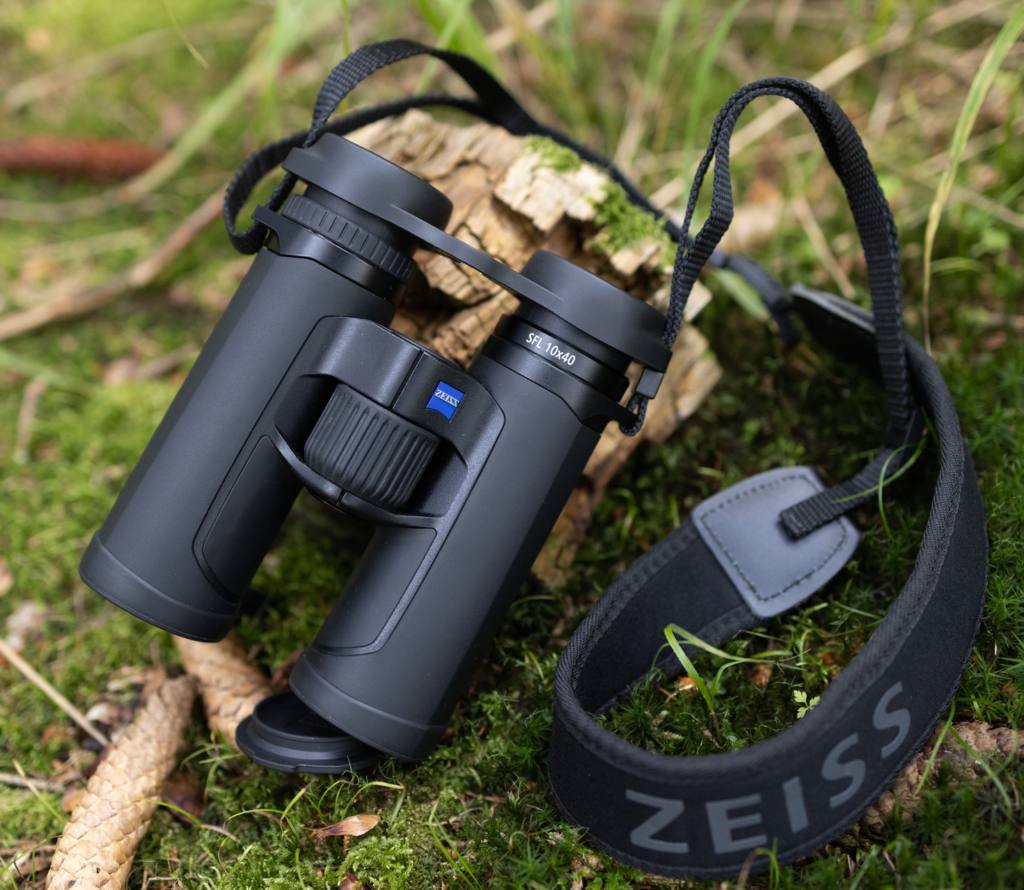
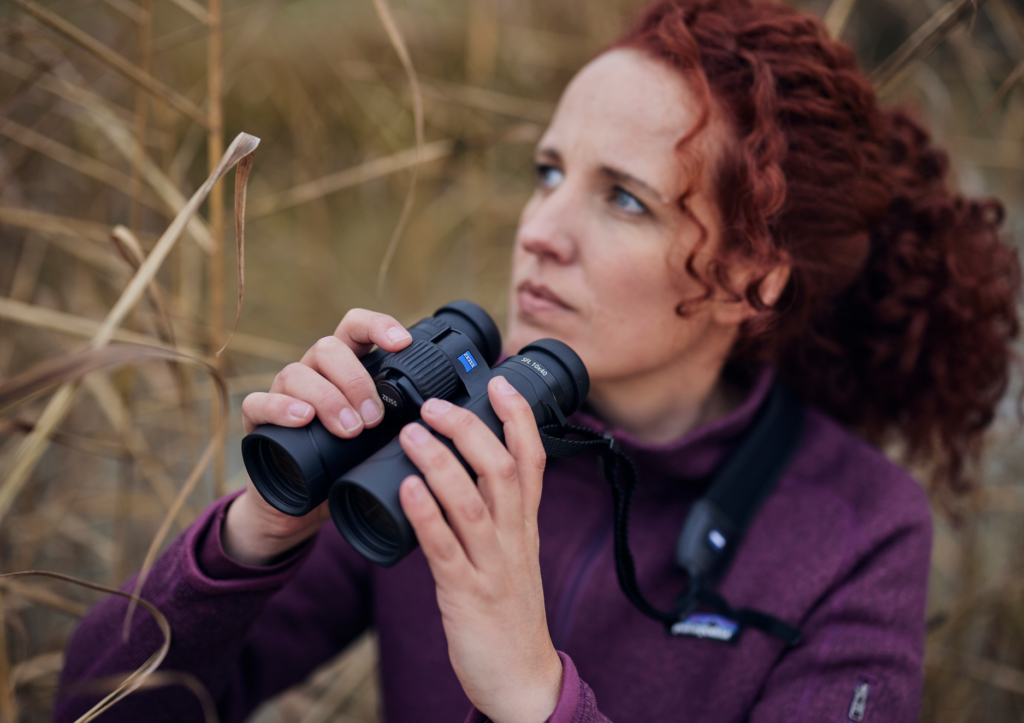
True lightweights among high-performance binoculars: ZEISS SFL

  • Ideal for observing birds and other animals!
  • Very lightweight and compact for nature walks!
  • Very high quality ZEISS lenses for lifelike colours and fine details!

ZEISS SFL

With the ZEISS SFL binoculars (SmartFocus Lightweight) special moments can be easily experienced. The binoculars are optimised so that they are as lightweight and compact as possible.

The new ultra-high definition (UHD) concept provides lifelike colour reproduction and ultra high detail. Thanks to its SmartFocus design, the focusing wheel is perfectly positioned and enables fast precision focusing – even when wearing gloves.

The optimised ergonomics and a large exit pupil provide a relaxed, undisturbed view.

The binoculars are available in the following versions:

ZEISS SFL


Omegon Pro Kolossus – the new mount for large binoculars

February 24 2022, Marcus Schenk

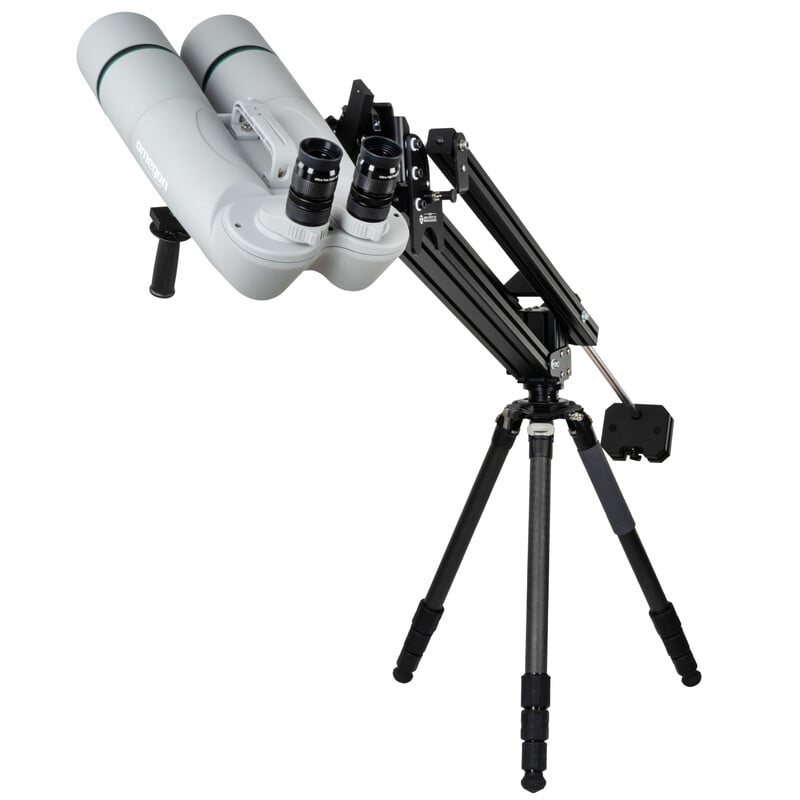
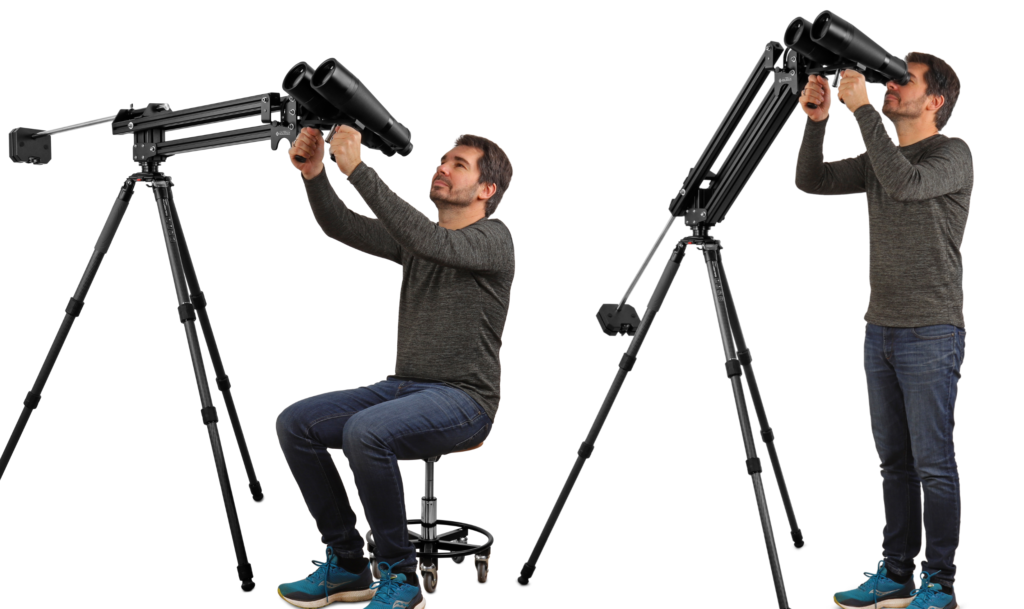
Large binoculars with diameters of 80mm or 100mm are almost reminiscent of a double refractor. So how can such heavy binoculars be used practically in the skies? With the new Kolossus parallelogram mount!

Using this, you can move heavy instruments like a feather across the sky.

Großfernglas auf Parallelogramm Montierung

Simply attach binoculars with a level view or an angled scope and then surf the skies. This is a good way to describe using your binoculars under the stars. Turn the mount in any direction you desire. Without having to tighten axles or kneel on the ground in awkward positions. Simple, natural and comfortable.

Different than usual

Normal tripods are small, too weak and you often need to position yourself awkwardly until you’re able to see an object. With the Kolossus parallelogram mount all that is history. You can move your binoculars upwards, downwards, to the right and to the left always in a relaxed position. This does not only lead to comfortable and more intensive observations – you also see more!

Parallelogramm Montierung für verschiedene Körpergrößen

Observe together

Your binoculars move where you want them to go! Observe when lying down, on a stool or sitting normally. Thanks to the huge swivel mechanism, you have complete freedom when observing. What would it be like to observe with others? This is easy with the Kolossus mount as height differences are not a problem. Within seconds, you can lower the binoculars and also let your children observe with you.

The Kolossus mount was specially-designed for large binoculars. The sturdy swivel arm allows for 360 degree rotation so that you can reach almost every point in the skies. When packed up, the new wonder mount fits into a practical carry bag. Optimal for transportation to the observation site. All you need are your favourite binoculars and a sturdy three-legged tripod. And your new observation sensation can begin.

Want to observe more simply and naturally? View the Omegon Kollossus parallelogram here.

A review of Omegon’s 2.1×42 wide-field binoculars by Sky&Telescope

June 24 2021, Marcus Schenk

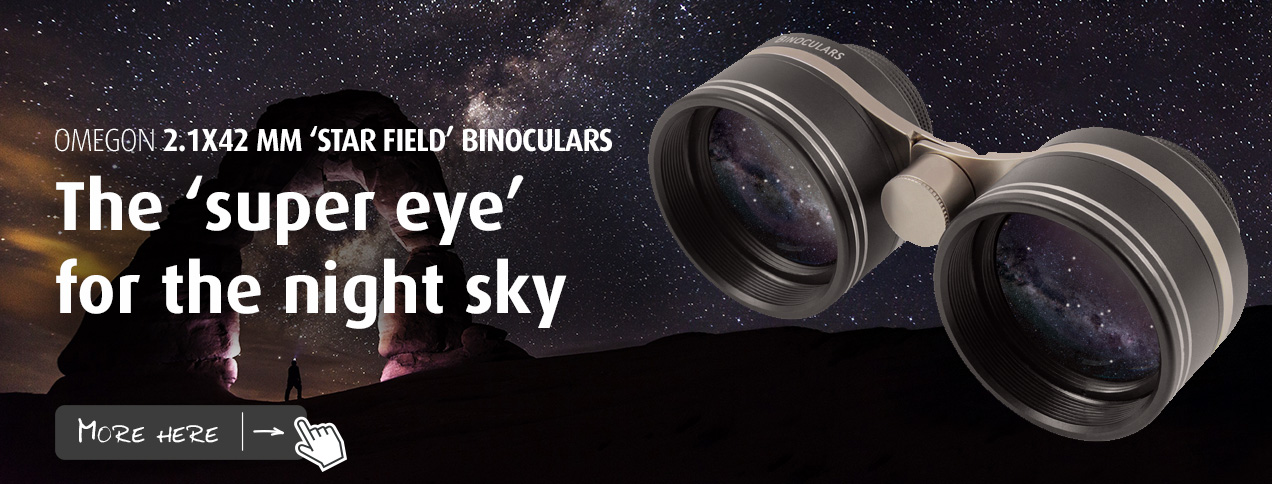
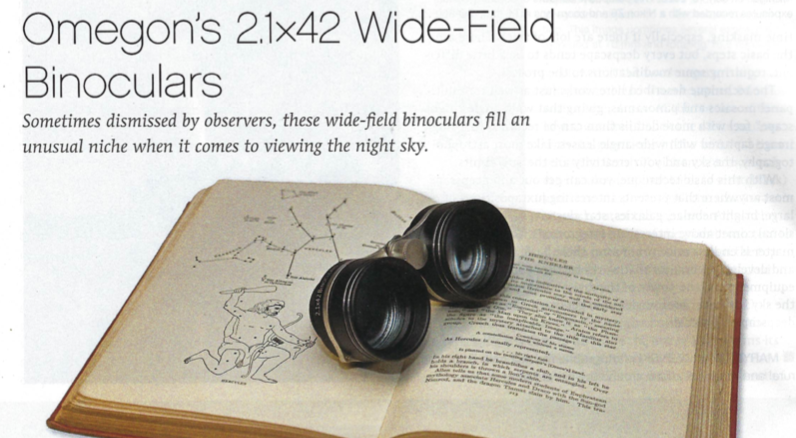
This Omegon 2.1x42mm star field binoculars is a great instrument for observing star fields, extended nebulae and entire constellations. Dennis di Cicco reviewed the Omegon star field binoculars for the astronomy magazine Sky&Telescope.

With a 42mm aperture and a magnification of 2.1x, the star field binoculars are truly remarkable. They offer a new observing experience that was previously not possible with binoculars and telescopes. This is also a reason why Sky&Telescope took a close look at this instrument. Among other things, the magazine liked its simplicity and compactness, the huge field of view, and the deep view of the sky. The author of the review was able to fully capture the constellations of Swan, Orion, Gemini, Wagoner, Perseus and others, as well as some deep sky objects or double stars like Algol.

Testbericht Omegon Sternfeldglas

Here are some quotes from the actual review:

Very well made

Excellent aid for learning and enjoying the night sky under less-than-ideal conditions

The Omegon 2.1×42 Binoculars are definitely a joy to use

I was seeing stars more than 1.5 magnitudes fainter in my suburban sky

Whether on vacation or on a hut tour through the Alps, the Omegon star field binoculars make beautiful observations possible even where you have no room for a telescope or binoculars. They also serve as a small observation treat from time to time. There is always a place in the (travel) bag for these Omegon 2.1×42 star field binoculars.

C/2020 F3 (NEOWISE): A new comet in the spotlight?

July 10 2020, Marcus Schenk

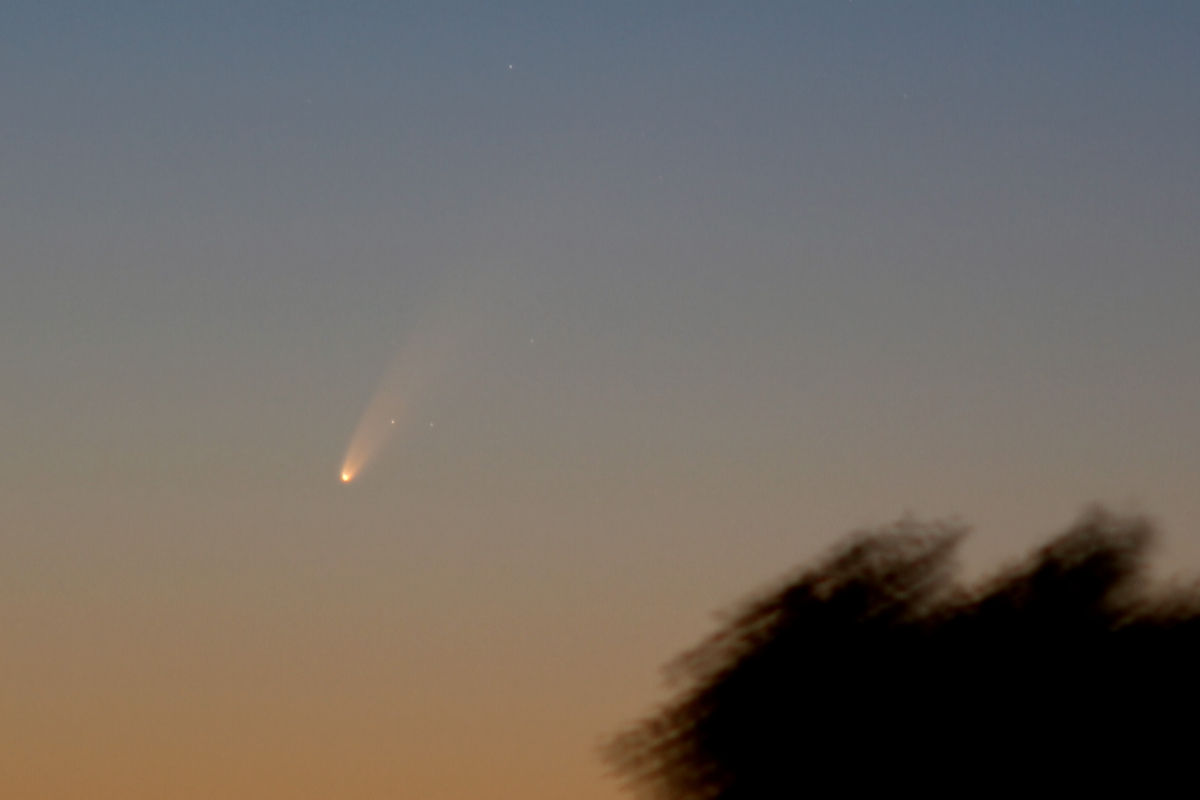
A star on the celestial stage? Or quietly disappearing through the stage door? Another promising comet is currently travelling through the solar system. But what kind of performance can we expect from C/2020 F3 (NEOWISE)? Predictions are creating suspense …
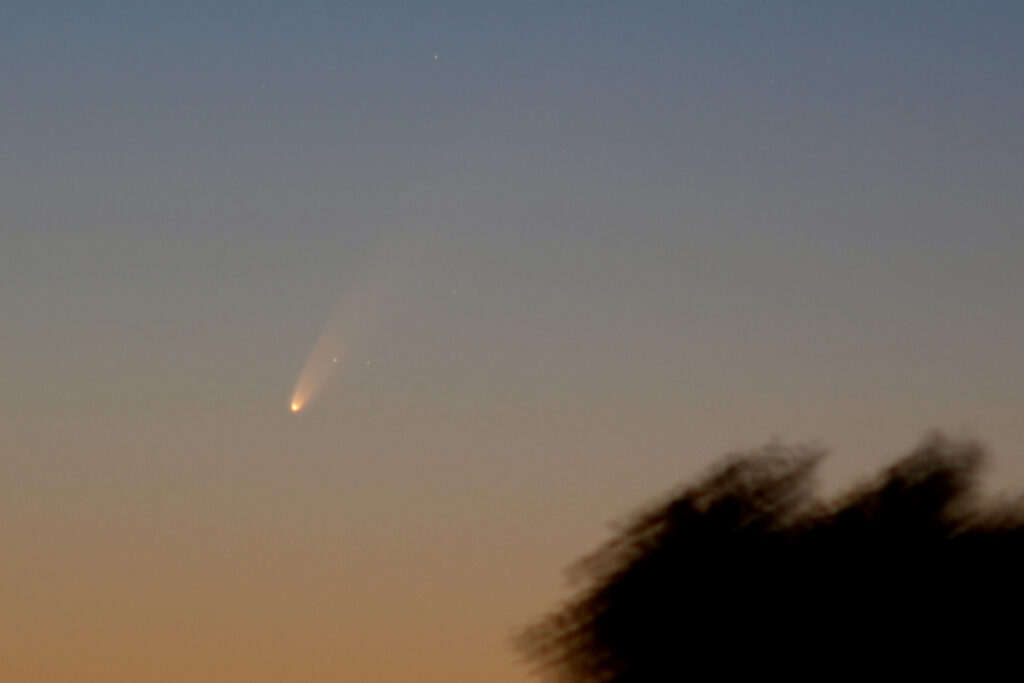
Komet F3 NEOWISE

Comet C/2020 F3 (NEOWISE)

It all kicked off in spring with the Y4 ATLAS comet: There were already rumours that it could be the Great Comet of 2020 as it was following a similar trajectory to the Great Comet of 1844. This reached a magnitude of -1 back in its day. In reality, comet Y4 ATLAS put on a good show until it suddenly disintegrated. Now its debris is continuing to travel through the solar system but the great experience failed to materialise. We were also able to see comet C/2017 C2 (Panstarrs) periodically but this also failed to meet expectations.

The wonderful new appearance of a bright comet – C/2020 F3 (NEOWISE)

But the Universe is always full of surprises: The new comet C/2020 F3 (NEOWISE) was discovered as a faint magnitude +17 firefly on 27 March by the NEOWISE Space Telescope. The comet talent scouts amongst the scientists are now predicting it will have a bright future. Whispered rumours say it could reach a magnitude of +0.6. What? No. Yes! But keep your voice down.
Where is the comet now and when can I observe it?

Pay attention, the most important information is coming up.
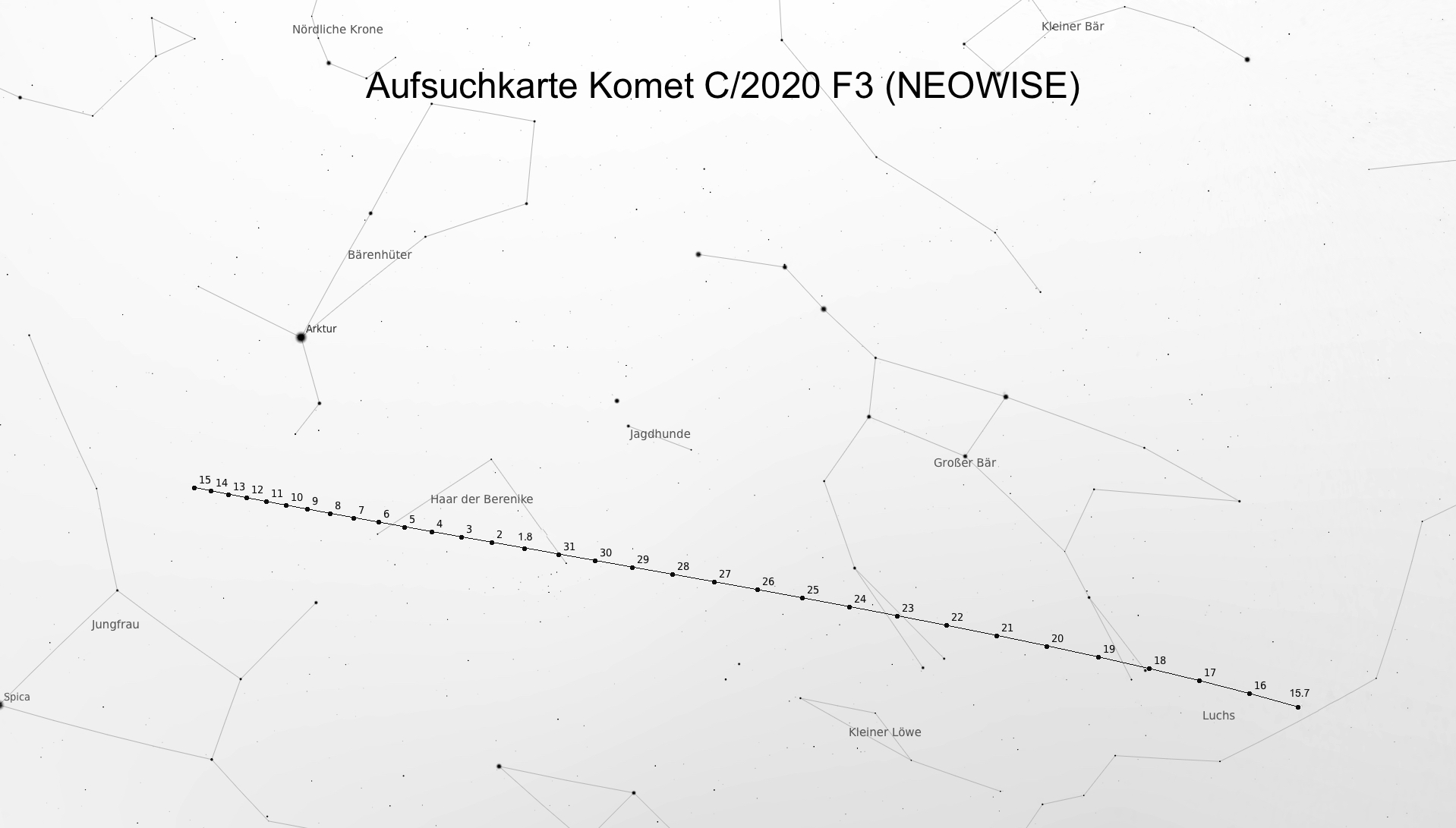
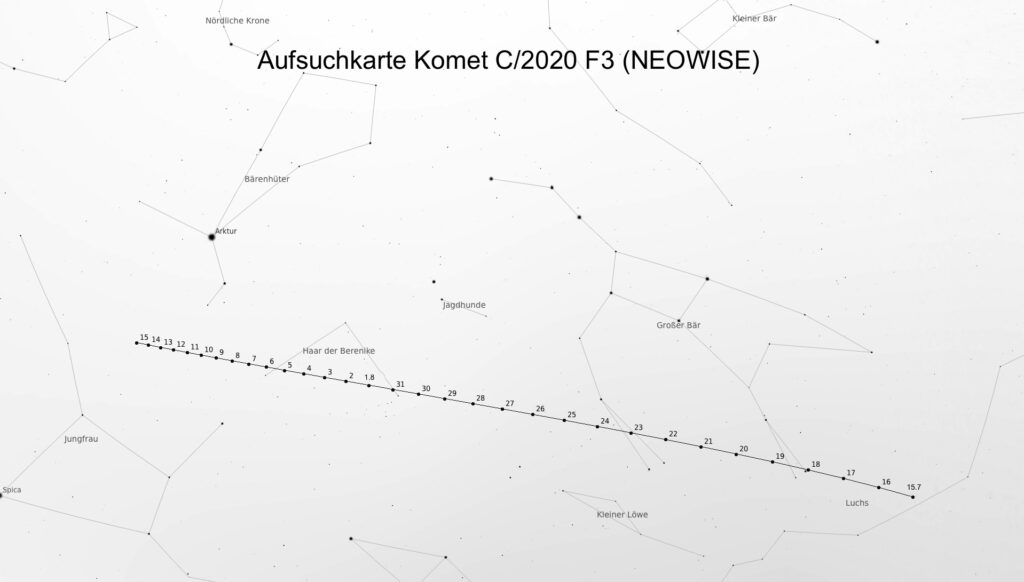
Comet NEOWISE is currently located in the southern sky but it is slowly moving into the northern sky and is climbing higher each day. From 15 July, you will be able to marvel at it in the evening sky (from 22:30) at 15 degrees above the north-western horizon. Unfortunately, its position close to the Sun means that you cannot see it all night long. In the following days it will traverse the Lynx constellation (which is rather faint) on its way to the Great Bear’s front paw. You only have a small window of time after twilight – but it’s worth it.

Telescope, binoculars or the naked eye?

If the experts are right, NEOWISE will reach a magnitude of +0.6 on 5 July during its perihelion. But it is also supposed to glow with an impressive magnitude +2 on 15 July . This would mean it was a comet for your telescope, any binoculars you can envision – and even for the naked eye.

Of course, its journey does not end mid-July: over the course of the month it wanders further along the Great Bear’s paw and reaches the amazing Coma Berenices (Berenice’s Hair) on 1 August. During this time, it leaves its magnitude behind, dimming to magnitude +3 by 20/07 and to magnitude 5.5 by 1 August. But even then it will be an attractive object. Partly because it will then be somewhat darker and the comet could gain more than 10 degrees of additional altitude.

Will we be able to finally break out of the vicious circle of faint comets? We will see. Have fun observing.

You can download a PDF of the star chart here: C:2020 F3 NEOWISE star chart.