

 Subscribe to

At the end of the year, ZWO is lowering prices on numerous products.
Take advantage of this offer until January 3, 2027. You can find all discounted items here in our shop.
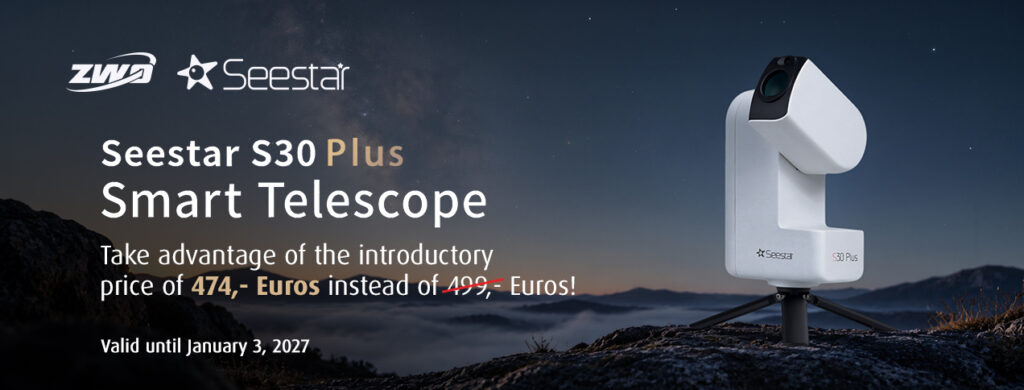
The new Seestar S30 Plus is the latest addition to the Seestar family and is ideal for beginners exploring the world of smart telescopes.
Take advantage of the special introductory price until January 3, 2027, and order yours directly here in our shop!
Candlelight and the smells of freshly brewed coffee and just-baked biscuits: it could all be so tranquil.
Instead, for most of us, the weeks before Christmas are the most stressful of the year. The children are moody and you still haven’t bought the tree. Phew!
How can this be a good time to research buying your first telescope?
Luckily, you don’t have to.
In the guide “Telescopes for beginners“, we show you how, in just a few minutes, you can find a telescope which will take you from your balcony directly into space. Together with suitable recommendations that will ensure that the parcel under the Christmas tree will bring you endless pleasure.
Read our buying guide: The best telescopes for beginners.

Still searching for the perfect gift? It’s not that easy, is it? Yet, every year this question sneaks back into our minds.
What if you didn’t have to worry about this at all this time? Just take a look at our gift page. You will find countless ideas for big and small astronomers there – and for those who want to become one.
Gifts for Astronomy Beginners: Useful gifts for getting started in Astronomy
Gifts for Hobby Astronomers: Even expert stargazers love to receive gifts!
Gifts for Nature Enthusiasts: Binoculars for observing birds and other animals
Gifts for Children and Teens: Ideas for young nature enthusiasts
Special Gifts: Looking for something extraordinary or particularly elegant?
Gifts for Hobby Microscopists: For everyone who loves discovering the world in miniature!
Get inspired and discover the most beautiful gift ideas!

The Holidays are coming…
Christmas has snuck up on us again this year. Still looking for a Christmas gift? You don’t want to spend hours with saint-like patience searching for telescopes and accessories, however?
Especially during the “peaceful” Advent season most people hardly have time for that. In order to facilitate some of this stressful Holiday time for you we have the perfect solution!
With our telescope gift sets you’ll find the right present for your loved ones. Eyepieces, filters and star charts are already included – ready to take the recipients into the sky , as if they were riding on one of Santa’s reindeers.
Take a look at our telescope sets!
We wish you a joyful Advent season!
November brings us dark skies for deep-sky observing – and a very special planet parade that you won’t want to miss. Here are three good reasons to catch it right now.
Planets are a great target, especially for beginners: most of them shine brightly and reveal details even in a small telescope. And right now, five planets are in the sky at the same time – in the hours after midnight. That doesn’t happen every month, so it’s the perfect excuse to point your telescope at our neighbours.
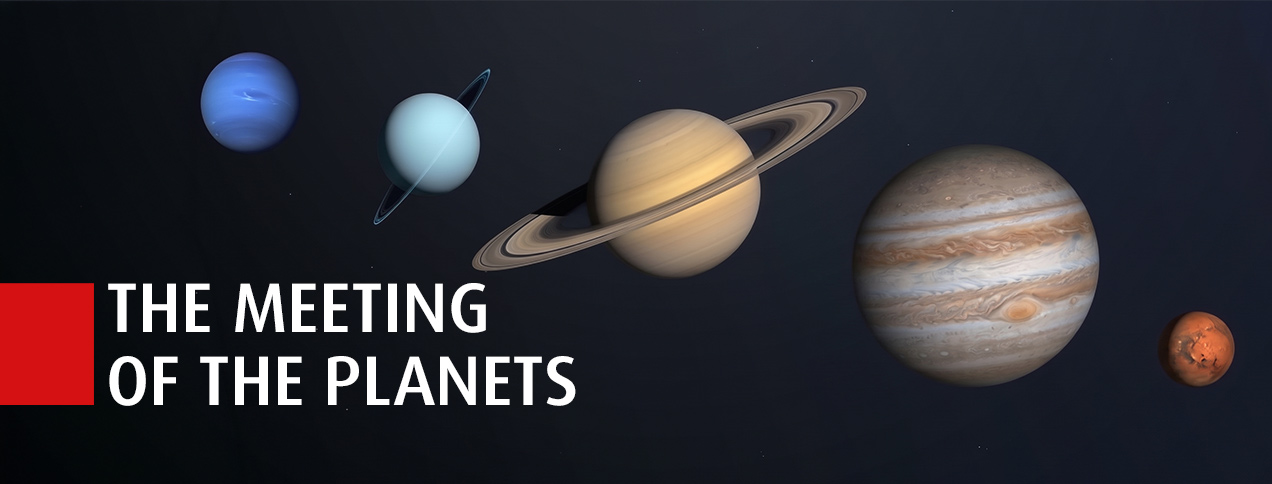
From 10 November until early December, Mars, Jupiter, Saturn, Uranus and Neptune are all in the sky together every night. Between roughly midnight and 2 a.m., each of them stands at least 10 degrees above the horizon – Uranus even reaches almost 60 degrees. The whole parade stretches across about 144 degrees of sky. The best time to observe is between 10 and 17 November, when there’s no moonlight to spoil the view.
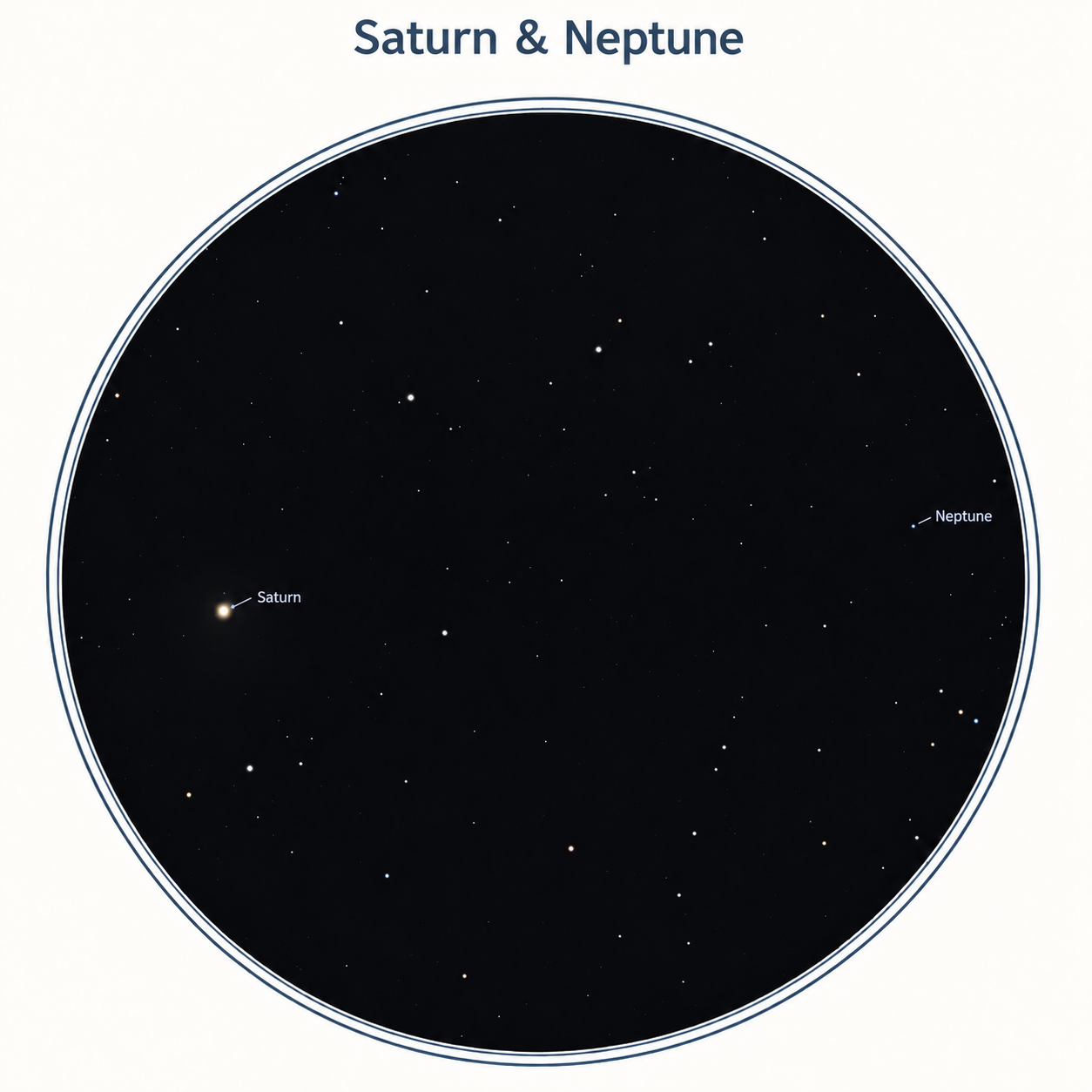
You’ll find Saturn in the south as early as the evening. It shines well below the constellation of Pegasus in a region with few bright stars. To be precise, it’s in the constellation of Cetus, the Whale, which contains many faint stars and is only easy to make out under a truly dark sky. Our ringed planet, however, stands out brightly. Even a small telescope shows the rings. At the moment they’re only slightly open and appear as a narrow, bright band on either side of the planet’s disc.
To see a real planet parade, though, you’ll need to wait until around midnight. By then Saturn has moved towards the southwest, and more planets rise in the east until all five are finally in the sky.
Neptune lies close to Saturn but is invisible to the naked eye. At magnitude 7.7, you’ll need at least a pair of binoculars – or better still, a telescope with higher magnification. At first it looks like a star, but with a finder chart you can identify it as a planet. Neptune is just under 7 degrees from Saturn. In wide-angle binoculars with a large field of view, both planets just fit into the same field. With 10×50 binoculars, simply sweep across from Saturn.
This time, Uranus is the planet in the middle of the line-up. It sits high in the sky in the constellation of Taurus, between the Hyades and the Pleiades. On 25 and 26 November it reaches opposition. At magnitude 5.6, it is theoretically visible to the naked eye under a very dark sky. Around opposition, however, the full Moon gets in the way – on 24 November it is only a few degrees from Uranus. So observing it is much more fun with binoculars or a telescope. The Pleiades lie a good 5 degrees away, and in wide-angle binoculars both appear together in the field of view. In a telescope, Uranus shows a small, greenish-blue disc.
Now let’s turn to the east. Low above the horizon, two bright planets appear: Jupiter and Mars.
Together, Mars and Jupiter make a striking contrast. Mars impresses with its orange-red colour, while Jupiter immediately catches the eye with its brilliant shine – it is almost 12 times brighter than Mars. On 16 November, the two are only 1.2 degrees apart, with the bright star Regulus sparkling right next to them. With an ultra-wide-angle eyepiece, you can even fit both planets into a single field of view around this date. The Omegon Panorama II eyepieces with a 100-degree apparent field of view, used at magnifications up to about 60x, are ideal for this. If you want to observe the two planets in detail, it’s best to wait a little longer. In the early morning hours they stand much higher. You’re then looking through less air, the image is steadier and the details are sharper.
As a bonus, the Leonids deliver a lovely finale on the night of 17 to 18 November. Their radiant lies in the constellation of Leo – exactly where Mars and Jupiter are. After moonset at around 11:30 p.m., your chances of spotting shooting stars are best.
Get ready with the right equipment now: a telescope, a pair of giant binoculars or the right eyepieces.
Tip: Two great telescopes for observing nebulae & planets are the Omegon telescope N 153/750 EQ370 and the Omegon Dobson telescope Advanced X 203/1200.
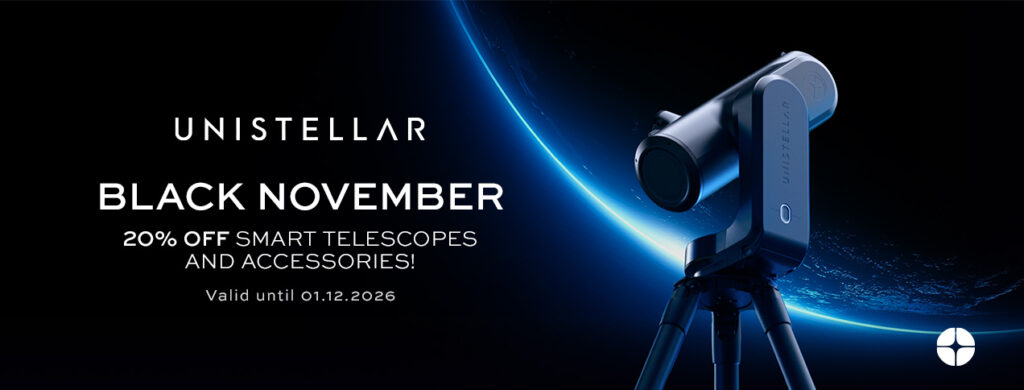
Until 1 December 2026, the French manufacturer Unistellar is offering a 20% discount on all products!
This applies in particular to the outstanding and very popular eVscope 2 Smart Telescope. Make the most of this great opportunity to get started with smart stargazing and astrophotography!
You can find all Unistellar products here in the shop.

Ten years ago, Vaonis revolutionised astronomy with the launch of its smart telescopes. Feedback from amateur astronomers led to a crucial realisation: the mount, precision mechanics and electronics are designed to last for years. The optics and sensor, on the other hand, benefit from rapid technological advances and should therefore be replaceable.
This philosophy gave rise to Atlas – a modular smart telescope that will be available in two versions:
Secure your pre-order price now and benefit from particularly attractive terms until 15 November 2026!
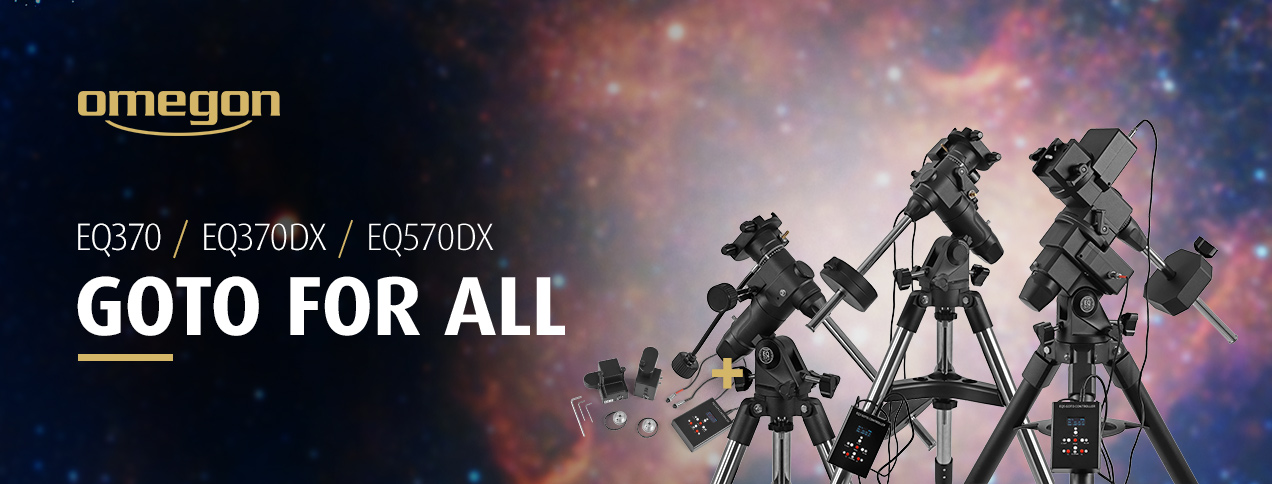
The new Omegon EQ mounts: From a flexible entry-level platform to a fully equipped all-round solution. With the new EQ series, Omegon offers mounts tailored to every requirement and budget – whether for an easy introduction to the hobby or as a reliable all-rounder for visual observing and astrophotography.
Omegon EQ370
Flexible entry with future-proof options: Many beginners are not yet sure whether they want to observe manually or opt for computer control right from the start. The EQ370 solves this dilemma: It offers a stable mechanical platform at an affordable entry-level price and can be upgraded with a GoTo system at any time and at low cost.
Omegon EQ370DX
Convenient computer control at a budget price: In practice, observing often becomes frustrating because of the time-consuming search for objects. The EQ370DX combines the solid mechanics of the EQ370 with an integrated GoTo control system. This allows you to find your desired targets at the touch of a button and effortlessly make full use of your optics – all at an unbeatable price-performance ratio.
Omegon EQ570DX
The portable all-rounder with a complete feature set for ambitious amateur astronomers looking for a versatile all-in-one package: The EQ570DX supports optical tubes with apertures of up to 20 cm, remains easy to transport and offers cutting-edge technology for well under €1,000. In addition to its solid mechanics, it stands out for its highly flexible control options – either conventionally via hand controller, wirelessly via Bluetooth/Wi-Fi on a smartphone, or through USB integration into a professional astrophotography setup, including guiding.

For a limited time only, NIKON is offering an instant discount of up to €150! We have already deducted the discount from the retail price.
The following models are on offer:
Don’t miss out – the discount is only valid until 20 October 2026!