Your partner for astronomy

Author Archives


Marcus Schenk

Marcus Schenk

Posts composed by Marcus Schenk

Blog Archives

Omegon Pro Kolossus – the new mount for large binoculars

February 24 2022, Marcus Schenk

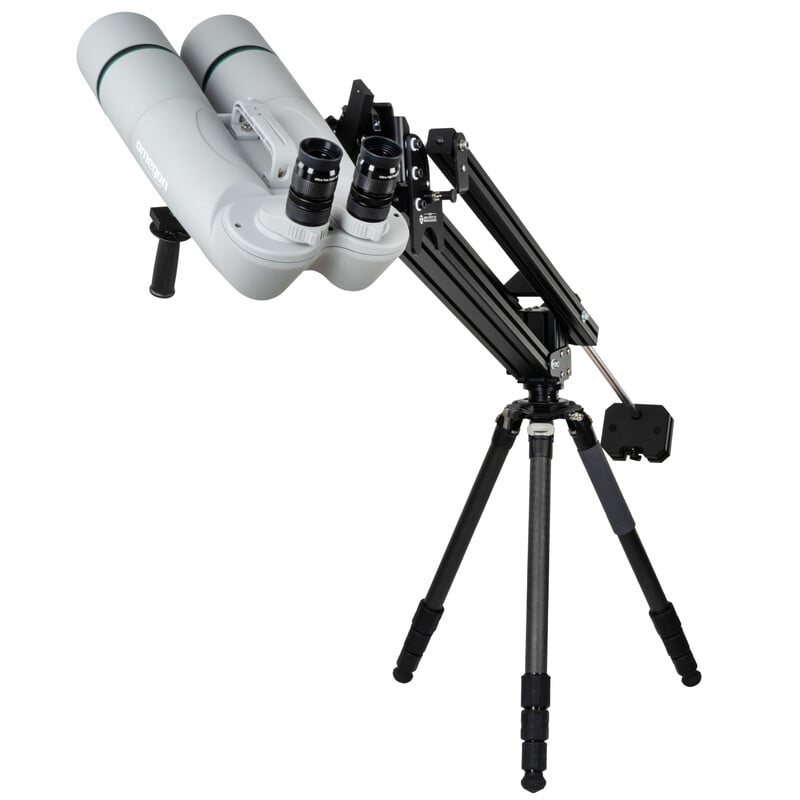
Large binoculars with diameters of 80mm or 100mm are almost reminiscent of a double refractor. So how can such heavy binoculars be used practically in the skies? With the new Kolossus parallelogram mount!

Using this, you can move heavy instruments like a feather across the sky.

Großfernglas auf Parallelogramm Montierung

Simply attach binoculars with a level view or an angled scope and then surf the skies. This is a good way to describe using your binoculars under the stars. Turn the mount in any direction you desire. Without having to tighten axles or kneel on the ground in awkward positions. Simple, natural and comfortable.

Different than usual

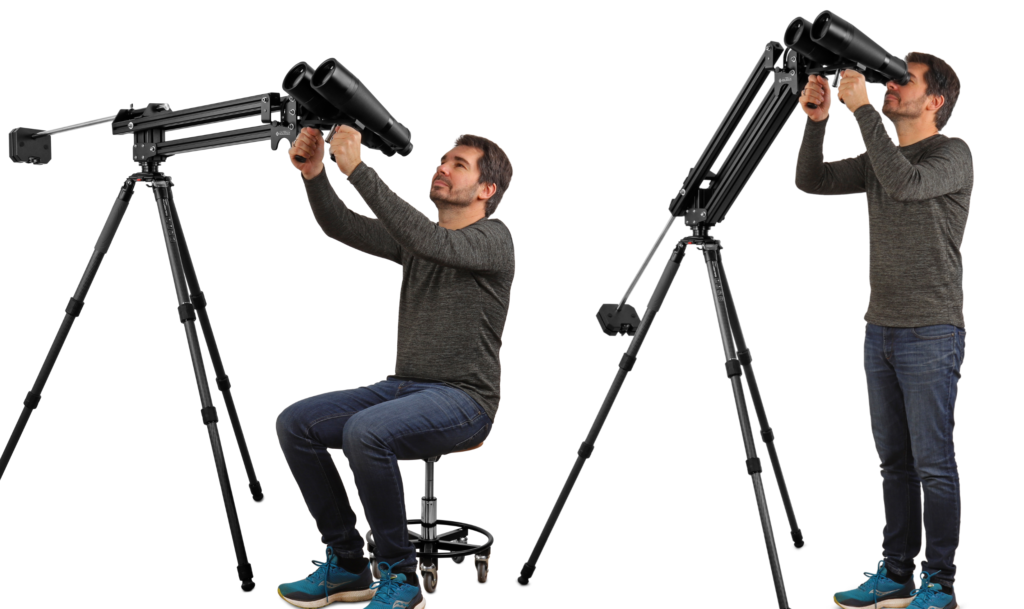
Normal tripods are small, too weak and you often need to position yourself awkwardly until you’re able to see an object. With the Kolossus parallelogram mount all that is history. You can move your binoculars upwards, downwards, to the right and to the left always in a relaxed position. This does not only lead to comfortable and more intensive observations – you also see more!

Parallelogramm Montierung für verschiedene Körpergrößen

Observe together

Your binoculars move where you want them to go! Observe when lying down, on a stool or sitting normally. Thanks to the huge swivel mechanism, you have complete freedom when observing. What would it be like to observe with others? This is easy with the Kolossus mount as height differences are not a problem. Within seconds, you can lower the binoculars and also let your children observe with you.

The Kolossus mount was specially-designed for large binoculars. The sturdy swivel arm allows for 360 degree rotation so that you can reach almost every point in the skies. When packed up, the new wonder mount fits into a practical carry bag. Optimal for transportation to the observation site. All you need are your favourite binoculars and a sturdy three-legged tripod. And your new observation sensation can begin.

Want to observe more simply and naturally? View the Omegon Kollossus parallelogram here.

Helping children: Astroshop donates €10,000 to UNICEF

December 22 2021, Marcus Schenk

The smell of freshly baked biscuits hangs in the air, poinsettias glisten, and our thoughts turn to the gifts we might find under the Christmas tree. But it is also time to reflect and ask ourselves whether there are people in the world who are less fortunate than we are? Unfortunately, there are many. That is why Astroshop is donating €10,000 euros to the children’s charity UNICEF this year.

“When you wake up in the morning, remember what a gift it is to be alive – to breathe, to think, to enjoy…”
Marcus Aurelius, Roman emperor, 121-180

The background to our donation

Every year we put some thought to who we could help by making a donation. Last year we supported Doctors Without Borders, this year it’s UNICEF – the United Nations Children’s Fund.

Dominik Schwarz, CEO of Astroshop (Nimax) commented: “This year we want to help those who are especially suffering from the effects of the worldwide Corona pandemic; children.”

UNICEF was founded 75 years ago as a children’s charity and has done a great deal of good work since then. Active in 190 countries, it is committed to the well-being of children, to education, to helping with medical provisions, and to combating child poverty. UNICEF sees itself as the global children’s advocate.

The Corona pandemic is the worst crisis since in UNICEF’s history. Even before the pandemic, 1 billion children lived in poverty, without medical care, without education. According to a recent study, a further 100 million children have been added to this number in the last two years alone. The gap between rich and poor is widening and there is an imbalance in the way that rich and poor countries recover from the pandemic. Every person in the world should have the right to medicine, food, and education.

Merry Christmas from Astroshop from Landsberg am Lech

Dear customer, now is the time to relax and to recharge your batteries. We wish you and your family a happy Christmas and a few contemplative hours with freshly baked biscuits or the smell of freshly cut wood. Perhaps you will have the chance to enjoy the stars at New Moon at the turn of the year, and maybe even welcome some shooting stars (the Quadrantids).

Thank you for your trust in us, and we wish you a successful, happy New Year!

Your Astroshop team

New: 80mm binocular spotting scope with ED optics from Omegon

December 14 2021, Marcus Schenk

Observe nature or the stars with both eyes. It’s plastic and fantastic! Soar over the Moon’s surface or marvel at animals at the forest’s edge. Observing is relaxed and natural with the new Omegon binocular spotting scope with ED optics.

Spektiv für beide Augen

Small and compact, and yet it gathers so much light that observing is clear and rich in contrast – even at dusk. This spotting scope combines two strong winners: multi-coated 80mm ED optics together with new binocular eyepieces with a beam splitter (dielectric) mirror. This gives you brighter and sharper images in daylight, at dusk or at night.

The highlights of this binocular spotting scope:

– Relaxed observing with both eyes
– Comfortable and practical, especially if you are not used to looking through an eyepiece or keeping one eye closed
– 80mm optics for bright images, even in poor light
– High-quality mirror binoculars with 99% reflection: images are bright, sharp and rich in contrast
– New sliding system: easy interpupillary distance adjustment from 58mm to 74mm, perfect for adults and children
– Supplied with 12.5mm LE eyepieces for 40-times magnification and comfortable viewing
– Eyepiece set can be extended at any time with additional 1.25-inch eyepieces
– Sturdy carrying case

Would you like to find out more? Then take a look at the new binocular spotting scope in our shop.

Astronomy Highlights in Winter 2021/22

December 3 2021, Marcus Schenk

The highlights of the winter sky are the bright stars around the constellations Orion and Taurus. But the next three months also offer us more to discover: a bright evening star, meteor showers and a beautiful necklace made of planets.

In the “Astronomy Highlights in Winter 2021/22” infographic, you will find many important celestial events at a glance. Information and further explanations of the events can be found in the accompanying text.

We wish you lots of observing pleasure.

December:

4 December Bright Venus

Venus is at its brightest at the beginning of this month. At mag -4.8, it stands out in the evening sky now and is, after the Moon, the brightest object in the sky.

7 December The Moon near Venus

In the early evening sky, the waxing crescent Moon joins an attractive planetary parade. Venus, Jupiter and Saturn are visible, looking almost like a pearl necklace.

8 December The Moon near Saturn and Jupiter

Those who sighted the Moon yesterday will discover it higher and about 14 degrees distant today, between Saturn and Jupiter.

13 December Geminids

If the sky is clear in the evening, you should take a look towards the south. There you will find the Geminids meteor shower, appearing to emerge from the constellation Gemini. More precisely: from a point two degrees above the star Pollux. The best time for observing it is between 21:00 and 06:00. With 120 meteors per hour, the Geminids are among the most prolific meteor showers. This year we have to wait until the morning hours to observe undisturbed and with no Moon.

17 December The Moon occults Tau (τ) Tauri

Tau Tauri is a star in the constellation Taurus and, at magnitude 4.3, it is visible with the naked eye. Since the Moon’s orbit appears to run through Taurus, occultations often occur. This is the case today: at 22:30 Tau Tauri disappears behind the almost full Moon and appears around 80 minutes later on the other side.

29 December Mercury near Venus

Mercury begins to be visible in the evening and meets with neighbouring planet Venus at dusk. If you have a good view of the horizon, you will discover both planets from 17:00.

January:

3 January Quadrantids

The Quadrantids are a meteor shower originating from the constellation Boötes. The new year brings us up to 100 meteors per hour, but they are only moderately bright. The radiant, from where the shooting stars seem to originate, does not appear until after midnight. The new Moon was just yesterday, making astronomical observations particularly worthwhile right now.  Green light for all deep sky observers!

5 January The Moon nears Mercury, Saturn and Jupiter

Planet fans will be delighted: at dusk you can see a beautiful chain of planets consisting of Jupiter, Saturn and Mercury. The three-day-old crescent Moon accompanies the trio. A lovely way to welcome the new year.

6 January The Moon occults Tau (τ) Aquarii

It’s still twilight and we’re waiting for the night to come. But the first astronomical highlight is already taking place. At 17:00, the Moon occults the mag 4 bright star Tau Aquarii in the constellation Aquarius. In this occultation, the Moon approaches from its unlit side.

8 January Mercury in the evening sky

Over the last few days, Mercury has become increasingly visible in the evening sky. It’s not exactly bombastic, but for those who would like to see reclusive Mercury, now is a great opportunity. Today and for the next two days, the conditions are particularly good, because its brightness and altitude in the sky are aligned. Soon Mercury will sink back toward the horizon and disappear.

11 January The Moon near Uranus

The planet Uranus is a distant agent in the solar system. Today, it is just 2.5 degrees from the Moon. Try your luck with a pair of binoculars.

26 January The Moon occults Alpha (α) Librae

This is something for early risers only: an occultation by the Moon of a star in the constellation Libra. More specifically, the Moon occults the mag 2.7 bright double star Alpha Librae. It gets going at 6:40!

29 January The Moon near Mars

Those with a great craving for the planet Mars will be able to see it at dawn in the south-east on 29 January. On this day there is an attractive meet-up with the narrow crescent Moon. You won’t catch another glimpse of Mars in the night sky until the coming summer.

February:

3 February The Moon near Jupiter

Jupiter accompanied us last year and was visible every evening in the sky. But soon it will escape our gaze and disappear from the sky for a while. On 3 February, it reveals itself once more in the twilight in a duo together with the delicate crescent Moon.

7 February The Moon near Uranus

Tonight, the Moon passes the planet Uranus at a distance of just 1.5 degrees.

9 February The Moon passes the Golden Gate of the Ecliptic

The area between the Hyades and the Pleiades has a name: the Golden Gate of the Ecliptic. Today, the Moon is a nocturnal wayfarer between the two well-known star clusters.

9 February Bright Venus

Venus lives up to its title of the Morning Star. Because with almost mag -5, it is radiantly bright. This astronomical spotlight appears above the horizon at around 05:00. It shines so brightly that no one can miss it.

27 February The Moon near Mars and Venus

Bright Venus, red Mars and a slender crescent Moon, just before the new Moon. What a great motivation to take a very early morning look at the sky. A peaceful morning mood is guaranteed.


New additions to the MiniTrack family: the new LX Quattro NS

November 22 2021, Marcus Schenk

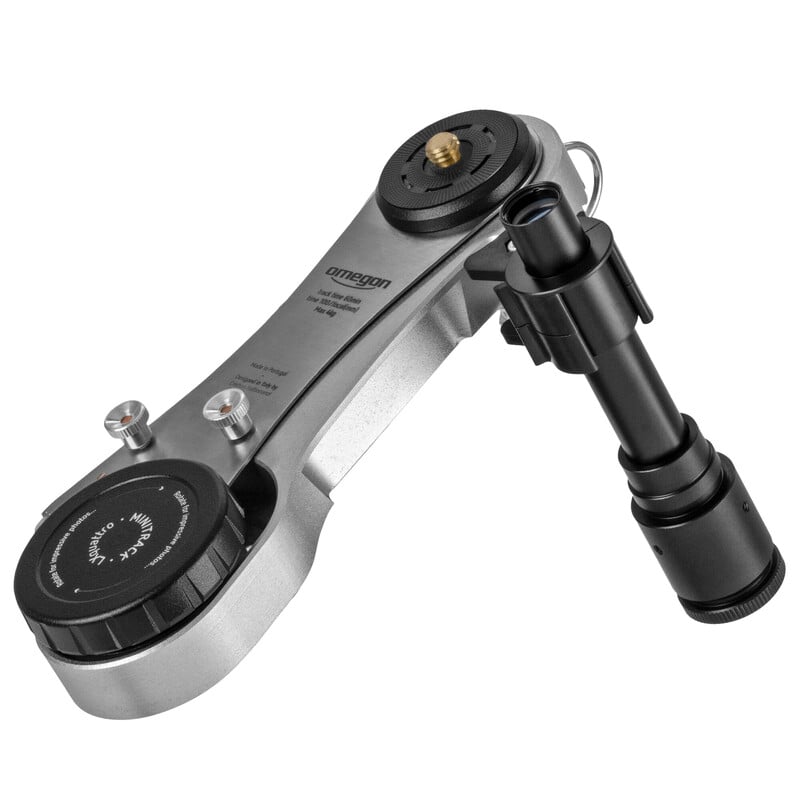
We’ve expanded our range and have welcomed a new member to the MiniTrack family: the MiniTrack LX Quattro NS. Unlike in most families, the new arrival is not the smallest member of the family, rather it is already fully grown. This means that our product developers were able to considerably improve the LX Quattro even more. But what exactly has changed?

MiniTrack, what is it?

The MiniTrack is a minute and fully mechanical travel mount (also known as an astrotracker) for astrophotography. You can use it to effortlessly produce images of the night sky. Cameras that are mounted on it follow the movement of the stars over a prolonged period. These photos often include the landscape of the night. This results in fascinatingly beautiful shots. It is also the perfect way to get into astrophotography.


The MiniTrack LX Quattro NS

LX Quattro stands for precision, increased power and a four-kilogram load capacity. The new MiniTrack combines all of this in one. Compared to the LX3, the load capacity is even higher. This means that you no longer need to avoid using your favourite lens, which was previously too heavy. Even with longer lenses, the MiniTrack takes things easily in its stride.

Tracking with the Quattro is extremely precise as a newly constructed needle bearing provides greatly improves this. This step was necessary to guarantee smooth tracking with heavy weights.

A brand new spring bar design provides better draft to move the load even more precisely. There is no longer any unilateral strain within the mechanical system. Yep, the Quattro simply has more oomph. An attractive side effect is that the MiniTrack is significantly more elegant and more user-friendly.

The MiniTrack LX Quattro is also a tracker for capturing the night sky using wide-angle and normal lenses. Anyone who has already gained a little experience can also treat themselves to a lightweight telephoto lens.

Overview of features:

  • 4kg load capacity for larger cameras or larger lenses
  • New and stronger spring system
  • Needle bearing for softer, precise movement
  • New, more stable CNC body – the Quattro should survive every night of observation with no scratches
  • Integrated Gp-style mounting as well as ¼“ und 3/8“ threads
  • Holiday anywhere now: usable beneath the northern and southern night skies.

You can find further information on the MiniTrack LX Quattro NS and its benefits on our product page. Furthermore,  this MiniTrack can be bought in a set with a ball head or with a ball head and polar wedge.


The other members of the MiniTrack family

What do you need to take beautiful photos? A MiniTrack alone is not quite enough. So we would like to introduce the other family members to you:


Omegon 32mm carbon tripod Thanks to the 32mm tripod legs, this tripod provides a sturdy foundation. Weighing only 2kg and with a length of 59cm, is it ideal for travel.

Stativ für die MiniTrack

Deluxe polar wedge: You can simply secure your Astrotracker to the tripod head. However, this is easier and more precise using a polar wedge. This enables you to precisely align the north celestial pole. The provides the benefit of providing a stable north orientation.

Polhöhenwiege Deluxe

Pole finder light: Being able to see the pole finder’s images in the night sky is a priceless advantage. At night you tend to have your hands full. It is good when you don’t need to use a lamp to complicatedly light up the polarscope. The pole finder light is convenient and evenly illuminates the images using a red LED.

Polsucherbeleuchtung MiniTrack

OM10 ball head Still don’t have a ball head? You need one to align your camera with areas of the night sky. The Omegon OM10 fits perfectly on the MiniTrack.

Kugelkopf für MiniTrack

MiniTrack LX3: The white version holds cameras up to 3kg in weight and contains an optical polarscope. To mount the LX3 on a polar wedge, you require the 55mm MiniPrismRails.

MiniTrack LX3

MiniTrack Essentials: Exceptionally good value and sufficient for getting started with wide-angle lenses. The MiniTrack Essentials contains a small polarscope that can be used to align the tracker with the Pole Star. This basic model can be upgraded at a later date.

MiniTrack Basis Version

Interested in taking your first images with the MiniTrack? You can find out how to do this in our step-by-step video “Astrophotos with the MiniTrack – a how-to guide”. Have fun observing and photographing.

Video: astrophotography with the Omegon MiniTrack

November 3 2021, Marcus Schenk

In this video, you will get to know the Omegon MiniTrack astrotracker. What equipment do you need for good landscape astrophotography? And what do you need to watch out for, adjust or activate once you’re outdoors?
We’ll take a step-by-step look at everything from set-up to capturing an image.
After the video, you’ll be ready to create your own beautiful pictures with the MiniTrack.

Hot off the press: we are also introducing the new MiniTrack LX Quattro!

Products used in the video:

Omegon MiniTrack LX3 mount set Product no.: 62037

Omegon MiniTrack LX Quattro NS mount Product no.: 69307

Omegon Deluxe polar wedge Product no.: 69370

Omegon Pro 32mm carbon tripod incl. ball head Product no.: 60251

Omegon polar finder light for MiniTrack LX 2 + 3 and EQ mounts with light unit Product no.: 69568

Omegon 55mm prism rail with screw Product no.: 64965

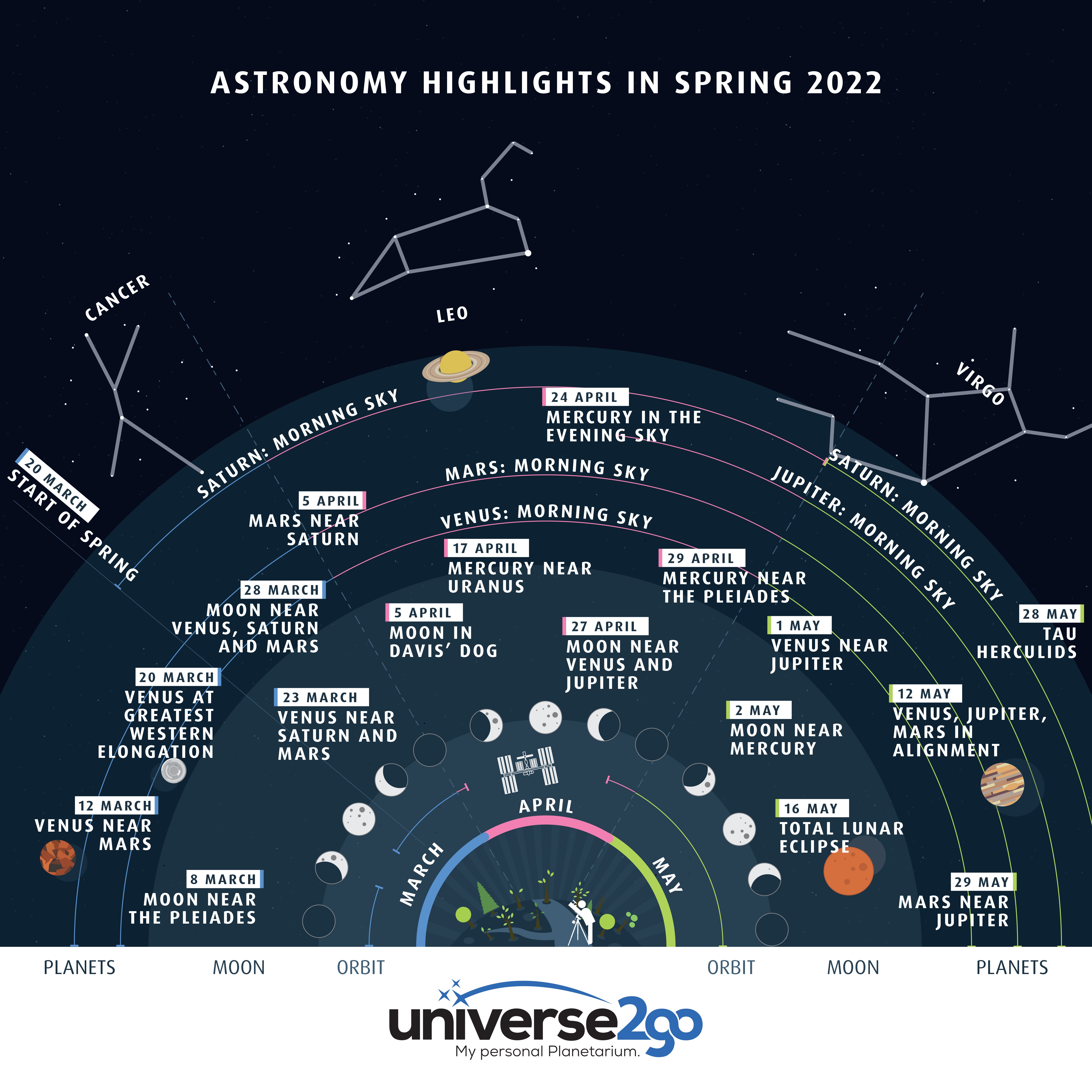
Infographic: Astronomy Highlights Autumn 2021

September 1 2021, Marcus Schenk

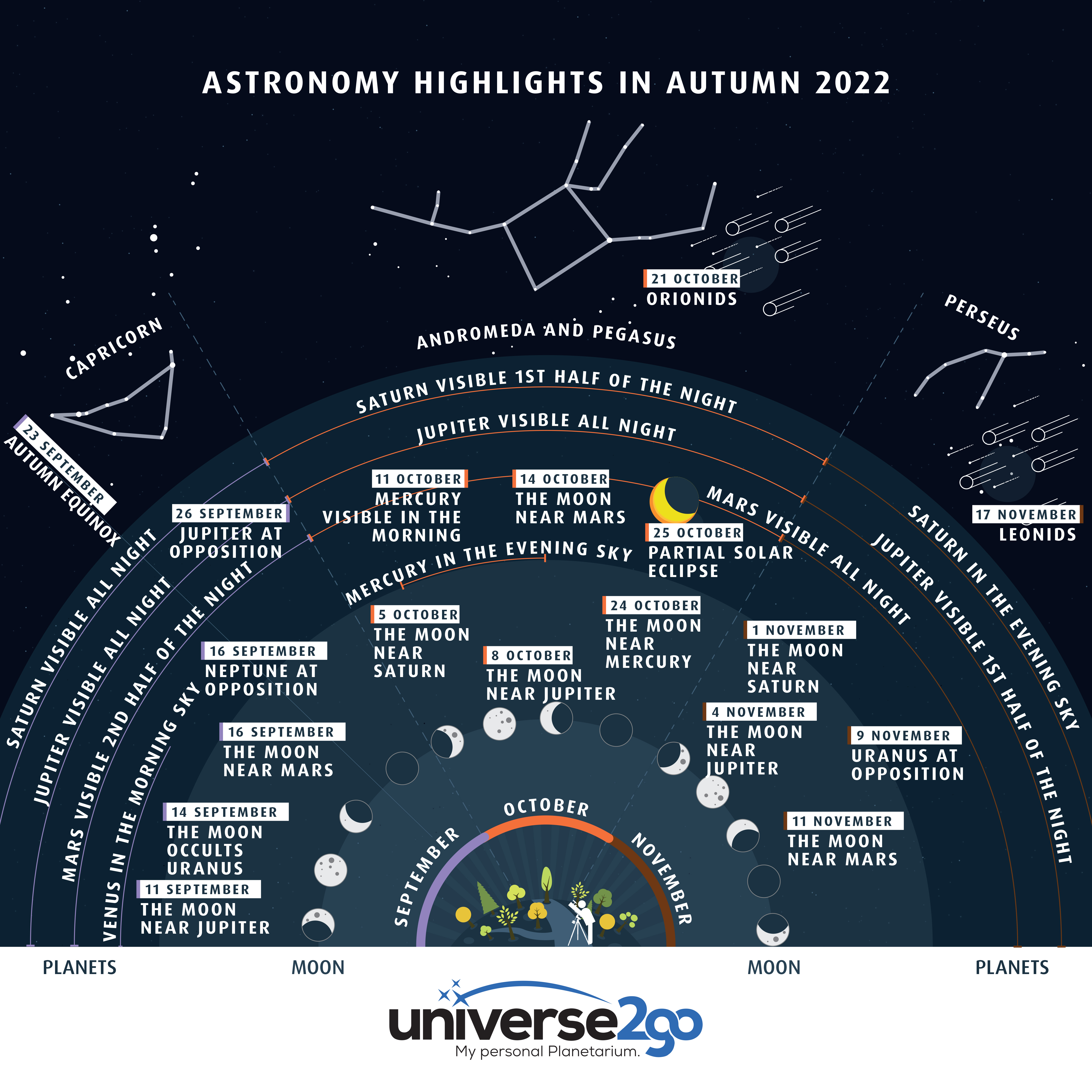
Autumn has a planetary focus on Jupiter and Saturn which are both still brilliantly visible. Additionally, you have the chance to see the two outermost planets, Uranus and Neptune, at opposition.

In the “Astronomy Highlights in Autumn 2021” infographic, you can find numerous important celestial events at a glance. You can find dates and detailed descriptions of the events in the accompanying text.

Have fun observing!
September

September occurs in the period between summer and autumn. This can also be seen in the night skies. The constellations Hercules and Lyra drift westward. Contrastingly, the constellation Capricorn is conspicuous alongside the large planets Jupiter and Saturn in the south.

02/09 The Moon occults Epsilon Gem – In the early hours of the morning, the slender crescent moon occults the star Epsilon Gem in the constellation Gemini. The Moon approaches with its illuminated side at around 2am. You need a very good view of the horizon facing towards the north-east. (Visibility depends on observer location)

03/09 The Moon occults Epsilon Gem – At 4:38am, the slender crescent moon occults the star Kappa Gem in the constellation Gemini. An attractive occultation as the Moon appears as a narrow crescent. (Visibility depends on observer location)

3.9. Conjunction between the Moon and Pollux – In the second half of the night, the Moon appears over the horizon in the constellation Gemini. Only 3 degrees separate it from Pollux.

14.9. Neptune at opposition – The solar system’s furthest planet is at opposition and looks magnificent. You can see it as a star by using binoculars but it is only by using a telescope that you can see the 2.3 arc second planet as a small sliver. A star chart or an app would benefit you here.

17.9. Conjunction between Jupiter and Saturn – Both large planets meet in the constellation Capricorn. With the Moon in the middle, they form a triangle.

October

October definitively marks the start of autumn. High above our heads we can see the famous Great Square of Pegasus and the constellation Andromeda. Time to take an extensive trip to the Andromeda Galaxy. Always an experience with binoculars.

03/10 The Moon occults Eta Leo – In the early hours of the morning, at around 5:27am, it is still dark. It is now that the Moon occults the 3.4 mag star Eta Leo with its narrow-illuminated side. It is definitely the most impressive star occultation of the quarter. (Visibility depends on observer location)

08/10 Giacobinids – The Giacobinids or Draconids are a meteor shower which appears to stem from the constellation Draco. The maximum fall rates can be expected on 8 October. Unfortunately, the expected number cannot be predicted as it can vary considerably. The radiant is located near the star Beta Draconis. Draco is part of a circumpolar constellation which is why the radiant is at its optimal visible altitude in the evening.

09/10 Conjunction between the Moon and Venus – At sunset, a brilliant Venus and a 3.5-day-young crescent moon rise in the southwest. There is a maximum time window of 2 hours until Venus disappears below the horizon.

14-15/10 Conjunction between the Moon, Jupiter and Saturn – At the end of the civil twilight, at around 19:00, the planets Jupiter and Saturn rise dominantly in the sky. Although they were at opposition in August, they are still a rewarding target. The Moon does not disrupt their observation.

21/10 Orionids – The Orionids are a smaller meteor shower with around 20 meteors per hour. The radiant is located in the constellation Orion, near the star Betelgeuse. Although you can observe the meteor shower all month, it peaks between October 20 and 21. The best time for observing is between 22:00 and 05:00.

23/10 Mercury in the morning sky – In May, Mercury could be seen in the evening sky whereas now the planet is offering us a short period of morning visibility. Between 23/10 and 31/10, you can see it just above the eastern horizon.

November

The constellation Perseus is near the zenith in November. This is where you will find the two brightest stars, Mirfak and Algol. The famous binary star cluster h + chi illuminates the space between Perseus and Cassiopeia and can be seen with the naked eye in dark areas.

03/11 Conjunction between the Moon and Mercury – There are two reasons to get up early today. This morning, the delicate crescent moon and Mercury are in conjunction. One of the last opportunities before Mercury disappears into the Sun’s glare.

05/11 Uranus at opposition – At mag. 5.6, Uranus is currently visible with the naked eye. However, it is easier to spot using binoculars or a telescope. This makes it appear as a tiny green disc with no recognisable details. However, it can still be identified as a planet.

08/11 Conjunction between the Moon and Venus – The waxing crescent moon is in conjunction with the twinkling brightness of Venus.

10/11 Conjunction between the Moon and Saturn – The Moon passes Saturn only 4.5 degrees beneath it.

11/11 Conjunction between the Moon and Jupiter – Tonight the Moon passes Jupiter, moving at almost one degree per hour. We can track the movement relative to Jupiter quite well.

17/11 Leonids – The Leonids reach their peak from November 16 to 17. Along with the Perseids, they are one of the most famous meteor showers. There have been years in which these meteors have fallen like raindrops from the sky. This generally takes place every 33 years when the Earth runs into the Leonid cloud. In normal years, the shower does not exceed 20 meteors per hour at its peak. This year, the slender crescent moon sets early on and we can enjoy the meteors all night long without interruption.

New: Deluxe equatorial wedge for Omegon MiniTrack

August 27 2021, Marcus Schenk

Using the latest deluxe equatorial wedge, aligning the MiniTrack with the north celestial pole is easier than ever. The advantages? Spherical stars all night long.

How do you align your MiniTrack and other astrotrackers without an equatorial wedge? In theory, this is possible using a tripod head but the alignment and the fixed support sometimes resemble weather forecasting, in a word: uncertain. And yet, the photography session is meant to be a success.

The right tools for success

Thanks to the deluxe equatorial wedge, you can simply and precisely align your MiniTrack with the north celestial pole. It’s easy peasy lemon squeezy!
A robust locking mechanism provides permanent polar alignment, even when you are continuously focusing your camera on new targets.

In our set-up, we use an Omegon 32mm carbon tripod, the deluxe equatorial wedge and a MiniTrack 3 with pole finder.

Simple installation on any tripod

Using the 3/8 inch thread, you can attach the polar wedge to any camera tripod. To do so, you simply need a mini Vixen-style rail, such as the Omegon 55mm prism rail, which can be used with the MiniTrack. You can then connect and align your astrotracker easily.

Quality made in Portugal

The equatorial wedge is manufactured to the highest quality and consists of CNC components and stainless-steel screws. It is produced in small batches in Portugal and checked for quality.

The ideal addition to your MiniTrack: view the Omegon Deluxe equatorial wedge in the shop now.

A review of Omegon’s 2.1×42 wide-field binoculars by Sky&Telescope

June 24 2021, Marcus Schenk

This Omegon 2.1x42mm star field binoculars is a great instrument for observing star fields, extended nebulae and entire constellations. Dennis di Cicco reviewed the Omegon star field binoculars for the astronomy magazine Sky&Telescope.

With a 42mm aperture and a magnification of 2.1x, the star field binoculars are truly remarkable. They offer a new observing experience that was previously not possible with binoculars and telescopes. This is also a reason why Sky&Telescope took a close look at this instrument. Among other things, the magazine liked its simplicity and compactness, the huge field of view, and the deep view of the sky. The author of the review was able to fully capture the constellations of Swan, Orion, Gemini, Wagoner, Perseus and others, as well as some deep sky objects or double stars like Algol.

Testbericht Omegon Sternfeldglas

Here are some quotes from the actual review:

Very well made

Excellent aid for learning and enjoying the night sky under less-than-ideal conditions

The Omegon 2.1×42 Binoculars are definitely a joy to use

I was seeing stars more than 1.5 magnitudes fainter in my suburban sky

Whether on vacation or on a hut tour through the Alps, the Omegon star field binoculars make beautiful observations possible even where you have no room for a telescope or binoculars. They also serve as a small observation treat from time to time. There is always a place in the (travel) bag for these Omegon 2.1×42 star field binoculars.

Omegon Advanced 150mm: now with 2″ focuser

June 16 2021, Marcus Schenk

The Omegon Advanced 150/750 EQ-320 telescope is a popular instrument offering an introduction to the exciting hobby of astronomy. With a new, large focuser, you can now even use 2″ eyepieces. For stunning observing and almost limitless views of the cosmos.

2" Okularauszug beim EQ-320 6"

Until now, observers using the Advanced 150/750 EQ-320 have only been able to use 1.25” eyepieces and accessories, but with the new 2″ Crayford focuser (patent pending), you will literally grow your horizons. This gives you the freedom to choose the eyepieces and accessories you want to use.

These are advantages the focuser offers:

With the 2″ eyepieces available in our shop, you can reach a larger area of the sky than is possible with 1.25″ eyepieces. For example, you can capture full-size large nebulae or enjoy seemingly never-ending vast fields full of stars. It also makes it easier for you to find objects. In short, a 2″ focuser is a blessing for deep-sky observers who want to experience the skies as if through a panorama window.

What if you complement the standard 1.25″ eyepiece, as supplied, with a  2″ eyepiece? The Omegon SWA 32mm 2″ eyepiece offers a fantastic image and a real wow-effect for deep sky observing.

Smooth mechanics for precise focusing

Such large focusers are quite unusual for a 150mm Newtonian telescope. However, our development department wanted to ensure that even owners of medium and compact telescopes could benefit from wide-angle eyepieces. In contrast to a normal geared focuser, the new 2″ Crayford focuser with ball bearings runs totally free of play. This allows you to focus your object smoothly and with high precision.

The advantages of the Advanced 150/750 EQ-320:

  • Experience sharp and clear objects: with the parabolic primary mirror
  • 2″ Crayford focuser (patent pending) for 1.25″ and 2″ eyepieces: you can connect additional accessories at any time – even from other manufacturers
  • Equatorial mount: so that you can precisely track celestial objects
  • Trouble-free start in the sky: complete telescope with two eyepieces
  • Find objects easily and successfully with an illuminated LED finder
  • Immediately recognise stars, planets and nebulae – even if you’re an absolute beginner

The Advanced 150/750 EQ-320 telescope is available with immediate effect with a 2″ focuser.