
 Subscribe to
November brings us dark skies for deep-sky observing – and a very special planet parade that you won’t want to miss. Here are three good reasons to catch it right now.
Planets are a great target, especially for beginners: most of them shine brightly and reveal details even in a small telescope. And right now, five planets are in the sky at the same time – in the hours after midnight. That doesn’t happen every month, so it’s the perfect excuse to point your telescope at our neighbours.
What exactly can you see?
From 10 November until early December, Mars, Jupiter, Saturn, Uranus and Neptune are all in the sky together every night. Between roughly midnight and 2 a.m., each of them stands at least 10 degrees above the horizon – Uranus even reaches almost 60 degrees. The whole parade stretches across about 144 degrees of sky. The best time to observe is between 10 and 17 November, when there’s no moonlight to spoil the view.
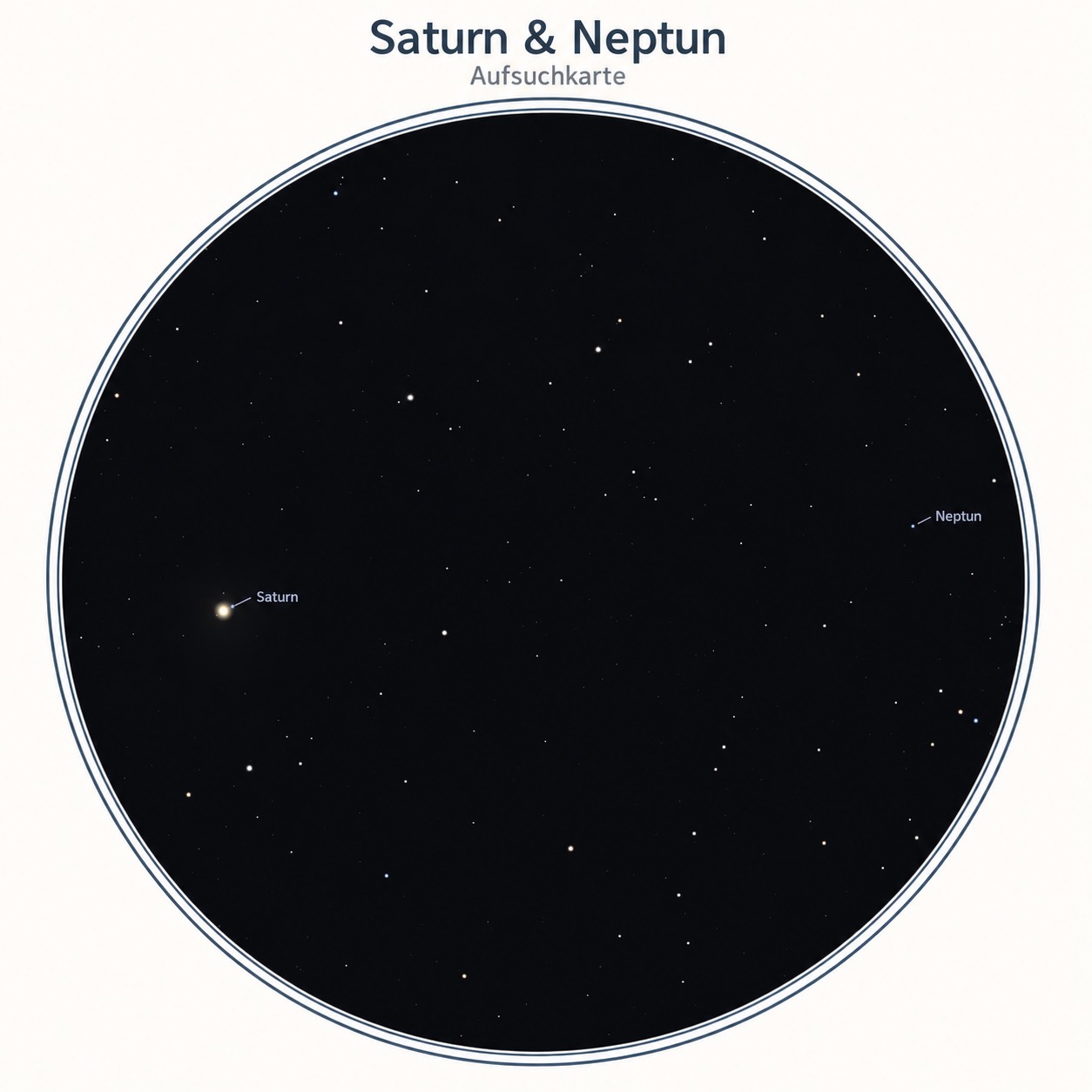
Saturn and Neptune in the southwest
You’ll find Saturn in the south as early as the evening. It shines well below the constellation of Pegasus in a region with few bright stars. To be precise, it’s in the constellation of Cetus, the Whale, which contains many faint stars and is only easy to make out under a truly dark sky. Our ringed planet, however, stands out brightly. Even a small telescope shows the rings. At the moment they’re only slightly open and appear as a narrow, bright band on either side of the planet’s disc.
To see a real planet parade, though, you’ll need to wait until around midnight. By then Saturn has moved towards the southwest, and more planets rise in the east until all five are finally in the sky.
Neptune lies close to Saturn but is invisible to the naked eye. At magnitude 7.7, you’ll need at least a pair of binoculars – or better still, a telescope with higher magnification. At first it looks like a star, but with a finder chart you can identify it as a planet. Neptune is just under 7 degrees from Saturn. In wide-angle binoculars with a large field of view, both planets just fit into the same field. With 10×50 binoculars, simply sweep across from Saturn.
Uranus high in the south
This time, Uranus is the planet in the middle of the line-up. It sits high in the sky in the constellation of Taurus, between the Hyades and the Pleiades. On 25 and 26 November it reaches opposition. At magnitude 5.6, it is theoretically visible to the naked eye under a very dark sky. Around opposition, however, the full Moon gets in the way – on 24 November it is only a few degrees from Uranus. So observing it is much more fun with binoculars or a telescope. The Pleiades lie a good 5 degrees away, and in wide-angle binoculars both appear together in the field of view. In a telescope, Uranus shows a small, greenish-blue disc.
Mars and Jupiter in the east
Now let’s turn to the east. Low above the horizon, two bright planets appear: Jupiter and Mars.
Together, Mars and Jupiter make a striking contrast. Mars impresses with its orange-red colour, while Jupiter immediately catches the eye with its brilliant shine – it is almost 12 times brighter than Mars. On 16 November, the two are only 1.2 degrees apart, with the bright star Regulus sparkling right next to them. With an ultra-wide-angle eyepiece, you can even fit both planets into a single field of view around this date. The Omegon Panorama II eyepieces with a 100-degree apparent field of view, used at magnifications up to about 60x, are ideal for this. If you want to observe the two planets in detail, it’s best to wait a little longer. In the early morning hours they stand much higher. You’re then looking through less air, the image is steadier and the details are sharper.
3 good reasons why this planet parade is worth it:
- 9 November is new Moon: until about 17 November, the Moon stays below the horizon in the hours after midnight. Ideal for the faint planets Uranus and Neptune.
- On 16 November there’s a close conjunction of Mars and Jupiter. The two planets are then just 1.2 degrees apart.
- On 25/26 November Uranus is at opposition: the planet is visible all night and reaches its greatest brightness of the year.
As a bonus, the Leonids deliver a lovely finale on the night of 17 to 18 November. Their radiant lies in the constellation of Leo – exactly where Mars and Jupiter are. After moonset at around 11:30 p.m., your chances of spotting shooting stars are best.
Get ready with the right equipment now: a telescope, a pair of giant binoculars or the right eyepieces.
Tip: Two great telescopes for observing nebulae & planets are the Omegon telescope N 153/750 EQ370 and the Omegon Dobson telescope Advanced X 203/1200.