

Noise in Astrophotography
Noise in Astrophotography? This article explores the reasons behind it
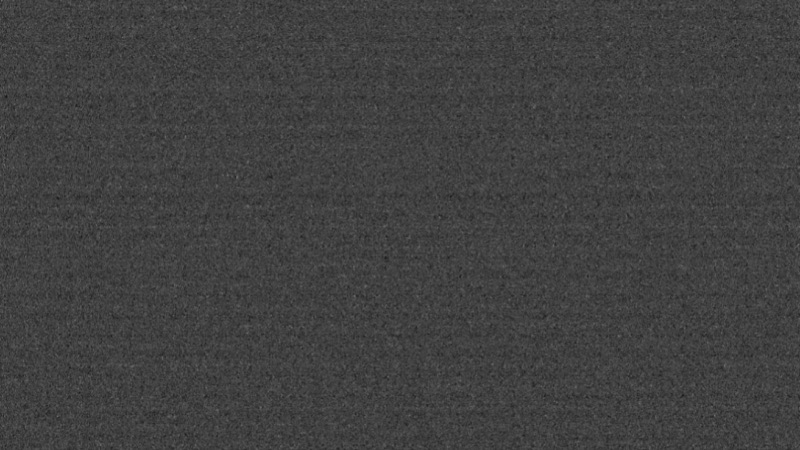 Dark frames at -5°C, 300s exposure, and gain 100 using a ZWO ASI 2600 mc
Noise is one of the biggest challenges for astrophotographers. Despite state-of-the-art techniques and even artificial intelligence, it remains a persistent source of interference that compromises image quality. But what lies behind this phenomenon? Why does it occur, and what forms does it take? In this article, we’ll explore the types and causes of noise and provide practical tips on how to optimize your astrophotos.
What is noise?
Noise refers to random variations in the signal that contain no useful information and degrade image quality. It appears as seemingly random fluctuations in brightness or color that are not part of the photographed subject. The signal-to-noise ratio (SNR) is critical to image quality and is calculated as follows:
SNR = A_signal / σ_noise
Here, A_signal represents the amplitude of the signal detected by the sensor—that is, an average of the signal—while σ_noise refers to the dreaded noise. An SNR of 1 means that the signal cannot be distinguished from the noise; an SNR value of 10 or higher is considered “good.” This information is particularly useful when selecting guide stars. Modern software automatically calculates the “best” stars in the field based on the FWHM (full width at half maximum of the star profile) and the SNR.
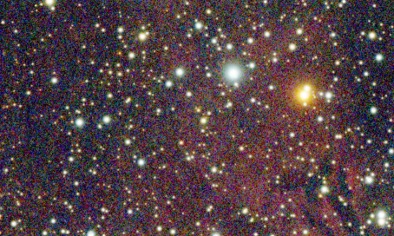 Example of a photo with noise
Types of Noise
In astrophotography, there are three main types of noise that are relevant:
Dunkelrauschen (Dark Noise)
Dark current is a noise signal caused by thermal fluctuations in the sensor. These fluctuations “activate” the sensor and generate unwanted noise that cannot be controlled. When taking photographs, the exposure time must be taken into account, since the longer the exposure, the more thermal fluctuations the sensor picks up. Dark noise is highly temperature-dependent, which is why there are now sophisticated cooled sensors that can reduce this noise to a minimum.
In addition, dark noise can be further reduced by capturing so-called dark frames. These dark frames must be captured under the same conditions as the actual light frames—that is, with the same exposure time, the same gain/ISO, and the same temperature.
Electronic Noise
Electronic noise is caused by random readout errors in the sensor and varies greatly from system to system. In CCD sensors, each pixel is associated with a root-mean-square fluctuation, which is referred to as readout noise. Electronic noise becomes particularly significant when photographing very faint objects, as it can mask and degrade the signals from these faint objects.
Shot noise or quantum noise
Shot noise, also known as quantum noise, is perhaps the most critical of the three types of noise. It arises from the discrete nature of light, which consists of photons. The number of photons detected during an integration time "t" follows a statistical distribution of photon counts.
To illustrate this, imagine a very rainy day when we set up a thousand buckets of the same size in a large garden to collect rainwater. These buckets are placed close together, much like the pixels on an astronomical sensor. We count how many raindrops fall into each bucket over a specific period of time. The number of drops in each bucket will vary; one bucket might have 100 drops, another 90, or perhaps 110.
The longer the buckets sit outside, the more water they collect (provided they don't overflow!). The same is true for light: photons do not strike every pixel of the sensor uniformly, and the photon count follows a statistical distribution. For monochromatic light (such as that from a laser), this is typically a Poisson distribution.
Based on the quantum nature of the signal, the number of counts is:
Counts = photon flux × QE × t
where "QE" is the quantum efficiency of the sensor—that is, the percentage of light converted into a signal—and "t" is the integration time. This yields the signal-to-noise ratio:
SNR ∝ √t
This formula illustrates that the longer the exposure time, the higher the signal-to-noise ratio and the lower the noise. Although this is a simplification (since astrophysical signals can have more complex distributions), the key point remains: Do you want less noise in your photo? Then increase the exposure time.
Taking hundreds of dark frames or bias frames can only reduce noise to a limited extent, since the perceived noise stems primarily from the quantum nature of light. To obtain a deep-sky photo with low noise, you should extend the integration time as much as possible, depending on your needs. For example, if you’ve exposed an object for 2 hours, an additional 10 minutes or even an hour of exposure won’t yield a significant improvement. As a rough rule of thumb, you’ll need to at least double the exposure time to achieve significant improvements. This means that if your initial exposure was 2 hours, you should extend it to at least 4 hours to achieve a noticeable improvement in quality.
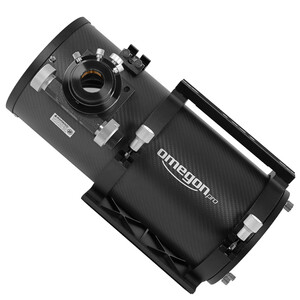
With exposure times of 20 hours or more, this can become a problem, but thanks to modern technology, there are alternatives. “Fast” telescopes, such as the extremely fast Omegon telescope, cut the required exposure time in half.
An aperture of f/2.8 allows for shorter exposure times (although this doesn't mean that more light is collected—that is determined by the aperture). So it's as if it were "magically" raining harder when you switch buckets.
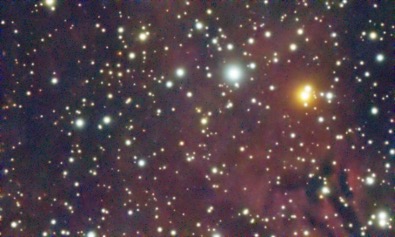 The same image, but with a noise filter applied
Summary
There are various sources of noise, essentially three main types: dark noise, electronic noise, and quantum noise. Quantum noise decreases as the integration time increases and, unlike the other two, does not depend on intrinsic instrumental factors. The rule of thumb is therefore: longer integration time = better photos.
Clear nights and good luck with your astrophotography!
Author: Emanuele La Barbera
Emanuele La Barbera
Emanuele is an astrophotographer who is studying physics at the University of Palermo.
Emanuele has been passionate about astronomy since he was a child. Today he is a talented astrophotographer, and his pictures are highly regarded and published on the Internet and in specialist journals. His academic background and his passion both guarantee you the best possible advice on products dedicated to amateur astronomy!
Languages: Italian, English