

Your partner for astronomy

Author Archives


Stefan Taube

Stefan Taube

Posts composed by Stefan Taube

Blog Archives

Astronomik: new clip filters for Canon DSLR cameras

July 31 2017, Stefan Taube

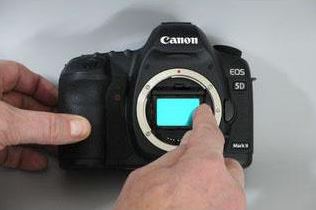
Northern German company Astronomik is a specialist for astronomical filters for astrophotographers or purely visual star gazers. Clip filters are a special innovation of Astronomik. These filters have a special mounting shape, which allows them to be placed directly into a DSLR or system camera – without using any tools!

Astronomik currently offer clip filters for:

The camera mentioned last is designed with extremely high sensitivity. We offer this camera as a specially astro-modified camera. For more information please follow this link: Sony Alpha 7s Astro.

For APS-C Format EOS cameras from Canon, Astronomik have now developed a new series. A special feature of these new XT filters is the very thin carrier with a thickness of only 0.3 mm, to which the filter layer is applied. When using filters with thicker glass carriers, image faults may become visible in the corners of the photos. Stars appear slightly dash shaped. This can be particularly noticed when using short focal lengths. So if you would like to use a Canon EOS with the camera lens on a camera mount to take wide angle shots of the night sky, an XT filter might be the right investment.

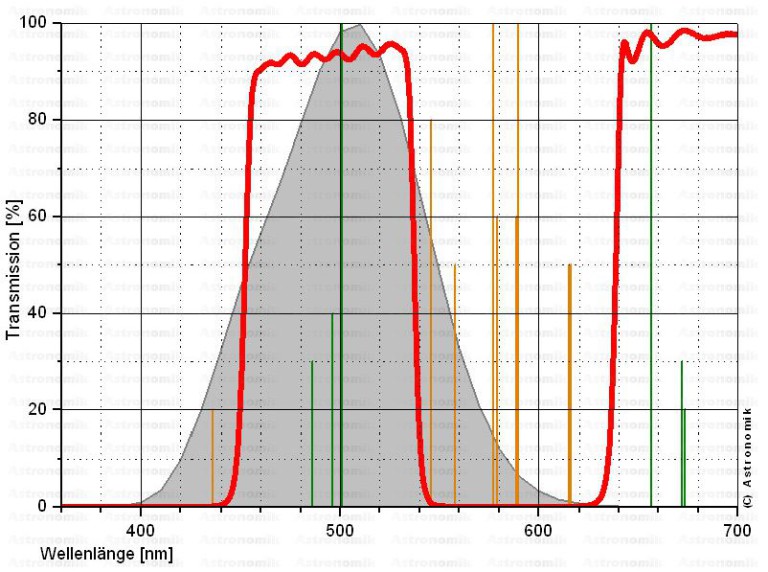
XT filters are available in the usual versions, from CLS to H-alpha all the way to SII filters. For novices we especially recommend the CLS filter, which suppresses artificial light pollution.

The red transmission curve reveals: The CLS filter blocks the light from the yellow street lamps.

The red transmission curve reveals: The CLS filter blocks the light from the yellow street lamps.


By the way: Removing a clip filter from the camera housing is just as easy as putting it in.

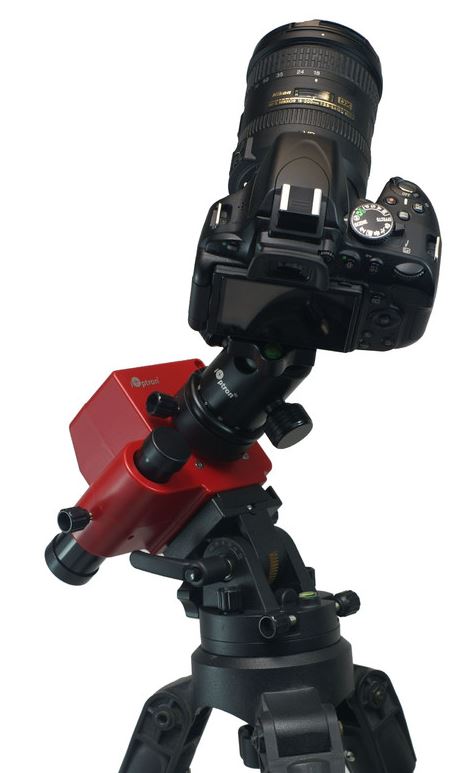
SkyGuider Pro: the large camera mount from iOptron

July 17 2017, Stefan Taube

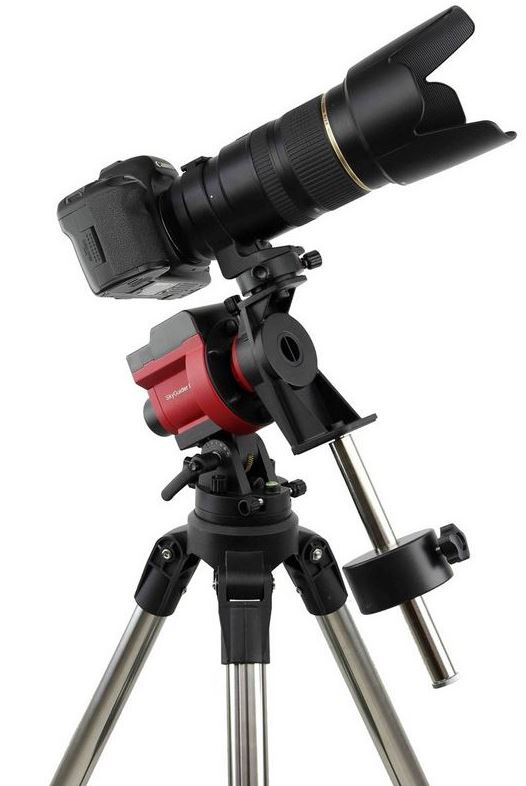
The SkyTracker Pro from iOptron is one of the most popular camera mounts. This handy unit tracks photographic equipment of up to three kilograms in weight to follow the rotation of the sky. This allows you to take panorama shots of the night sky with long exposure times.

The new SkyGuider Pro from iOptron can even carry up to five kilograms of photographic equipment. This is easily sufficient for a small telescope, such as the Photography Scope with camera. The scope of delivery already includes a mounting plate for small telescopes.

The scope of delivery also includes a counterweight for balancing the photographic equipment. This provides stability and takes pressure off the rotation axis.

However, you can also install a second camera with up to three kilograms in weight instead of the counterweight. This way you can take photos of the same sky area, but with two different focal lengths.
Alternatively, you can use the second camera as an autoguider.

On the product page for the iOptron Mount SkyGuider Pro you will find an illustration showing the vast variety of applications for this camera mount.

In addition to the counterweight, the scope of delivery of the SkyGuider Pro includes almost everything you need. The only thing missing is a tripod and a ball head might also make sense. Both these articles can be found under the tab “Recommended Accessories” on the product page.

The SkyGuider Pro comes with a power pack which can simply be recharged via USB. There is hardly any mount for sky photography available for use with photographic equipment of up to five kilograms in weight, that is more light-weight or more compact. As with other mounts from iOptron, the SkyGuider Pro also offers a satisfying, solid mechanical design. We are convinced that this new camera mount will meet your approval!

Good things always return: The ETX-125 telescope from Meade

June 29 2017, Stefan Taube

It is available again, the ETX-125 from Meade. Easy to transport, versatile in use and computer controlled – this made the ETX-125 a classic in the past!

ETX125

The advantages of the Meade ETX-125:

  • Compact Maksutov optics: Longer focal length despite the short tube. Ideal for watching the moon and planets, but also for observing nature in the daytime. The robust Maksutov is stable in adjustment and, due to the closed tube, has a well protected mirror.
  • With its opening of 127 millimetres, it is the biggest optics of the ETX series and also suitable for watching objects beyond our solar system: The Orion nebula, the big star cluster M13 in the Hercules constellation, and many other objects.
  • The optical tube is fixed in a bracket mount. It reliably carries the optical system, its motors in both axes align it with the desired observation object and track the telescope in line with any rotation of the sky. The integrated battery compartment provides the required electric current for the motors during outdoor use. However, the ETX-125 can also be powered via an optionally available power supply unit.
  • The tube is actually fixed in the fork, but the fork can be removed from the tripod for easier transportation. The steel pipe tripod carries the telescope without any negative wobbling. Another special feature: The tripod comes with an integrated equatorial wedge. This makes the azimuthal bracket mounting an equatorial GoTo mount, as is needed for astro photography.

And all this for a fair price!

The Meade ETX-125 is a GoTo telescope. This means that it is equipped with computer control, which makes it possible for beginners to find and identify objects in the sky.

The telescope is controlled via the new AudioStar-Handbox:

AudioStar

With AudioStar, you can choose from 30,000 celestial objects. However, the control also suggests objects for watching. A special feature of AudioStar is the audio output. It provides interesting information about the chosen object – however, only in English.

The compact, robust and computer controlled Meade ETX-125 also convinces in its new design!


CGX-L: The Large Version of the New Celestron Mount

June 12 2017, Stefan Taube

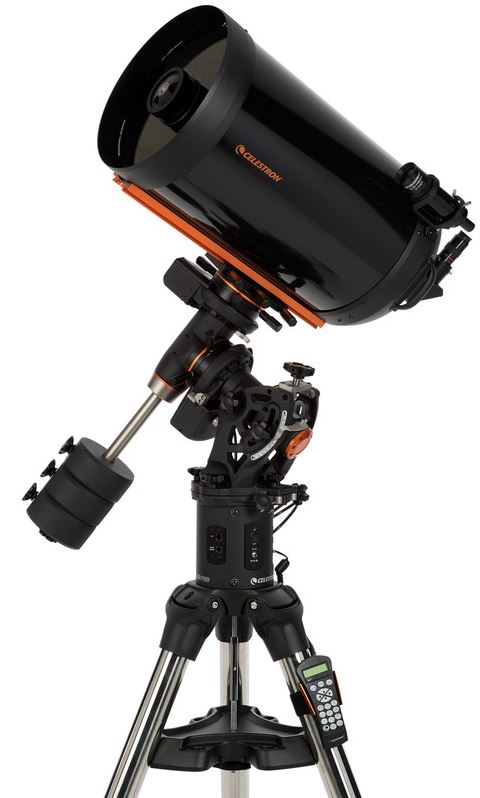
At the beginning of February, we introduced the latest development from Celestron: Celestron CGX. The CGX now has a big sister. The brand-new  CGX-L mount is able to carry 34 kilogrammes and thus almost 10 kilogrammes more than the CGX.

The large 14 inch optics can thus also be used with the new technology of the CGX-mounts:

CGX-L-1400

The generously sized 144 millimetre worm gears are an important factor in increasing the load bearing capacity. They enable smooth running, even when carrying heavy telescopes. Apart from this, the dovetail clamps were extended to 270 millimetres, so that large telescopes are also securely held in place.

The illustration shows the mount head with the large worm gear and the toothed belt drive:

CGX-L-Antrieb

Another positive aspect: Additional AUX ports and the autoguider connection on the DEC-axis ensure a better cable management.

If you intend to use large optics with photo equipment, you need a heavy counter weight. With 31.5 millimetres in diameter, the counterweight shaft has been adequately dimensioned for carrying heavy loads.

Despite the increased load bearing capacity, the CGX-L is still portable. And not only the mount is able to carry higher loads: Celestron delivers the CGX-L with a steel tripod which has been considerably reinforced compared to the CGX. The tripod legs have a diameter of 70 millimetres!

The CGX-L is a universally usable mount, with hardly any limits: You may use it stationary in your garden observatory or transport it to telescope meetings or to your favourite observation location.

We offer the mounts CGX and CGX-L individually. With the dual saddle plate, you can combine these mounts with almost any optics system. But you can also decide on a complete telescope system consisting of mount and Schmidt-Cassegrain optics. You will find these product series under the two links CGX- telescopes and CGX-L telescopes.

No matter whether you decide for the CGX or directly for the larger sister CGX-L, you will receive a modern mount, which will set the standard for the next few years.

Now available: the new CGEM II mount from Celestron

May 17 2017, Stefan Taube

The American telescope manufacturer Celestron has revised their work horse for astrophotographers. The CGEM II is very popular, and rightly so, because when it comes to load bearing capacity it has a lot of reserves as compared to the smaller Advanced VX mount; but it is cheaper than the big CGX. In the field of equatorial GoTo mounts for mobile astrophotography the CGEM II takes a middle position.

CGEM II

The new CGEM II not only looks very trendy, but it also features a few real innovations when compared with its predecessor.

  • New powerful motor electronics with the latest firmware.
  • USB 2.0 port on the hand controller. This way you can simply connect the hand controller to a PC for software updates.
  • PPEC (Permanent Periodic Error Control) ensures precise tracking.
  • Autoguider port. Indispensable for sophisticated astrophotography!
  • Tracking beyond the meridian.
  • The mounting saddle accepts prism rails acc. to Vixen and Losmandy standard. No adapter required.
  • Improved tripod with height marks: This makes it even easier to place the tripod horizontally.

With this mount, the telescope, camera and guider may have a weight of up to 18 kg. This leaves a really big tolerance range.

We offer the CGEM II, but also as a set together with the Schmidt-Cassegrain optics with apertures ranging from 8 to 11 inch (~200 to 280 millimetres): CGEM-II telescopes.

Combined with the classic SC-telescopes this provides you with excellent astronomical equipment which will give you joy for the rest of your life! If you have extra spending money, you should consider the CGEM II with EdgeHD. This variant of the Schmidt-Cassegrain telescope already has the correction optics for the unavoidable coma error integrated, allowing you to take sharp photos right to the edge.

Whatever you will decide, with the CGEM II you can’t go wrong!

Observing the Sun with the DayStar QUARK Calcium-H

May 11 2017, Stefan Taube

The American sun filter manufacturer DayStar revolutionised sun observations with its QUARK series. For a comparatively low price you can now use a refracting telescope with a small aperture for watching the Sun in a defined spectral line – this is no more complicated than plugging an eyepiece into a diagonal mirror.

DayStar have now extended their QUARK series by a model to watch the Sun in a spectral line of the chemical element calcium. With the DayStar QUARK Calcium-H-line sun filter you can watch the sun at a wave length of 397 nanometres – or perhaps not: Not everyone is able to notice such short-wave light.

However, with a planet camera this short-wave radiation can be recorded without any problems. Corresponding tests were undertaken by our colleague Bernd Gährken:

Sonne-Calcium-H

For this photo 4 images were combined. In addition to the QUARK Calcium-H-line, an Omegon photoscope with 1.6x Barlow and a planet camera were used. The scope of delivery includes adapters for 1.25″ and 2″ focusers. The Calcium filter works without telecentrics and requires an optical path of 6.2 centimetres. With many optics the focus cannot be reached directly. We therefore recommend also ordering the reasonably priced path corrector. It can be screwed directly into the QUARK filter. In terms of cameras, we specifically recommend the Mono Guider from Touptek or the planet cameras from ZWOptical. When photographing a tight spectral range, the complete resolution of the sensor can only be utilised when using a black-and-white camera (“mono”).

Unfortunately there were no sunspots on the sun when this photo was taken. This exemplary image provided by the manufacturer shows what sunspots in the light of the Calcium-H-line look like.

Sonne-Calcium-H-Daystar

Photographic data for this image can be found on the product page, QUARK Calcium-H-line.

Observing the sun is a fascinating alternative or an additional challenge for stargazers.

Explore Scientific Twilight AZ – the uncomplicated mount!

March 27 2017, Stefan Taube

The equatorial mount with GoTo functionality is not necessarily a must-have.  Sometimes you just want to have a quick look at the moon or the planets, search for a comet or observe large areas of the sky with a suitable refractor. In this case, an uncomplicated and quickly available azimuthal mount is fits the bill.

The new Twilight I AZ from Explore Scientific is just such a mount. It accommodates telescopes with a weight of up to eight kilograms – which is quite strong for a mount of this class.

ES-Twilight-AZ

Moving to the desired objects is a simple task: With just one lever each you can loosen the clamps of the elevation and the azimuth axis and quickly move the telescope. Once you have retightened the clamps, you use the two flexible shafts and the precision worm gear for fine tuning and tracking.

The mounting saddle accommodates telescopes with a prism rail, compatible with the very popular Vixen standard. With the enclosed Allen key, the mount arm can be adjusted to optimize the viewing height of your optical system and to make sure that the telescope will not hit the tripod leg. Speaking of tripods: the Twilight I AZ comes with a steel tripod with extendible legs and an eyepiece tray.

The mount Twilight I AZ is currently available for a price of 279 Euro – an excellent price for a mount of this quality!

DeepSky-Set: Cooled camera ASI 1600 with filter and filter wheel from ZWO

March 13 2017, Stefan Taube

ASI 1600 MM series cameras from ZWOptical have really found their place in astrophotography. With its small pixels, the highly sensitive CMOS sensor offers high resolution, and this even in connection with a relatively big sensor diameter.

We now offer the cooled black and white camera of the ASI 1600 series in a set with a motorized filter wheel and suitable filters: ASI 1600 MMC DeepSky-Imaging-Set for a price of 2,019 Euro. You save 29 Euro when compared with individual prices!

ASI-1600-MMC-Mono-DeepSky-Imaging-Set

A camera with active cooling is optimal for taking photos of nebulae and galaxies, because the cooling reduces sensor noise and thus enables long exposure times. This enables you to even take photos of very faint objects in the sky.

Even though the cooled ASI 1600 is available as colour or black and white camera, only the black and white camera offers the full resolution of the sensor. Ambitious photographers therefore favour this variant. In order to show the colour of the celestial object you just simply take photos through three colour and one luminance filters – the latter to increase brightness. The computer then uses these four images to produce a colour image (L-RGB method).

The filters are placed into a filter wheel, so that the camera does not have to be removed and realigned again for each filter change. The filter change simply takes place by turning the wheel. The filter wheel in the Set with the ASI 1600 is electrically powered and controlled via the camera, meaning you do not need an additional cable connecting to your computer. You simply use the camera control to change from one filter to the next, and this, above all, without having to touch anything.

The four filters in the DeepSky-Imaging-Set were specially developed for the ASI 1600. The colour weighting has been optimized for its sensor, which in this case is a high-quality interferential filter. Since the filters are parfocal to one another, the focus position does not change when changing the filter. Besides the three filters for the red, green and blue channel, the set also contains an UV/IR band-rejection filter for luminance.

Just as the graph concerning the filter transparency (transmission) of the set indicates, the filters block out the disturbing light of many street lamps, but are highly sensitive in the red range of the H-Alpha and SII-line. The transmission rate is greater than 92%.

Transmission

With the ASI 1600 MMC DeepSky-Imaging-Set you receive a high-quality, yet reasonable, camera system with almost unlimited possibilities!


Celestron CGX: a mount close to the limits of perfection

February 27 2017, Stefan Taube

The Celestron brand once again has set the standard for hobby astronomers: The new CGX-mount combines the current technical standard with a well thought out product design – and all for an reasonable price.

CGX-Montierung

Some special features of the CGX-mount:

  • Toothed belt drive and spring pressure mechanism: The belt drive minimises the gear play when changing the direction of movement (“backlash”). The spring pressure mechanism ensures uniform contact pressure between the worm gear and shaft, reducing friction and optimising the operation of the gear – also evident by the reduced noise level.
  • Optical encoders register the position of the mount. The motors can then be stopped before the mechanical slew limit is reached and approach their home position. The mount is able to track objects up to 20° above the meridian.
  • Internal wiring: Only the power supply cable and the cable to the hand control box are exposed. However, the sockets for these exposed cables are arranged in such a way that they do not need to move with the mount.

Der neu konzipierte Antrieb der CGX-Montierung.

  • Large handles: Transport handles ensure easy transport, but all clamping levers are also designed for operation with gloves.
  • Compact design: The saddle plate position near the right ascension axis gives the mount very favourable oscillation characteristics. The declination motor serves as a counterweight.
  • Latest variant of the Nexstar+ control with internal clock to save the last settings and USB-port for simple software update.

Further information on our CGX product page.

Die neue CGX-Montierung mit dem EdgeHD 925 Teleskop.

The CGX-mount is available on its own or as a set with the well-established Schmidt-Cassegrain optics from Celestron. You can find all variants under the link CGX-Telescopes.For ambitious astrophotographers we highly recommend the CGX 925 in its Edge HD version. The most reasonably priced and recommended combination of SC-optics and mount for beginners is the CGX 800.

However, due to the dual Vixen/Losmandy saddle plate you can easily combine almost any other optic from other manufacturers with the CGX-mount.

Now available: the EQ6-R mount from Skywatcher!

February 20 2017, Stefan Taube

The new EQ6-R Pro SynScan GoTo mount from Skywatcher is now available for ordering. With its price of EUR 1,599 it is just slightly more expensive than its predecessor. We offer you the EQ6-R even cheaper than the price recommended by the manufacturer: You save EUR 100!

The EQ6-R mount is the further development of one of the most popular astronomical mounts. The classic EQ-6is an equatorial mount with computer control (GoTo). It has a high load capacity, but is still portable. And this all for a fair price. No wonder that the EQ6 has really found its way into the heart of the stargazer community.

“Only those who change remain true to themselves.” (Wolf Biermann)

The new EQ6-R does not do everything differently, but many things better:EQ6-R-Pro-SynScan-GoTo

  • Ergonomic design with bigger twist handles for polar elevation setting and a better polar elevation display, convenient handle for transport, mounting saddle for Vixen or Losmandy standard prism rails.
  • Latest version of the SynScan hand controller, permanent PEC correction and camera shutter control.
  • And best of it all: a toothed belt drive! With this new drive system there is no effect known as backlash, i.e. no gear play when changing direction. The mount runs much quieter, with higher torque. All this has a positive effect on autoguiding.

With this new version Skywatcher gives its classic mount a facelift. This way the new EQ6-R will be a standard in hobby astronomy for years to come: the EQ6 just keeps on running…