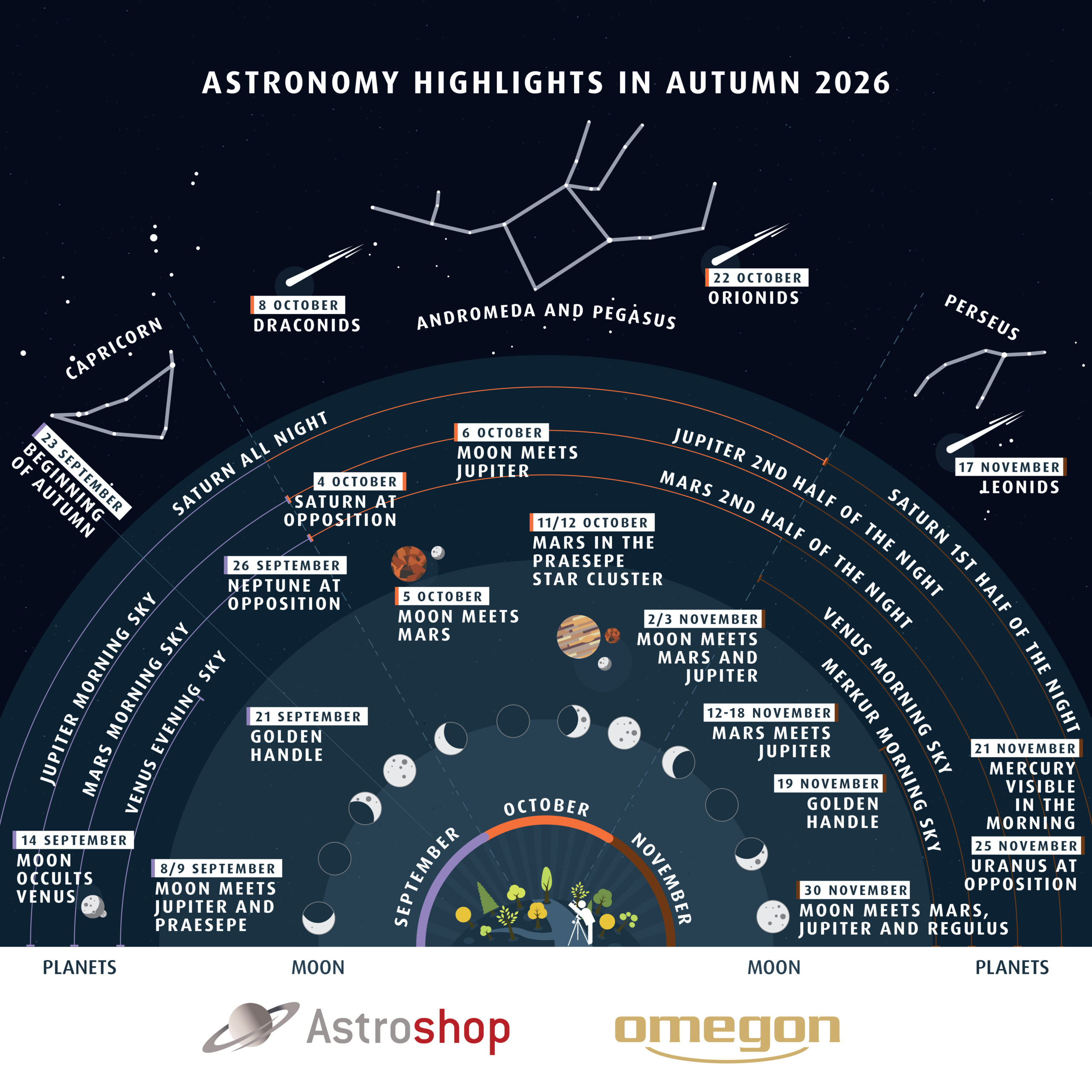
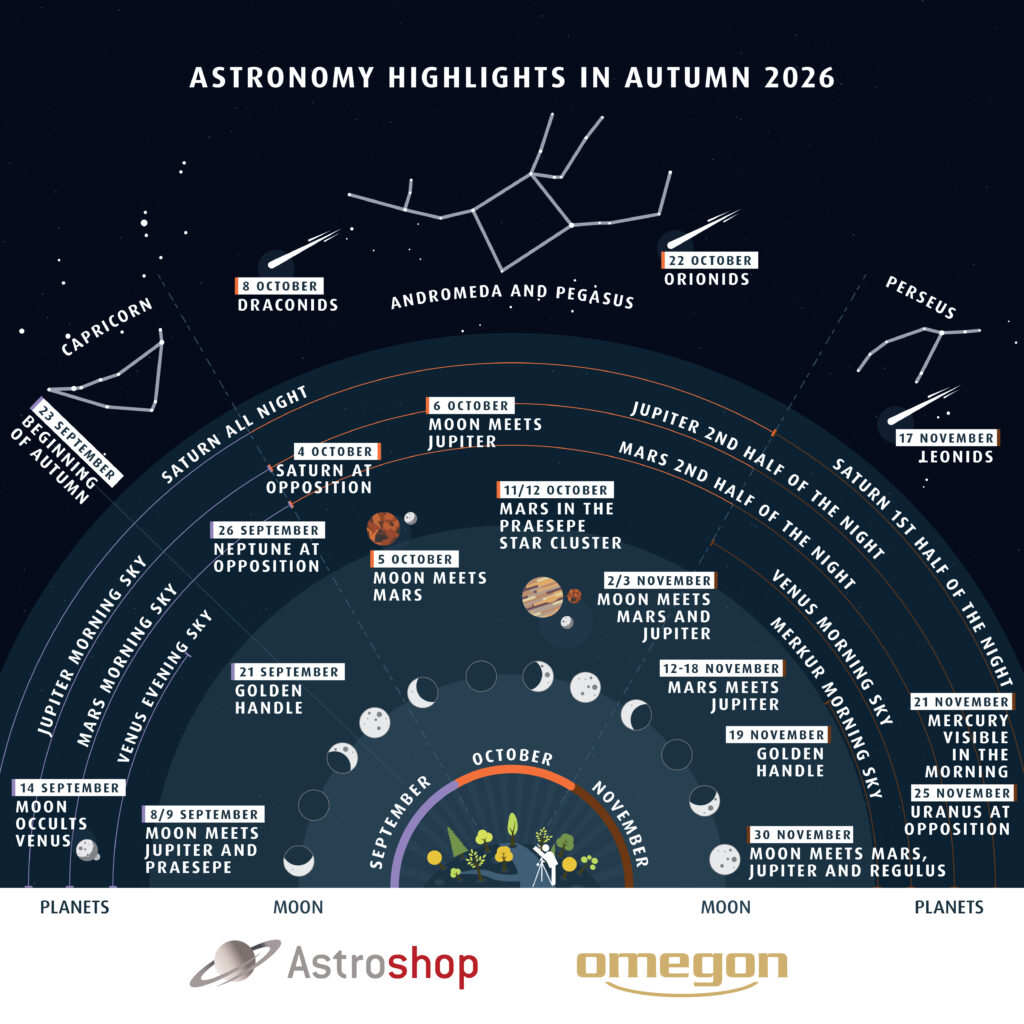
The nights are getting longer, and the Moon, planets and star clusters meet in the sky. The new infographic shows you the most beautiful celestial events of autumn 2026.
Saturn, Neptune and Uranus are particularly easy to observe. Mars passes through the Praesepe star cluster and later meets Jupiter. This time, there is also a rare occultation of Venus in the daytime sky.
This infographic gives you a quick overview. You can find out more about the individual events in the accompanying text.
Enjoy observing!
You are welcome to use this graphic on your own website. Please include a link to www.astroshop.eu.
September
08./09.09.2026 Moon meets Jupiter and Praesepe
In the early morning hours of 8 September, the slender crescent Moon passes through the open star cluster Praesepe, also known as the Beehive Cluster or M44. The star cluster is especially beautiful when viewed through binoculars. The following morning, the crescent is positioned below Jupiter. This creates two particularly beautiful configurations low above the eastern horizon. An unobstructed view to the east is important.
14.09.2026 Moon occults Venus
This is one of the most exciting events of the autumn: in the daytime sky, the slender crescent Moon passes in front of Venus. Depending on the observing location, the planet disappears behind the Moon between approximately 11:29 and 11:35 and reappears at around 12:40.
Because the celestial event takes place during the day and the Moon is only low above the horizon, you will need a telescope and an unobstructed view. Important: the Sun is also in the sky (of course, it is daytime). Never search for the Moon and Venus without a precise plan. It is best to observe using an automatically aligned mount and make sure that it cannot accidentally point towards the Sun.
After sunset, the pair appears once again in the evening sky. The slender crescent Moon and bright Venus are then low in the west. Here too, you will need an unobstructed horizon.
21.09.2026 Golden Handle
Today, the Golden Handle appears on the Moon. The Sun is already illuminating the peaks of the Montes Jura, while the plain of Sinus Iridum is still in shadow. This creates a bright, curved handle at the edge of the Moon.
The play of light begins in the early evening and remains visible for several hours. The Golden Handle is particularly well displayed at around 20:00. Binoculars are sufficient, but through a telescope the seemingly floating arc of mountains looks even more impressive.
23.09.2026 Beginning of autumn
On this day, the Sun crosses the celestial equator heading south. This marks the beginning of astronomical autumn for us in the Northern Hemisphere: day and night are now approximately equal in length. Over the coming weeks, it will get dark progressively earlier. For us stargazers, this marks the beginning of a particularly pleasant observing season, and we can even look at the stars during the week without having to struggle with tired eyes the following day.
26.09.2026 Neptune at opposition
Today, Neptune is opposite the Sun and visible throughout the night. The distant planet is located in the constellation Pisces and reaches a brightness of approximately magnitude 7.8. It therefore remains invisible to the naked eye.
Even with a smaller telescope, you can spot Neptune as a star-like point of light. With an aperture of around 100mm or more and steady air, it can be identified as a tiny bluish disc. A precise finder chart or GoTo control makes it easier to locate.
October
04.10.2026 Saturn at opposition
Now is an especially good time to observe Saturn. It is opposite the Sun, rises in the evening and remains visible throughout the night. After midnight, it reaches its highest position above the horizon.
Through a telescope, Saturn appears with a planetary disc measuring around 19.7 arcseconds. Its rings are also slightly more open than in the previous year, at 9 degrees. Even a small telescope clearly separates the ring from the planet. With a larger aperture, fine details and several of its moons become visible.
05.10.2026 Moon meets Mars
For almost the entire second half of the night, the Moon is only slightly more than one degree away from Mars. Both are located near the Praesepe star cluster. Through binoculars, you can observe the reddish planet, the crescent Moon and several stars of the cluster together.
06.10.2026 Moon meets Jupiter
The very next morning, the Moon meets Jupiter. The two are positioned very close together. During the day—something we are unable to observe—their separation temporarily shrinks to around 15 arcminutes.
You can spot the Moon and Jupiter above the eastern horizon. The slender crescent and the bright planet create a beautiful subject for a landscape photograph.
08.10.2026 Draconids
The Draconids originate from the constellation Draco. The point from which they appear to radiate is already high in the sky in the evening. You can therefore begin observing as soon as darkness falls.
It is difficult to predict how many meteors will appear from this shower. In some years it remains inconspicuous, while in others unexpectedly elevated rates occur. Conditions are particularly good in 2026: the Moon is only about one percent illuminated and hardly interferes with observations.
11./12.10.2026 Mars in the Praesepe star cluster
For night owls or early risers, this is a worthy celestial event: during the second half of the night, Mars moves directly through the open Praesepe star cluster in the constellation Cancer. The red planet stands out clearly from the cluster’s many fainter stars.
The encounter is best observed through binoculars. It is also very interesting for astrophotography: because Mars is located in the midst of the star cluster, this rare sight is well worth photographing.
22.10.2026 Orionids
The Orionids reach their maximum during the night of 21 to 22 October. The meteors originate from dust particles left by Halley’s Comet and strike the Earth’s atmosphere at particularly high speed. Under good conditions, around 20 shooting stars per hour are possible.
During the first half of the night, the bright Moon still causes interference. It sets at around 3:00. After that, the sky becomes darker and conditions improve. The best observing period is therefore between approximately 3:00 and the beginning of morning twilight.
November
02./03.11.2026 Moon meets Mars and Jupiter
During the night of 2 November, in the second half of the night, the Moon, Mars and Jupiter form a trio. Jupiter stands out because of its great brightness, while Mars can be identified by its reddish light.
By the following morning, the Moon has already passed both planets. This significantly changes their arrangement. It is therefore worth looking at the sky on both days.
12.–18.11.2026 Mars meets Jupiter
For several days, Mars and Jupiter move progressively closer together in the morning sky before passing one another. Between 15 and 17 November, their separation is only around 1.2 degrees. Both planets therefore fit together within the field of view of many telescopes and binoculars.
Their brightness and colour make the pair particularly striking: Jupiter shines considerably brighter, while Mars adds an orange-red accent beside it. The encounter can be followed over several nights.
17.11.2026 Leonids
The Leonids reach their maximum during the night of 17 to 18 November. Their radiant lies in the constellation Leo. At around 10–20 meteors per hour, the shower is generally rather quiet, although occasional outbursts occur. The shooting stars are very fast and sometimes leave bright trails.
The Moon sets during the first half of the night. Conditions are therefore good during the second half of the night. At that time, Leo is also higher above the horizon.
19.11.2026 Golden Handle
The Golden Handle appears on the Moon for the second time this autumn. The peaks of the Montes Jura are already glowing in sunlight, while Sinus Iridum remains in darkness. Binoculars are sufficient for observing it. Through a telescope, the rugged mountain landscape can be seen especially clearly.
21.11.2026 Mercury visible in the morning
Mercury reaches its greatest western elongation from the Sun. This provides the best morning visibility of the year. The planet rises around one hour and 45 minutes before the Sun and appears low above the eastern horizon.
Begin searching approximately 1.5 hours before sunrise. Binoculars will help you locate Mercury in the twilight. As soon as the Sun rises, you should stop observing.
25.11.2026 Uranus at opposition
Today, Uranus is opposite the Sun and visible throughout the night. The planet is located in the constellation Taurus and reaches a brightness of approximately magnitude 5.6. Under a very dark sky, this theoretically places it at the limit of naked-eye visibility. Binoculars make it significantly easier to locate.
Through a telescope, Uranus appears as a small greenish-blue disc. Since the full Moon occurred only one day earlier, its light strongly brightens the sky. Observing conditions are better a few days before or after opposition. Uranus will still remain visible for almost the entire night.
30.11.2026 Moon meets Mars, Jupiter and Regulus
At the end of the month, the Moon, Mars and Jupiter gather in the morning sky. Regulus, the principal star of Leo, is also part of this busy scene of celestial objects. Jupiter and the Moon are the most conspicuous. Mars is somewhat farther away and can be recognised by its reddish colour. From the second half of the night onwards, you will find the group above the eastern horizon.


 Subscribe to