Wonderful astro photos with a professional telescope
This Cassegrain telescope was created to make better, more beautiful astro photos. Pictures have more contrast and a sharper field of view right up to the edge. It’s no surprise that professional astronomers almost exclusively use this telescope design. Now this technology is affordable for amateurs too. Can you imagine if you too could produce astro photos to a professional standard?
The advantages at a glance:
- Primary mirror with 94% reflection for brighter images than a standard telescope.
- 8 light baffles for more contrast and sharper images.
- Quartz mirror: better imaging whilst the telescope is cooling down. Focus remains stable even over a long evening of photography.
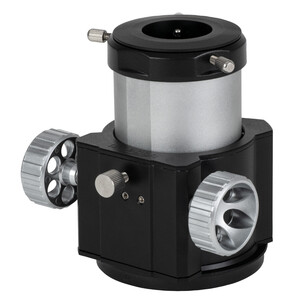
- Crayford focuser with 2” and 1.25” adapters: no mirror shift and greater back focus. For astrophotography: simply attach your SLR camera using the 50mm and 25mm extension connectors supplied.
- Full illumination with APS-C sensors or sensors with up to 30mm diameter
Who is this telescope suitable for?
A Cassegrain telescope is a system for more beautiful astro photos that you can be proud of. Many telescope designs are supposed to do everything from photos to visual observations. But that’s not entirely correct: everyone knows that there is no such thing as an expert on everything. For this reason, this telescope has been created specifically with astrophotographers in mind. We don’t want an average telescope for average photos, but instead a capable tool for astrophotography. For this it is perfect - it will produce first-class images of the night sky for you.
Full illumination for most sensors
The Omegon Cassegrain telescope is a master photographer of the night sky. Attach cameras with sensors up to 30mm diameter and benefit from illumination without vignetting.
Why is a Cassegrain better than a Schmidt-Cassegrain telescope?
The Omegon Cassegrain’s primary mirror is parabolic and the secondary mirror has a hyperbolic shape. This means fewer aberrations: the image area is flatter, there is less coma and the sharpness of the field is considerably higher. For you that means: you will take photographs with significantly better images of stars and with visible fine detail. All in all your astro photos will look fascinating.
That’s better than a SC telescope:
- Sharper pictures
- No lens in the optical path, and so an infra-red filter is not needed for planet photography
- Larger usable image field for astrophotography with fewer optical aberrations
- Minimal obstruction, giving you more contrast
- No chromatic aberration
- No ghosting on the image
Quicker cooling times
Do you have to set the telescope up and then wait an eternity? It doesn’t have to be that way. The quartz parabolic primary mirror hardly changes its profile during the cooling phase and is considerably more stable than Pyrex. The advantage for you: a crystal-clear image from the very first minute.
Quartz primary mirror with 94% reflection
94% enhanced coating: because every percentage point counts where brighter pictures with more contrast are concerned. This mirror is a strong contender as it offers 6% more reflection than the standard variation built into most telescopes.
You can look forward straight away to brighter images and faint deep-sky objects.
Crayford: more than enough focus
Attach any accessory to your telescope and don't worry about focus. With most cameras it’s no problem to get sharp images; the reason for this is the long back focus. You can also use a reducer or even binoculars.
8 lens hoods
The 8 lens hoods ensure more contrast for sharper images in which you can see more detail.
No mirror shift
Ping pong was great fun, but as a photographer catching planetary nebulae in your eyepiece is not such a great game. The good news: it's no longer necessary. Because unlike a SC telescope this Cassegrain has a fixed parabolic primary mirror, so the object doesn’t jump across the eyepiece, it stays fixed on the spot.
What objects can you photograph?
The Omegon Cassegrain is a master for all compact objects in the solar system or in interstellar space. Even small nebulae can be reached with the long focal length. That makes this telescope especially good for:
- lunar craters
- planets
- distant groups of galaxies - planetary nebulae
- globular star clusters
A target in the eyepiece: but without fumbling and wobbling
Gazing at the starry sky is lovely. But exploring it yourself is even better. The Omegon mount conveniently guides your telescope to your chosen celestial object – via the app or the hand controller. This allows you to start exploring the starry sky straight away, from Saturn to distant nebulae. You can rely completely on your mount. GoTo control, Wi-Fi, Bluetooth, a toothed belt reduction system and a sturdy steel tripod are all included. What’s behind it?
Advantages at a glance
- GoTo control: Select your target and the mount will automatically move to it.
- Observe and photograph: A sturdy base for relaxing nights of observation and getting started in astrophotography.
- Control it however you like: Use the hand controller or control the mount conveniently via the app.
- Open to your setup: Compatible with ASIAIR, SkySafari, N.I.N.A., PHD and many other astronomy apps.
- Toothed belt reduction for photography: Smooth drive for precise tracking and longer exposures.
- Stable base: The 40 mm steel tripod ensures a secure footing, even on uneven ground.
- 8 kg load capacity: Ideal for small and medium-sized telescopes as well as entry-level photography set-ups.
A stable base for every observation
The best telescope is only as good as the mount behind it. It forms the basis of your entire setup. It determines just how stable your equipment really is. The mount can support up to 8 kilograms, making it ideal for small and medium-sized telescopes. Whether you’re conducting Moon observations, tracking planets or taking your first deep-sky photographs. Today you’re looking through the eyepiece. Tomorrow you’ll be embarking on your first astrophotography project.
Find the objects without a long search
Finding a celestial object takes time – especially if you’re not particularly experienced. What’s more, many objects are faint or aren’t located near brighter stars. But with the GoTo control system, this mount takes a lot of the work off your hands. Simply select your chosen object via the hand controller or the app, and the mount will move to the target. That way, you spend less time searching and more time on observation.
The astronomer’s style: simple or high-tech
Tonight, you just want to observe the Moon. On other nights, you’re drawn out to deep-sky objects: perhaps the Orion Nebula or galaxies. And then there’s astrophotography, of course. This mount makes both possible: relaxing nights of observation and a gateway into astrophotography. With its toothed belt reduction system, it ensures precise tracking. What’s more, the mount can be controlled not only via the hand controller, but also via Wi-Fi or Bluetooth using software such as ASIAIR, SkySafari, N.I.N.A. or PHD. You’re free to choose how you work, and the mount adapts accordingly.
One decision, but many years of enjoyment
Ask ten experienced amateur astronomers where you shouldn’t skimp. Nine of them would reply: the mount. Because it determines whether your telescope tracks smoothly and the objects don’t dance around in the eyepiece at the slightest breeze. The EQ370DX is suitable for small and medium-sized telescopes and offers you a comfortable introduction to computer-assisted sky observation and astrophotography. You buy it once and enjoy observing with it for a long time to come.